
Quick Answer
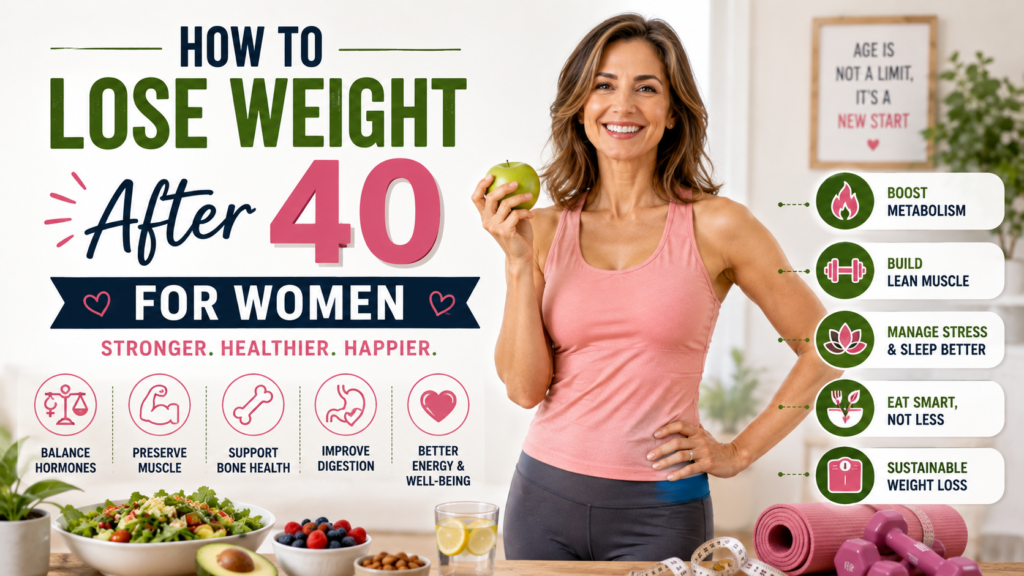
Here’s the answer on how to lose weight after 40 for women: a small cut of 300 to 500 calories a day, 30 to 40 grams of protein at each meal, strength training three times a week, and 7 to 8 hours of sleep. Expect half a pound to a pound a week. That’s slow. It also lasts.
Table of Contents
Why weight loss gets harder after 40
You’ve probably heard a friend say it. Or said it yourself. “I’m eating the same food. So why am I gaining weight?”
It’s not in your head.
After 40, your body changes in a few ways at once, and they all push in the same direction. Muscle starts to slip away, a little each year. And muscle matters, because muscle burns more energy than fat, even when you’re just sitting there. Less muscle means fewer calories burned, without you doing anything different.
Then there are hormones. As estrogen drops in perimenopause and menopause, fat tends to settle around the belly. It’s frustrating, and it’s common. Sleep gets patchy too. And when you sleep badly, you wake up hungrier. Cravings hit harder. Stress piles on top of all that, and stress is linked to belly fat as well.
So no, you’re not doing something wrong. Your body has changed, and the plan has to change with it.
What worked at 25 — skipping meals, cutting calories hard, doing hours of cardio — often backfires now. It can leave you tired, hungry, and weaker, because you’re losing muscle along with fat. A gentler plan, done steadily, works far better.
The basics are still the basics. Eat a little less than you burn. Eat enough protein. Move. Sleep. The difference is in the dose: more protein than before, more strength work, and far less punishment.
If this is new to you, our guide on weight loss tips for women is a good place to start. It covers the foundations. This article builds on them, for women over 40 specifically.
How to lose weight after 40 for women: a safe calorie deficit
Let’s keep this simple. To lose fat, you need to eat slightly fewer calories than your body uses. Slightly is the important word.
For most women, a cut of 300 to 500 calories a day is about right. That usually means losing around half a pound to a pound a week. Not dramatic. But it adds up, and it’s much easier to keep.
Go too low and things fall apart. Below 1,200 calories a day, without a doctor watching over you, is not a good idea. You get tired. Your hair can thin. Your mood dips. And you lose muscle, which is the last thing you want at this age. You also struggle to get enough iron, calcium, and protein.
So start small. Use the table below as a rough guide, not a rule written in stone.
| Activity level | Maintenance | Weight-loss target | Protein |
|---|---|---|---|
| Sedentary | 1,600-1,800 kcal | 1,200-1,400 kcal | 70-80 g per day |
| Lightly active | 1,800-2,000 kcal | 1,400-1,600 kcal | 80-90 g per day |
| Active | 2,000-2,200 kcal | 1,500-1,700 kcal | 85-100 g per day |
Your exact number depends on your height, weight, and how much you move. Don’t obsess over one day’s weight. Weigh yourself two or three times a week, same time, same clothes, and watch the weekly average.
Stuck after three weeks? Change one thing. Cut about 100 to 150 calories, or add 2,000 steps a day. Just one thing, so you can tell what actually helped.
Protein: the most important change
If I had to pick one change for women over 40, it would be protein. Honestly.
Protein does three jobs at once. It keeps you full for longer. It protects your muscle while you lose fat. And your body burns more energy digesting it than it does with carbs or fat.
Most women I write about don’t eat nearly enough of it at breakfast. Toast, tea, a bit of fruit — and almost no protein. Then by 11 in the morning, the cravings start. Sound familiar?
Aim for 30 to 40 grams at each main meal. That sounds like a lot. In real food, it’s not. Three eggs. A cup of Greek yogurt with a handful of nuts. A cup of cooked lentils with half a cup of paneer. A piece of chicken or fish about the size of your palm.
Eggs, Greek yogurt, cottage cheese, paneer, lentils, chickpeas, beans, tofu, fish, chicken, lean meat — all good. A simple plate helps: a palm-and-a-half of protein, a fist of whole grains, and two fists of vegetables or salad.
You don’t need protein powder to hit these numbers. It can help on a busy day, sure. But food first, always. And spread it out. A protein-rich breakfast, in particular, makes the rest of the day easier. Try eggs with vegetables, or Greek yogurt with berries and oats, or a lentil bowl with vegetables.
Strength training
Here’s something a lot of women get wrong after 40: they do more and more cardio, and skip the weights.
Cardio burns calories while you’re doing it. Strength training protects the muscle that burns calories all day, every day. That’s a big difference.
You don’t need a gym to start, though a gym does help. Three sessions a week, about 30 minutes each, is enough. Focus on the big muscles — legs, back, chest, arms. Squats. Lunges. Push-ups, even against a wall. Rows with a band or dumbbells. Glute bridges.
Pick a weight that feels hard on the last two or three reps. If you can breeze through 15 reps, it’s too light. Rest a minute or so between sets. Two to three sets per exercise is fine.
And walk. Every day. If 10,000 steps feels impossible right now, don’t start there. Start where you are, add 1,000 steps a week, and build up. A 10-minute walk after a meal helps blood sugar too, and it costs you almost nothing.
One warning: cardio alone, hour after hour, tends to leave women hungrier and more tired, without protecting muscle. Strength three times a week, plus daily walking, is a much better deal.
What to eat
You don’t need a diet with a name. You need a way of eating you can still follow in six months.
The Mediterranean-style pattern is a good fit for most women. Lots of vegetables. Whole grains. Beans and lentils. Fish. Olive oil. Nuts. Fruit. Less processed food, fewer sugary drinks, less fried food.
A plate rule makes it easy, without counting every calorie: half the plate vegetables or salad, a quarter protein, a quarter whole grains or starchy vegetables.
What helps most? Vegetables, lentils and beans, oats, brown rice, eggs, fish, yogurt, nuts, seeds, fruit. What to keep in check? Sugary drinks, sweets, white bread, pastries, fried snacks, processed meat, and alcohol. Alcohol deserves a special mention after 40. It adds calories, wrecks sleep, and can make hot flashes worse.
Indian food fits this pattern well, by the way. Our Indian meal diet plan for weight loss shows how roti, dal, vegetables, and curd work for weight loss when portions are sensible. Two rotis instead of four. A cup of dal. Half the plate vegetables. Ghee and fried food for special occasions, not every day.
Don’t cut out whole food groups unless a doctor tells you to. Very low-carb diets work for some women, but they’re hard to stick to, and they can leave you tired and constipated. A balanced plate is easier to live with.
Best foods for women over 40
Some foods just make this easier. More protein, more fibre, more nutrients — for fewer calories. Build your meals around them.
Start with vegetables. Spinach, kale, broccoli, cauliflower, carrots, cucumbers, tomatoes. They fill the plate without filling you with calories, and the fibre keeps you full. Get them in at lunch and dinner, not just as a tiny side.
Then protein. Eggs are hard to beat — cheap, filling, quick to cook. Greek yogurt has far more protein than regular yogurt. Lentils, chickpeas, and beans give you protein and fibre together, which is ideal for vegetarian meals. Fish like salmon, sardines, and rohu bring protein and healthy fats. Chicken breast is lean and easy to use in a dozen ways.
Whole grains help too. Oats in the morning. Brown rice in small portions. Whole wheat roti instead of white bread. They digest slowly, so your blood sugar stays steadier and you stay full longer.
Healthy fats? Don’t fear them. Olive oil, nuts, seeds, avocado — they help you absorb vitamins and they keep you satisfied. Just watch the portion. Fats are calorie-dense. A small handful of nuts, about 30 grams, is plenty for a snack.
And the occasional foods — sweets, fried snacks, sugary drinks, white bread, pastries, processed meat — keep them occasional. You don’t have to ban them forever. Keeping them occasional is what makes a plan last for months instead of days.
Sleep, stress and menopause
Sleep is where a lot of weight-loss plans quietly fall apart.
Sleep badly and your hunger hormone goes up while your fullness hormone goes down. Next day, you crave sugar. You’ve felt that, haven’t you? One bad night, and suddenly the biscuits are calling.
Aim for 7 to 8 hours. Same bedtime most nights. Bedroom dark and cool. No screens for half an hour before bed. No caffeine after midday. If hot flashes are wrecking your sleep, don’t just put up with it — talk to your doctor. The U.S. Office on Women’s Health has clear, practical information on menopause and sleep, and it’s worth reading before your appointment.
Stress does the same kind of damage. When you’re stressed, you eat more, sleep less, and move less. You don’t need a stress-free life — nobody has one. You need one small habit you actually do. A 10-minute walk. Slow breathing. A short break with no phone.
Here’s a simple evening routine that helps both sleep and weight. Eat dinner 2 to 3 hours before bed, and keep it light. No heavy late-night snack. After dinner, walk for 10 minutes, then dim the lights and put the phone away half an hour before bed. If you wake in the night, don’t check your phone or wander into the kitchen. A regular routine tells your body when to sleep, and better sleep makes tomorrow’s food choices easier.
Menopause itself? Yes, it matters. As estrogen falls and muscle falls, belly fat often rises even if your total weight barely moves. The fix is the same set of tools in this article, done more consistently: more protein, more strength training, better sleep, a modest calorie cut. Hormone therapy is a decision for you and your doctor. It’s not a weight-loss treatment on its own, and this article doesn’t recommend any medicine.
One more thing. If you have diabetes, thyroid disease, PCOS, high blood pressure, or you take regular medicine, talk to your doctor before you start a new diet or exercise plan. That’s not a formality. It matters.
Common mistakes
- Eating too little. A very low-calorie diet makes you hungry, tired, and weaker. A small cut works better.
- Skipping protein at breakfast. Then the cravings arrive by mid-morning, every time.
- Doing only cardio. Without strength work, a lot of the weight you lose is muscle.
- Weighing once and panicking. Your weight can move 1 to 2 pounds in a day — water, salt, food. Watch the weekly average.
- Copying a younger woman’s plan. A 25-year-old recovers faster. After 40, the plan has to be gentler.
- Drinking your calories. Sugary tea, sweet coffee, juice, alcohol — they can quietly add 300 to 500 calories a day.
- Giving up at a plateau. A plateau is normal. It doesn’t mean you’ve failed.
The plateau
Almost everyone hits one. Usually after 6 to 12 weeks, your body needs fewer calories because you’re lighter. The scale stops moving, and it feels like nothing is working.
Before you change anything, check the basics. Have portions crept up? Are you sleeping less? Have your steps dropped? Most plateaus are just habits drifting, not a broken metabolism.
If the basics are solid, change one thing for two weeks. Add 1,000 to 2,000 steps a day. Add one more strength session a week. Cut 100 to 150 calories. Or add 10 grams of protein a day. One thing. Not all of them at once — that just leaves you exhausted.
And look at your waist, not just the scale. Measure once a week, at the navel. If you’re getting stronger and losing belly fat, your waist can shrink even when your weight stays put.
If nothing has moved for more than eight weeks, despite a steady plan, see your doctor. Thyroid problems, medicines, and sleep apnoea can all affect weight, and they need checking.
A simple 1-day sample plan
This plan is about 1,580 calories, with roughly 30 to 40 grams of protein at each main meal. Adjust the portions to your own target.
| Meal | What to eat | Calories |
|---|---|---|
| Breakfast | 2 eggs, 1 slice wholegrain toast, spinach and tomato | 350 |
| Mid-morning | 1 cup Greek yogurt, berries | 180 |
| Lunch | 1 cup lentil soup, chicken or paneer, 1 roti, salad | 450 |
| Evening snack | Roasted chickpeas, green tea | 150 |
| Dinner | Fish or tofu stir-fry, vegetables, half a cup of brown rice | 450 |
Drink about 2 to 2.5 litres of water a day, more when it’s hot or you’ve exercised. Keep dinner light, and finish eating 2 to 3 hours before bed. Swap any food you don’t like for a similar one with similar protein and calories. The pattern matters far more than any single meal.
FAQs
How can a woman lose weight after 40?
Eat in a small deficit of 300 to 500 calories a day, eat 30 to 40 grams of protein at each meal, do strength training three times a week, walk daily, and sleep 7 to 8 hours. Aim for half a pound to a pound a week. Slow, steady, and sustainable beats fast and miserable.
Why is it so hard to lose belly fat after 40?
Because estrogen falls, muscle falls, and sleep and stress get worse — all at the same time. And no, sit-ups won’t fix it on their own. Belly fat comes down with overall fat loss: a calorie deficit, protein, strength training, and better sleep. Our guide on how to lose belly fat explains the same ideas in more detail.
Should women over 40 do intermittent fasting?
Some women love it, because it makes a calorie deficit easier. Others feel tired, hungry, or sleep worse. A 12-hour overnight fast is a gentle place to start. A 16:8 pattern works for some women, but not for everyone — especially with diabetes, low blood pressure, or a history of disordered eating. Talk to your doctor first, and stop if you feel unwell.
How much protein should a woman over 40 eat?
Most women over 40 do well on about 1.2 to 1.6 grams of protein per kilogram of body weight a day, spread across meals. That’s roughly 30 to 40 grams at each main meal. If you have kidney disease, ask your doctor before raising your protein.
Can I lose weight after 40 without exercise?
Yes, you can lose weight with a calorie deficit alone, but it’s slower, and more of the loss is likely to be muscle. Exercise, especially strength training, protects muscle and makes the result last. If you can’t exercise right now, start with food and daily walking, then add strength work when you’re ready. Even two short sessions a week beat none at all.
How long does it take to see results after 40?
Most women notice a change on the scale in 2 to 4 weeks, and a change in how clothes fit in 6 to 8 weeks. Real, lasting change usually takes 3 to 6 months. Faster isn’t better if it means losing muscle and putting the weight straight back on.
Final verdict
Losing weight after 40 is different. It’s not impossible — just different.
The plan is simple, even if it isn’t easy: a small calorie deficit, enough protein, strength training, daily walking, good sleep, and patience. That’s it. No magic food, no magic pill.
Start with one change this week. Just one. Protein at breakfast. Or two strength sessions. Or 2,000 extra steps a day. When that feels normal, add the next one. Small changes that stick beat a perfect plan that lasts a week.
If you start today, don’t expect a perfect week. Expect a normal week, with one or two good days, and build from there. Track your food for a week, track your steps, weigh yourself at the same time each week. After a month, look back at what actually worked for you, keep those habits, and drop the ones that didn’t. That’s how learning how to lose weight after 40 for women becomes a lasting change, not another short diet.
HealthSpots will keep building this series with practical, research-based guides for women. Start today, track your weekly average, and give your body time to respond.
Disclaimer: This article is for general information only and is not medical advice. Talk to your doctor before starting a new diet or exercise plan, especially if you are pregnant, breastfeeding, have PCOS, thyroid disease, diabetes, heart disease, kidney disease, or take regular medicine.
Sources: U.S. Office on Women’s Health; Centers for Disease Control and Prevention; National Institute on Aging.