Quick Answer
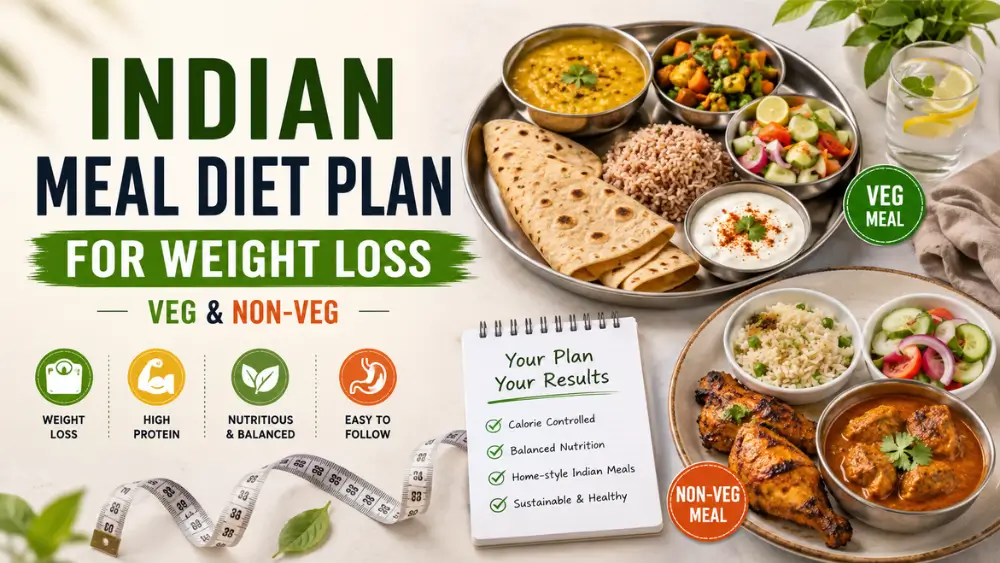
A well-structured Indian meal diet plan for weight loss combines high-fibre staples like dal, sabzi, and whole wheat roti with lean proteins and portion control. Both vegetarian and non-vegetarian Indian diets can achieve a 500–750 calorie daily deficit — enough to lose 0.5–1 kg per week — without abandoning traditional cuisine or flavour.
Table of Contents
Why Indian food is actually great for weight loss
Indian cuisine has an undeserved reputation for being heavy or fattening. In reality, traditional Indian cooking is one of the most weight-loss-friendly culinary systems in the world — when prepared mindfully. The typical Indian home meal is built around vegetables, lentils, whole grains, and fermented foods, all of which are cornerstones of modern nutritional science.
The issue is not Indian food itself. The problem is the restaurant and festive version of Indian food: deep-fried snacks, cream-loaded gravies, refined flour (maida) breads, and sugar-dense sweets. Strip those out and return to home-cooked Indian basics, and you have a remarkably balanced, nutrient-dense eating pattern.
The role of spices in metabolism
Indian cooking’s most powerful — and most overlooked — weight-loss tool is its spice palette. Several core Indian spices have clinically studied effects on metabolism, inflammation, and blood sugar regulation.
- Turmeric: Reduces inflammation linked to metabolic resistance
- Cumin: Boosts metabolic rate by up to 25% in some studies
- Cinnamon: Improves insulin sensitivity and lowers blood sugar spikes
- Fenugreek: Slows carbohydrate absorption; reduces post-meal hunger
- Black pepper: Activates turmeric’s benefits; aids fat cell breakdown
High-fibre staples that keep you full
The core of any traditional Indian meal — dal, sabzi, and a whole grain bread or rice — is naturally high in dietary fibre. Fibre slows digestion, stabilises blood sugar, and prolongs satiety, which means you eat less without feeling deprived. A bowl of masoor dal contains approximately 8g of fibre and 18g of plant protein per serving — comparable to many expensive protein supplements.
Common Indian diet mistakes that cause weight gain
Watch out for
The biggest culprits are: excess ghee/oil in cooking (each tablespoon adds 120 calories), white rice in large portions, deep-fried snacks as daily staples (samosa, pakora, puri), excessive chai with full-fat milk and sugar (up to 4 cups/day adds 300+ empty calories), and late-night heavy dinners after 9 PM when metabolism slows.
“The Indian kitchen doesn’t need a revolution. It needs a recalibration — smaller portions, less oil, more dal, and dinner before 8 PM.”
How many calories should you eat? Setting your targets
Before diving into the meal plans, you need to know your personal calorie target. Weight loss occurs when you consistently eat fewer calories than you burn. For most Indian adults aiming to lose 0.5–1 kg per week, a deficit of 500–750 calories per day is both safe and sustainable.
| Profile | Maintenance calories | Weight-loss target | Protein target |
|---|---|---|---|
| Woman, sedentary (25–40 yrs) | 1,600–1,800 kcal | 1,200–1,300 kcal | 70–80g/day |
| Woman, moderately active (25–40 yrs) | 1,900–2,100 kcal | 1,400–1,600 kcal | 80–95g/day |
| Man, sedentary (25–40 yrs) | 2,000–2,200 kcal | 1,500–1,700 kcal | 90–105g/day |
| Man, moderately active (25–40 yrs) | 2,400–2,600 kcal | 1,800–2,000 kcal | 110–130g/day |
The plans below are calibrated at approximately 1,400–1,600 calories per day — suitable for most moderately active Indian women and sedentary Indian men. Adjust portion sizes up or down based on your personal target. Aim for a macro split of roughly 40% carbohydrates, 30% protein, 30% fat.
Pro tip
Never go below 1,200 calories/day without medical supervision. Severe restriction triggers metabolic adaptation — your body slows down to compensate, making long-term weight loss harder.
7-day Indian vegetarian diet plan for weight loss
This plan uses ingredients readily available across India — no protein powders, no exotic superfoods. Every meal is built from the traditional Indian kitchen, just recalibrated for calorie control and higher protein intake.
Vegetarian Plan — ~1,450 calories/day
| Day | Breakfast | Lunch | Snack | Dinner | Cals |
|---|---|---|---|---|---|
| Mon | Vegetable poha (1 cup) + 1 boiled egg white / 100g low-fat paneer | 2 whole wheat rotis + moong dal (1 cup) + cucumber raita | 1 apple + 10 almonds | Mixed vegetable sabzi + 1 roti + 1 cup vegetable soup | 1,440 |
| Tue | Moong dal chilla (2 pieces) + mint chutney | Brown rice (¾ cup cooked) + rajma (1 cup) + salad | Buttermilk (1 glass) + 1 small banana | Palak paneer (low-oil) + 1 whole wheat roti | 1,460 |
| Wed | Oats upma (1 cup) with vegetables + green tea | 2 jowar rotis + chana sabzi (1 cup) + tomato onion salad | Roasted chana (30g) + cucumber slices | Dal tadka (1 cup) + 1 roti + steamed broccoli | 1,430 |
| Thu | Idli (3 pieces, steamed) + sambar + coconut chutney (1 tbsp) | Quinoa pulao (1 cup) + dal makhani (light) + raita | Fruit chaat (1 cup, no sugar) + green tea | Methi sabzi + 2 rotis + vegetable clear soup | 1,470 |
| Fri | Greek yogurt (150g) + 2 tbsp flaxseeds + handful of berries | Chole (1 cup, low-oil) + 2 whole wheat rotis + onion salad | Roasted makhana (20g) + herbal tea | Paneer bhurji (low-oil) + 1 roti + steamed peas | 1,450 |
| Sat | Besan chilla (2) + tomato chutney + 1 glass warm water with lemon | Vegetable khichdi (1.5 cups) + pickle (1 tsp) + salad | 1 pear + low-fat paneer (50g) | Baingan bharta + 2 rotis + dal soup | 1,440 |
| Sun | Dosa (2, thin) + sambar + small bowl curd | Brown rice (½ cup) + sambhar + vegetable avial + salad | Sprouts chaat (½ cup) + lemon water | Mixed dal soup (1.5 cups) + 1 roti + stir-fried vegetables | 1,455 |
Cooking note
Use a maximum of 1 tsp oil per meal (preferably mustard oil or cold-pressed coconut oil). Steam or grill vegetables wherever possible. Limit ghee to 1 tsp per day total — use it strategically on your roti rather than in your cooking.
7-day Indian non-vegetarian diet plan for weight loss
Non-vegetarian eaters have a natural advantage for weight loss: animal proteins are complete proteins with all essential amino acids, they are highly satiating, and they have a higher thermic effect — meaning your body burns more calories digesting them. This plan leans on chicken breast, fish, and eggs as primary protein sources.
Non-Vegetarian Plan — ~1,480 calories/day
| Day | Breakfast | Lunch | Snack | Dinner | Cals |
|---|---|---|---|---|---|
| Mon | 2 boiled eggs + 1 whole wheat toast + black coffee | Chicken curry (light, 150g chicken) + 1 roti + cucumber salad | Greek yogurt (100g) + 10 walnuts | Grilled fish (150g, masala) + stir-fried vegetables + ½ cup brown rice | 1,490 |
| Tue | Egg bhurji (2 eggs, 1 tsp oil) + 1 multigrain roti + green tea | Fish curry (light coconut, 130g fish) + ¾ cup brown rice + salad | Roasted chana (30g) + 1 orange | Chicken soup (clear, 200ml) + moong dal + 1 roti | 1,470 |
| Wed | Poha with 2 egg whites + vegetables + buttermilk | Keema (lean mince, 120g) + 2 rotis + onion tomato salad | 1 apple + hard-boiled egg (1) | Grilled chicken tikka (150g, no cream) + dal + steamed vegetables | 1,480 |
| Thu | Idli (3) + sambar with chicken pieces + coconut chutney (1 tsp) | Mutton (lean, 100g) + 1 roti + vegetable salad | Roasted makhana + green tea | Fish tikka (150g, grilled) + vegetable khichdi (1 cup) | 1,500 |
| Fri | Omelette (2 eggs, 1 tsp oil, vegetables) + 1 whole wheat toast | Chicken biryani (light, 1.5 cups, minimal oil) + raita | Sprouts (½ cup) + lemon water | Prawn masala (light, 130g) + 1 roti + spinach sabzi | 1,460 |
| Sat | Besan chilla (2) + scrambled eggs (1) filling + mint chutney | Chicken stew (150g, light Kerala style) + appam (2) or 1 roti | Fruit (1 medium) + low-fat curd | Grilled pomfret/surmai + dal tadka + steamed vegetables | 1,485 |
| Sun | Egg paratha (1, with 1 egg, 1 tsp ghee) + curd (100g) | Rogan josh (lean, 130g mutton) + 1 roti + salad | Boiled egg (1) + 10 almonds | Chicken clear soup + moong dal khichdi (1 cup) | 1,475 |
Best protein choices
For maximum weight loss, prioritise chicken breast, fish (surmai, rohu, pomfret, salmon), and eggs over red meat. If eating mutton or beef, choose lean cuts and limit to 2 times per week. Avoid fried preparations — grilled, baked, or curry (light gravy) preparations are preferred.
Best Indian foods for weight loss — and what to avoid
Eat freely (or in moderation)
- All lentils & dals (masoor, moong, chana)
- Chicken breast (grilled/boiled)
- Fish (all varieties, grilled)
- Eggs (boiled or scrambled, min oil)
- All vegetables (especially leafy greens)
- Whole wheat roti (2–3/day max)
- Brown rice (½ cup cooked)
- Low-fat curd / buttermilk
- Paneer (low-fat, 50–80g/day)
- Sprouts (moong, chana)
- Roasted makhana / chana (snacks)
- All whole spices & herbs
- Green tea, black coffee (no sugar)
Limit or avoid
- Deep-fried snacks (samosa, bhajia, puri)
- White rice in large portions (>¾ cup)
- Maida / refined flour (naan, white bread)
- Full-fat cream & butter-laden curries
- Sweetened chai (4+ cups/day)
- Packaged biscuits & namkeen
- Cold drinks & fruit juices (with sugar)
- Mithai & sweets (daily)
- Excess ghee (>1 tsp/day)
- Alcohol (high calorie, disrupts fat burning)
- Processed meats (sausage, salami)
- Restaurant / takeaway food (daily)
Roti vs rice — which is better for weight loss?
This is one of the most debated questions in Indian nutrition. The answer is nuanced: whole wheat roti is generally better for weight loss than white rice, primarily because it has a lower glycaemic index (GI of ~55 vs white rice at ~72), more dietary fibre, and leaves you feeling full longer.
However, brown rice and white rice in controlled portions are not the enemy. A ½ cup of cooked brown rice with plenty of dal and vegetables is a perfectly good weight-loss meal. The problem is not rice per se — it is the generous serving sizes (1.5–2 cups) eaten with very little protein or vegetable alongside.
Practical answer
If you are a rice-eating South Indian, do not force yourself onto rotis. Simply reduce your portion to ½ cup of brown rice, double your sambar/rasam, and add a large vegetable side dish. The result is a calorie-controlled, high-fibre meal that honours your food culture.
Indian diet plan tips for faster weight loss results
Meal timing and portion control
When you eat matters almost as much as what you eat. For best results with an Indian eating pattern, follow these timing principles:
Breakfast (7–9 AM): Eat within 90 minutes of waking. Make it protein-rich — eggs, dal chilla, Greek yogurt, or paneer. Never skip breakfast; it sets your appetite hormones for the rest of the day.
Lunch (12:30–2 PM): This should be your largest meal of the day. Your insulin sensitivity is highest at midday, meaning carbohydrates are metabolised most efficiently. A full dal-roti-sabzi meal is ideal here.
Snack (4–5:30 PM): A small, protein-forward snack prevents evening binge eating. Roasted chana, a boiled egg, or a small bowl of curd works well.
Dinner (7–8 PM): Keep dinner light — ideally under 400 calories. Prioritise protein (dal, eggs, chicken soup, grilled fish) with minimal carbohydrates. Finish eating 2–3 hours before bed.
How to adapt this plan for South Indian cuisine
South Indian cuisine is naturally well-suited for weight loss — it relies on rice, lentils, fermented foods (idli, dosa), and coconut-based cooking rather than cream or excessive ghee. Key adjustments for South Indian eaters:
Replace white idli rice with a mix of 70% idli rice and 30% urad dal for higher protein. Use thin dosas (not the ghee-drenched restaurant version). Replace white rice with millet rice (foxtail, little millet, or kodo millet) — millets have a much lower GI and three times the fibre of white rice. Rasam and sambar are excellent — eat generous portions. Reduce the frequency of coconut-heavy chutneys to 1 tablespoon per meal.
Combining Indian diet with intermittent fasting
Intermittent fasting (IF) pairs very naturally with Indian meal culture. The most practical protocol for Indian eaters is 16:8 — eating between 10 AM and 6 PM, or 12 PM and 8 PM. This allows you to maintain lunch as the main meal (culturally normal) while skipping the heavy evening snacking that many Indian families engage in. Studies show that combining IF with a balanced Indian diet accelerates fat loss by an additional 10–15% compared to calorie restriction alone.
Sample grocery list & meal prep tips
Grains & lentils
- Whole wheat atta (2 kg)
- Brown rice (1 kg)
- Oats (500g)
- Masoor dal (500g)
- Moong dal (500g)
- Chana dal (500g)
- Rajma (500g)
- Quinoa (250g)
Vegetables
- Spinach / palak (2 bunches)
- Tomatoes (1 kg)
- Onions (1 kg)
- Cauliflower / gobhi (1)
- Broccoli (1 head)
- Cucumber (4–5)
- Capsicum / bell pepper (3)
- Methi leaves (1 bunch)
Protein (non-veg)
- Chicken breast (1 kg)
- Fish — surmai/rohu (500g)
- Eggs (12–14)
- Prawns (optional, 250g)
Protein (veg)
- Low-fat paneer (400g)
- Greek yogurt (500g)
- Low-fat curd (1 kg)
- Tofu (optional, 200g)
- Sprouts (moong, 200g)
Snacks & fats
- Almonds (100g)
- Walnuts (100g)
- Roasted chana (200g)
- Makhana / fox nuts (100g)
- Flaxseeds (100g)
- Mustard oil / olive oil
- Ghee (small jar)
Spices & condiments
- Turmeric, cumin, coriander
- Fenugreek seeds
- Cinnamon sticks
- Ginger & garlic
- Green chillies
- Apple cider vinegar
- Low-fat buttermilk
Meal prep tip: Every Sunday, cook a large batch of dal (store for 4 days), portion your rotis (refrigerate uncooked dough), and chop and blanch your vegetables. This reduces weekday cooking time to under 20 minutes and eliminates the “I’m tired, let me order food” temptation that derails most Indian weight-loss attempts.
FAQs
What is the best Indian diet to lose weight fast?
The fastest results come from combining a calorie-controlled Indian diet (1,200–1,600 kcal depending on your size) with a 16:8 intermittent fasting schedule and 30 minutes of daily movement. Focus on dal, sabzi, whole wheat roti, and lean protein at every meal. Eliminate fried snacks, sweetened chai, and restaurant food entirely for the first 30 days. Expect 1–1.5 kg of fat loss per week in the first month.
Which Indian food is best for weight loss?
The single best weight-loss food in the Indian kitchen is moong dal. It is low in calories (~212 per cup cooked), extremely high in protein and fibre, easy to digest, and incredibly versatile — soups, chillas, khichdi, or simple tadka dal. After moong dal: palak (spinach), sprouts, buttermilk, roasted chana, and all fish varieties are excellent.
Can I eat roti during weight loss?
Yes, absolutely. Whole wheat roti is a healthy carbohydrate source with good fibre content. The key is portion size: 2–3 rotis per day is appropriate for most people. If you are following a lower-calorie plan (under 1,300 kcal), keep it to 2 rotis. Use thin rotis made with whole wheat or multigrain atta, and avoid layering them with excess ghee or butter.
How much weight can I lose in a month on an Indian diet?
Following a structured Indian meal plan with a 500–750 calorie daily deficit, most people lose 2–4 kg of actual fat in the first month (plus an initial 1–2 kg of water weight in the first week). Results vary based on starting weight, activity level, and adherence. Heavier individuals typically lose faster initially due to higher baseline metabolic rate.
Is rice or roti better for weight loss?
Whole wheat roti has the edge over white rice for weight loss due to its lower glycaemic index and higher fibre content. However, brown rice or millet rice in controlled portions is comparable to roti. The most important factor is not roti-vs-rice, but rather your total calorie intake, your protein consumption, and how much vegetable and dal accompanies your carbohydrate serving.
Final verdict — is the Indian diet good for long-term weight loss?
Expert conclusion
Yes — emphatically. The traditional Indian home diet, stripped of its deep-fried and sugar-heavy festive indulgences, is one of the most scientifically sound weight-loss eating patterns available. It is rich in plant protein, dietary fibre, anti-inflammatory spices, and probiotic foods (curd, buttermilk, fermented idli-dosa batter).
The advantage of an Indian diet over Western low-carb or keto protocols is cultural sustainability. You do not have to eat foods that are foreign to you, fight social pressure at every family meal, or give up the flavours that bring you comfort. A well-designed Indian diet plan is something you can follow for life — not just for 30 days.
Start with the 7-day plan above. After one month, reassess your results, adjust your calorie target, and explore the South Indian, protein, or intermittent fasting variations linked below.