Quick Answer
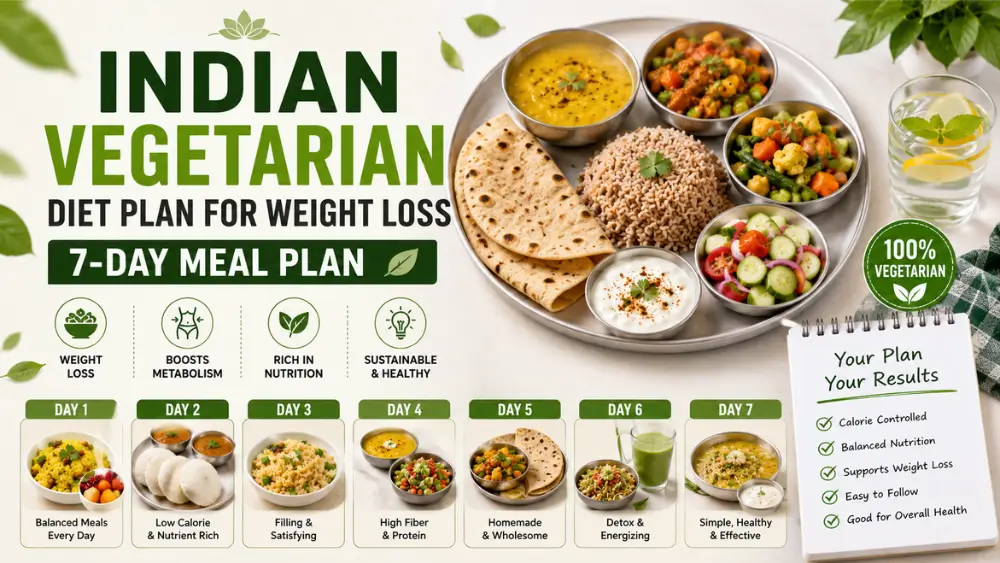
A 7-day Indian vegetarian diet plan for weight loss works by combining high-fibre dals, whole grain rotis, low-fat paneer, and abundant vegetables into meals totalling 1,400–1,500 calories per day — creating a sustainable 500-calorie daily deficit that supports 0.5–1 kg of fat loss per week without eliminating a single ingredient from your kitchen.
Table of Contents
Why a vegetarian Indian diet works for weight loss
There is a widespread and frustrating myth that vegetarians struggle to lose weight because they cannot get “enough protein.” This myth is not just wrong — it is nearly the opposite of the truth when applied to a well-planned Indian vegetarian kitchen.
Dal alone contains 18–22g of protein per cooked cup. Add paneer, curd, sprouts, and a besan-based chilla, and a vegetarian Indian eater can comfortably hit 70–90g of protein daily without a single scoop of protein powder or a piece of meat. The challenge is not protein availability — it is knowing which combinations to choose.
Beyond protein, a traditional Indian vegetarian diet is naturally rich in dietary fibre (which controls hunger hormones), anti-inflammatory spices (which support metabolic health), and probiotic foods like curd and buttermilk (which improve gut health, a key but underappreciated factor in weight regulation).
The protein challenge — and how to solve it
The real protein challenge for Indian vegetarian dieters is not quantity but completeness. Plant proteins are often missing one or more essential amino acids. The solution, practised instinctively in Indian cooking for centuries, is food combining: dal + rice creates a complete amino acid profile. Curd + roti does the same. The Indian kitchen solved this problem long before nutritional science did.
Key vegetarian protein sources in the Indian kitchen
- Moong dal (24g protein / 100g dry): Easiest to digest; ideal for every meal
- Low-fat paneer (18g protein / 100g): Limit to 80–100g/day when losing weight
- Greek curd / Dahi (10g protein / 150g): Probiotic; excellent snack or raita base
- Sprouted chana (9g protein / 100g): Higher bioavailability than cooked chana
- Besan / Gram flour (22g protein / 100g dry): Chillas, dhokla, kadhi — versatile & filling
- Rajma / Chole (15g protein / cooked cup): High fibre too — potent satiety combo
Fibre, satiety, and blood sugar — how dal dominates
Dal is the secret weapon of every successful Indian vegetarian weight-loss story. A bowl of masoor dal has a glycaemic index of just 21–30 — far lower than white rice (72) or even whole wheat bread (69). This means eating dal causes a slow, steady rise in blood sugar rather than a spike, keeping you full for 3–4 hours and dramatically reducing the urge to snack. A diet built around dal at every meal is, functionally, a low-GI diet — one of the most evidence-backed dietary approaches for sustained weight loss.
“Eating dal at lunch is not tradition — it is metabolic intelligence. Your grandparents were following a low-GI diet before the term was invented.”
Setting your calorie and protein targets
Before following any meal plan, you must know your personal targets. The 7-day plan below is calibrated at 1,400–1,500 calories per day, which is appropriate for most moderately active Indian women and sedentary Indian men of average build. Adjust portion sizes up or down based on the table below.
| Profile | Maintenance | Weight-loss target | Daily protein | Expected loss/week |
|---|---|---|---|---|
| Woman, sedentary, 50–65 kg | 1,600–1,750 kcal | 1,200–1,300 kcal | 65–75g | 0.4–0.6 kg |
| Woman, active, 55–70 kg | 1,900–2,100 kcal | 1,400–1,500 kcal | 75–90g | 0.5–0.8 kg |
| Man, sedentary, 65–80 kg | 2,000–2,200 kcal | 1,500–1,700 kcal | 90–105g | 0.5–0.8 kg |
| Man, active, 70–90 kg | 2,400–2,700 kcal | 1,800–2,000 kcal | 110–130g | 0.6–1 kg |
Macro split to target
Aim for approximately 35–40% carbohydrates, 30–35% protein, and 25–30% fat. This ratio is higher in protein than a typical Indian diet — intentionally so, since protein preserves muscle mass during fat loss and keeps hunger suppressed for longer than carbohydrates or fat alone.
Your complete 7-day Indian vegetarian diet plan for weight loss
Every meal below uses ingredients available at any Indian kirana store or supermarket. Oil is capped at 1 teaspoon per meal (approximately 40 calories). Ghee is allowed at ½ teaspoon once daily. All calorie counts are approximate and based on standard Indian portion sizes.
Full Vegetarian Plan
Target: 1,400–1,500 kcal/day – Protein: 70–90g/day
| Day | Breakfast | Lunch | Snack (4–5 PM) | Dinner | Totals |
|---|---|---|---|---|---|
| Mon | Moong dal chilla × 2 (1 tsp oil) + mint chutney + 1 glass warm lemon water | 2 whole wheat rotis + masoor dal (1 cup) + palak sabzi + cucumber-onion salad | Roasted chana (30g) + 1 small apple | Vegetable khichdi (1.5 cups, moong + brown rice) + low-fat curd (100g) | 1,420 kcal 78g protein |
| Tue | Besan chilla × 2 (spinach, tomato) + 1 glass buttermilk (no salt) | Brown rice (½ cup cooked) + rajma curry (1 cup, light oil) + baingan bharta | Low-fat paneer (60g) + cucumber sticks + green tea | Methi dal (1 cup) + 1 jowar roti + stir-fried broccoli (no oil, steamed) | 1,450 kcal 82g protein |
| Wed | Oats upma (1 cup, with vegetables) + 1 boiled egg white (optional) + black coffee | 2 whole wheat rotis + chole (1 cup, light) + tomato-onion salad + raita (100g) | Moong sprouts chaat (½ cup) + lemon + cumin | Paneer bhurji (80g paneer, 1 tsp oil, vegetables) + 1 roti + vegetable soup (clear) | 1,440 kcal 85g protein |
| Thu | Idli × 3 (steamed) + sambar (1 cup) + 1 tbsp coconut chutney | Quinoa pulao (1 cup) + dal makhani (light, 1 cup) + mixed greens salad | Roasted makhana (20g) + 1 orange + herbal tea | Lauki sabzi + 2 whole wheat rotis + 1 cup moong dal soup | 1,460 kcal 76g protein |
| Fri | Greek curd (150g) + 1 tbsp flaxseeds + seasonal fruit (½ cup) + green tea | Jowar roti × 2 + kadhi (light, 1 cup, low-fat curd) + aloo gobhi (small portion) | Chana chaat (½ cup sprouted) + lemon + chaat masala (minimal) | Mixed vegetable dal (masoor + moong, 1 cup) + 1 roti + steamed spinach | 1,430 kcal 80g protein |
| Sat | Poha (1 cup, low-oil) + ½ cup curd + 1 glass warm water with amla juice | Brown rice (½ cup) + sambar (generous, 1.5 cups) + vegetable avial (no coconut oil excess) | Low-fat paneer tikka (80g, air-fried or grilled) + mint chutney | Palak paneer (80g paneer, light oil) + 1 whole wheat roti + vegetable soup | 1,480 kcal 88g protein |
| Sun | Pesarattu / green moong dosa × 2 + sambar + coriander chutney | Vegetable biryani (light, 1 cup brown rice base) + raita (100g) + salad | Fruit chaat (½ cup, no sugar) + roasted seeds (pumpkin + flax, 1 tbsp) | Dal tadka (masoor, 1 cup) + 1 roti + stir-fried seasonal vegetables | 1,450 kcal 79g protein |
Cooking rules for the plan
Maximum 1 tsp oil per cooked meal (use mustard oil or cold-pressed coconut oil). Steam or grill wherever possible. ½ tsp ghee once daily — apply on one roti for flavour rather than in cooking. Use low-fat paneer (not regular). All dal portions are cooked weight. Drink 2.5–3 litres of water daily, starting with a glass before each meal.
High-protein vegetarian Indian meals to rotate into your plan
After the first week, variety is essential to avoid boredom and ensure you stick to the plan. Below are additional high-protein vegetarian Indian meal ideas to swap into any day’s plan — each with approximate protein and calorie counts to keep your tracking simple.
Best dal combinations for maximum protein
Not all dals are equal in protein density. Moong and masoor are the highest-protein, lowest-calorie choices — ideal for weight loss. But combining dals unlocks even more benefit: a mix of moong and chana dal in equal parts creates a complete amino acid profile with approximately 22–24g of protein per cooked cup, rivalling chicken breast gram-for-gram in protein density (if not in calories).
Try these high-protein dal combinations: panchratan dal (five-lentil mix, great for Sunday cooking), moong-masoor mix tadka (quick weekday option), and chana dal with lauki (gourd adds volume with almost no calories).
Paneer — how much is too much?
Paneer is beloved and protein-rich, but it is also calorie-dense — regular full-fat paneer runs to 265–300 calories per 100g. The right limit for weight loss is 80–100g of low-fat paneer per day (approximately 150–160 calories). Beyond this, the calorie cost outweighs the protein benefit when you can get equivalent protein from dal at a fraction of the calories. Use paneer as a flavour anchor and protein booster, not as a daily centrepiece.
Paneer swap
Replace full-fat paneer with low-fat paneer made from toned or double-toned milk — it has nearly the same protein (16–18g per 100g) but around 40% fewer calories. You can make it at home in 15 minutes using toned milk and lemon juice.
Sprouted legumes — the underrated weight-loss superfood
Sprouting transforms legumes. When moong, chana, or methi seeds are soaked and allowed to germinate, their protein bioavailability increases by 30–40%, their glycaemic index drops further, and their vitamin C content rises dramatically. A small bowl of moong sprouts (100g) gives you 9g of protein and only 105 calories — among the most efficient protein-per-calorie foods available. Eat them raw in a salad, lightly stir-fried, or as a chaat with lemon and chaat masala. Aim for sprouts at least 4 days per week.
Jain and Sattvic diet variation
If you follow a Jain diet (avoiding onion, garlic, and root vegetables) or a Sattvic diet (avoiding onion, garlic, and overly stimulating foods), the standard 7-day plan above needs only minor adjustments. The core principles — high fibre, high protein, calorie control — remain identical.
Jain & Sattvic Adaptation
Adapting the plan without onion and garlic
Replace onion and garlic in all recipes with asafoetida (hing), cumin, ginger, and green chillies — this combination provides a comparable flavour base and hing itself has digestive and anti-inflammatory properties. For Jain diets, also replace root vegetables (potato, carrot, beetroot) with above-ground vegetables: ridge gourd (turai), bottle gourd (lauki), pointed gourd (parwal), and leafy greens.
| Standard ingredient | Jain/Sattvic replacement | Flavour note |
|---|---|---|
| Onion in dal tadka | Hing + cumin seeds + tomato | Equally aromatic with more umami |
| Garlic in sabzi | Ginger + hing + mustard seeds | Pungent and warming |
| Potato in aloo sabzi | Raw banana or raw jackfruit | Similar starchy texture |
| Carrot in salads | Cucumber + capsicum + radish (mooli) | Crisp and refreshing |
| Beetroot (iron source) | Spinach + amla + pomegranate | Higher iron, lower GI |
The Jain variation is, if anything, even more weight-loss-friendly than the standard plan — the absence of starchy root vegetables naturally reduces calorie density, while the abundance of gourds and leafy greens adds volume and fibre. Many Jain dieters find they lose weight faster on a well-structured plan than on general vegetarian diets for this reason.
Grocery list & meal prep
Grains & dals
- Whole wheat atta — 2 kg
- Jowar / bajra atta — 500g
- Brown rice — 1 kg
- Oats (rolled) — 500g
- Quinoa — 250g
- Moong dal — 750g
- Masoor dal — 500g
- Chana dal — 500g
- Rajma — 500g
- Chole / kabuli chana — 500g
- Besan (gram flour) — 500g
Vegetables
- Spinach / palak — 2 large bunches
- Methi leaves — 1 bunch
- Tomatoes — 1.5 kg
- Broccoli — 1 head
- Cauliflower — 1 head
- Ridge gourd / turai — 4
- Bottle gourd / lauki — 2
- Capsicum — 3 (mixed)
- Cucumber — 6
- Baingan / eggplant — 2
- Beans / broad beans — 250g
Protein dairy
- Low-fat paneer — 400g
- Low-fat curd / dahi — 1 kg
- Greek curd — 500g
- Buttermilk (low-fat) — 1 litre
- Toned milk — 500 ml
Snacks & seeds
- Almonds — 100g
- Walnuts — 100g
- Roasted chana — 200g
- Makhana (fox nuts) — 100g
- Flaxseeds — 100g
- Pumpkin seeds — 50g
- Moong for sprouting — 200g
Spices & pantry
- Turmeric, cumin, coriander
- Mustard seeds, hing
- Fenugreek seeds
- Cinnamon, cardamom
- Ginger (fresh) — 200g
- Green chillies
- Mustard oil — 500 ml
- Ghee (small jar) — 100g
- Apple cider vinegar
- Amla juice (unsweetened)
Fruits
- Apples — 6
- Oranges — 4
- Seasonal berries — 200g
- 1 pomegranate
- Lemons — 8
- Guava — 4 (high fibre)
Sunday meal prep — 45 minutes
Every Sunday, cook a large pot of mixed dal (keeps refrigerated for 5 days), soak rajma or chole overnight (cook Monday morning in a pressure cooker — 3 whistles), prepare your roti dough and refrigerate, wash and chop all vegetables into containers, and soak moong for sprouting (ready by Tuesday). This reduces weekday cooking to under 20 minutes and eliminates the tired-evening takeaway trap that derails most diet attempts by Day 4.
5 common mistakes vegetarian Indian dieters make
- Relying on paneer as the only protein source: Paneer is excellent, but eating 150–200g per day to hit protein targets pushes your calories far above your limit — full-fat paneer at 200g adds 560 calories before you have cooked anything else. Many vegetarian Indian dieters stall at the same weight for weeks because of invisible paneer calories.
- Fix: Use moong dal, besan, curd, and sprouts as primary protein sources. Cap paneer at 80–100g of low-fat variety.
- Eating too many rotis and not enough dal: The typical Indian home meal skews heavily toward roti (3–5 pieces) with a small dal portion. This inverts the ideal weight-loss ratio. Each roti is 70–80 calories. Four rotis with minimal dal gives you 300+ calories of carbohydrates with very little protein, leading to faster hunger return and higher overall calorie intake.
- Fix: Limit to 2 rotis at lunch and 1 at dinner. Double your dal portion to compensate for volume and protein.
- Skipping the 4–5 PM snack and overeating at dinner: Skipping the afternoon snack feels virtuous — it seems like “eating less.” But arriving at dinner with 5–6 hours since lunch means your blood sugar is crashing, your hunger hormones are spiking, and your willpower is at its lowest. The result is almost always a dinner 200–300 calories larger than planned.
- Fix: Eat a planned 100–150 calorie snack at 4:30 PM daily — roasted chana, fruit with curd, or makhana. Your dinner portions will naturally decrease.
- Thinking “vegetarian” automatically means healthy or low-calorie: Puri, bhatura, halwa, mithai, and deep-fried pakoras are all vegetarian. A plate of chole bhature from a restaurant can contain 900–1,100 calories — more than two-thirds of a daily weight-loss target in a single meal. Vegetarian does not equal low-calorie. Preparation method and portion size matter as much as ingredient choice.
- Fix: Track calories for the first 2 weeks to build intuition about which vegetarian meals are calorie-dense. You’ll be surprised.
- Four cups of sweetened chai per day: This is the single most common hidden calorie source in Indian households. Four cups of chai made with full-fat milk and two teaspoons of sugar each adds up to 280–320 calories daily — the equivalent of a full meal — from drinks that provide almost no nutrition or satiety. Most people do not count chai in their daily calories at all.
- Fix: Switch to 1–2 cups of unsweetened or lightly sweetened chai with toned milk. Use cinnamon for sweetness. Save 200+ calories daily with zero diet changes elsewhere.
FAQs
What is the best vegetarian diet plan for weight loss in India?
The best Indian vegetarian diet plan for weight loss is built around three pillars: a protein source at every meal (dal, paneer, curd, besan, or sprouts), controlled portions of whole grain carbohydrates (whole wheat roti or brown rice), and abundant non-starchy vegetables. The 7-day plan above follows exactly this framework. Combined with a 500-calorie daily deficit and 30 minutes of daily movement, most people lose 2–3 kg of fat in the first month.
How can a vegetarian Indian lose weight fast?
The fastest healthy approach combines three strategies simultaneously: a 500–700 calorie daily deficit (not starvation), 16:8 intermittent fasting (eating between 10 AM and 6 PM works well for Indian meal timings), and protein at every meal to prevent muscle loss and control hunger. Implementing all three together typically produces 1–1.5 kg of fat loss per week in the first month. Avoid dramatic calorie restriction below 1,200 calories — it triggers metabolic adaptation and is not sustainable.
What should a vegetarian Indian eat to lose weight?
Focus your diet on: moong and masoor dal (eaten at least twice daily), low-fat paneer and curd, sprouted legumes (moong, chana), whole wheat or jowar rotis (2–3 per day), unlimited non-starchy vegetables, and small amounts of healthy fats (mustard oil, walnuts, flaxseeds). Strictly limit deep-fried foods, refined flour, sweetened chai, white rice in large portions, and mithai. This combination creates a naturally high-fibre, high-protein, moderate-carbohydrate diet well-suited for fat loss.
Is paneer good for weight loss?
Yes — when used in the right quantity and type. Low-fat paneer (made from toned or double-toned milk) at 80–100g per day is excellent for weight loss: it provides 14–18g of high-quality protein, keeps you full for hours, and fits easily within a 1,400-calorie plan. The problem is full-fat paneer in large portions — 200g of regular paneer adds 560 calories before you have cooked anything else. Always use low-fat paneer for weight loss, and treat it as a protein supplement rather than the main dish.
Can I lose weight eating only Indian food?
Absolutely yes. The idea that you need Western diet patterns — salads, protein shakes, overnight oats — to lose weight is a marketing myth, not a nutritional fact. The traditional Indian kitchen, when cooked with minimal oil and appropriate portions, produces meals that are perfectly calibrated for weight loss: high in fibre, moderate in protein, low in processed ingredients, and rich in anti-inflammatory spices. Millions of people have lost significant weight eating exclusively Indian food. The plan in this article is proof.
Final verdict
Expert conclusion
An Indian vegetarian diet is not a compromise you make when you cannot eat meat — it is a genuinely superior weight-loss strategy when properly structured. The combination of high-fibre dals, probiotic curd and buttermilk, anti-inflammatory spices, and low-glycaemic whole grains creates a metabolic environment that supports fat loss naturally, without hunger, and without abandoning the foods that define your culture and daily pleasure.
The 7-day plan above is a starting framework, not a rigid prescription. Swap meals between days freely. Adjust oil to zero on some days and ½ teaspoon on others. The Jain variation shows that even further restrictions do not reduce effectiveness — they often improve it.
Begin with Week 1 exactly as written. Track your weight on Day 1 and Day 8. Adjust calorie targets based on your actual loss rate. By Week 3, the habits will feel normal. By Month 2, they will feel effortless. That is the goal — not a 30-day sprint, but a recalibrated relationship with the Indian kitchen you have always had.