
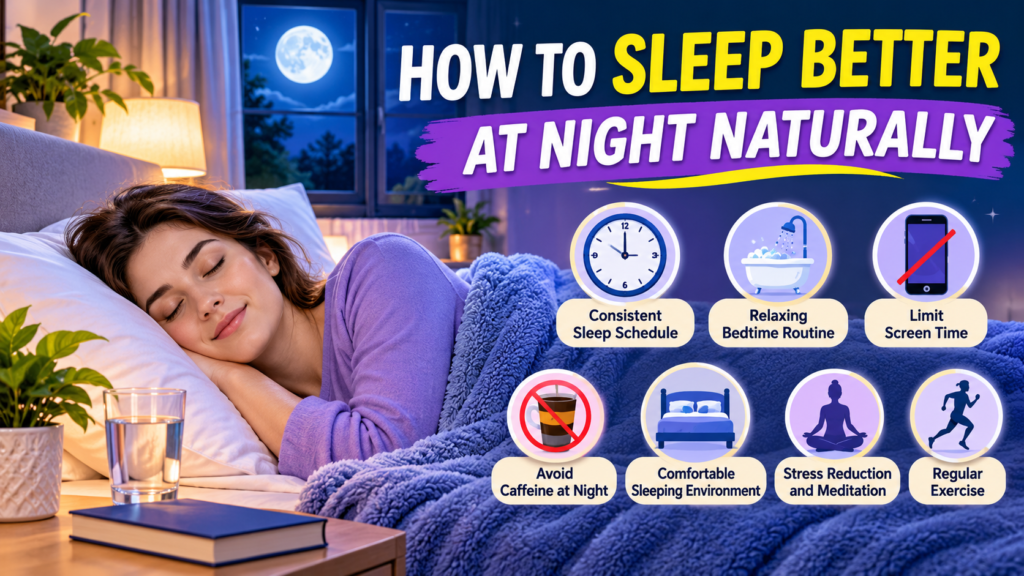
Quick Answer: To sleep better at night naturally, keep the same bedtime and wake time every day, get morning daylight, stop caffeine after noon, and wind down without screens for the last hour before bed. A cool, dark, quiet bedroom and a regular routine help most adults fall asleep faster and wake up rested within one to two weeks.
Table of Contents
If you want to know how to sleep better at night naturally, the first thing to understand is that good sleep is not a luxury — it is a health habit, just like eating well or walking every day. Most adults need seven to nine hours of sleep a night, yet millions get far less, and the cost shows up everywhere: low energy, bad mood, poor focus, stronger cravings, and a body that finds it much harder to lose weight.
The good news is that most sleep problems are not caused by a single mysterious fault. They are caused by small daily habits that fight against your body clock — bright screens late at night, caffeine after noon, irregular bedtimes, and a bedroom that is too warm or too bright. Change those habits, and sleep usually improves within one to two weeks, without any product or supplement.
This guide walks through ten proven tips in plain language: how to set your body clock, how light and screens affect sleep, what to eat and drink before bed, how to build a wind-down routine, and what to do on the nights when sleep still does not come. You will also find a table that shows which tip fixes which sleep problem, so you can start with the one that matches your situation.
If stress is part of the reason you lie awake, our guide on how to reduce stress and anxiety naturally pairs well with this one — but first, if you are new to healthy living in general, our guide on weight loss tips for women explains how sleep, food, and daily movement work together for your health.
Why Good Sleep Is a Health Habit, Not a Luxury
Sleep is when your body does its most important repair work. While you sleep, your brain clears out waste, stores memories, balances hormones, and repairs muscle. Your immune system strengthens, your blood pressure drops, and the hormones that control hunger reset for the next day. None of this happens properly when sleep is short or broken.
The effects of poor sleep show up fast. After just one short night, most people feel hungrier, crave sugary and fatty food, and find it harder to focus or control their mood. After weeks of short sleep, the effects deepen: higher blood pressure, higher blood sugar, weaker immunity, and weight gain around the waist. Research has found that people who sleep five or six hours a night eat more the next day and lose more muscle and less fat on the same diet than people who sleep seven to nine hours.
Sleep also shapes your weight directly. Two hormones control hunger: ghrelin, which makes you feel hungry, and leptin, which tells you that you are full. Short sleep raises ghrelin and lowers leptin — a combination that makes you feel hungry all day even when you have eaten enough. That is why a bad night often ends with extra snacking the next day, and why our weight loss guides always treat sleep as a core step, not an optional extra.
The encouraging part is that sleep responds well to routine. Your body has an internal clock that loves regularity. Give it the same signals at the same times each day — light in the morning, darkness at night, meals at regular times — and it will start making you sleepy at the right hour on its own.
How much sleep you really need
Most adults need seven to nine hours a night. Some people genuinely need slightly less, and some need slightly more, but very few adults function well on less than seven hours over the long term. The best test is simple: if you wake up without an alarm feeling rested, and you stay alert through the afternoon without caffeine, you are probably getting enough. If you need an alarm, coffee, and a nap to get through the day, you are probably short on sleep.
| Sleep problem | Most likely cause | First tip to try |
|---|---|---|
| Cannot fall asleep | Bright screens, caffeine, racing thoughts | Wind-down routine, no screens last hour |
| Wake up in the night | Alcohol, warm room, stress | Cool dark bedroom, no alcohol before bed |
| Wake up too early | Light in the bedroom, irregular schedule | Blackout curtains, fixed wake time |
| Feel tired despite 8 hours | Poor sleep quality, snoring, late meals | Fixed schedule, check for snoring |
| Mind races at bedtime | Unprocessed worries, late work | Write worries down before bed |
| Sleepy all day | Short sleep, late caffeine | Regular schedule, caffeine only in morning |
How to Sleep Better at Night Naturally: The 10 Proven Tips
These ten tips are listed in order of impact. Start with the first three — a fixed schedule, morning light, and a caffeine cut-off — and most people notice a real difference within a week. Add the rest one at a time.
Tip 1 — Keep the same bedtime and wake time
This is the single most powerful sleep habit. Going to bed and waking up at the same time every day, including weekends, trains your body clock. Within one to two weeks, your body starts making you sleepy at the right time and waking you up naturally. A regular wake time matters even more than a regular bedtime, because it anchors the whole clock. Pick a wake time you can keep every day, and build your bedtime backwards from it — seven to nine hours earlier.
Tip 2 — Get daylight in the morning
Morning light is the strongest signal that sets your body clock. Spend ten to twenty minutes outside within an hour of waking — a walk, breakfast near a window, or simply standing in the garden. Bright morning light tells your brain to stop making melatonin, the sleep hormone, and starts the timer for sleepiness about fourteen to sixteen hours later. This is why people who spend the whole day indoors often struggle to feel sleepy at night.
Tip 3 — Stop caffeine after noon
Caffeine blocks the sleepiness signal in your brain, and it stays in your body far longer than most people realise. Half of the caffeine from a cup of coffee is still there six hours later. That means a coffee at 4 p.m. is still affecting you at 10 p.m. Keep caffeine to the morning — one or two cups before noon — and switch to water or herbal tea after that. If you feel more tired for two or three days after cutting back, that is normal; it passes quickly.
Tip 4 — Move your body during the day
Regular movement improves sleep quality, and it does not have to be intense. A brisk thirty-minute walk during the day helps most people fall asleep faster and sleep more deeply. Morning or afternoon exercise works best for sleep. Very hard exercise late in the evening can make it harder to fall asleep, because it raises your body temperature and alertness, so keep late workouts gentle — stretching or a slow walk is fine.
Tip 5 — Eat dinner earlier and keep it light
A heavy meal close to bedtime forces your body to digest when it should be winding down, which can cause discomfort, heartburn, and broken sleep. Try to finish dinner at least two to three hours before bed, and keep the evening meal moderate in size. If you feel hungry later, a small light snack — a banana, a small bowl of yogurt, or a handful of nuts — is better than a large meal. A safe calorie deficit of 300–500 calories a day, if you are losing weight, should come from smaller portions during the day, not from skipping dinner and then snacking at midnight. Never drop below 1,200 calories a day without medical supervision.
Tip 6 — Avoid alcohol before bed
Alcohol can make you feel drowsy, so many people use it to fall asleep. But it is a poor sleep aid: it fragments sleep, causes waking in the second half of the night, and makes snoring worse. Even one or two drinks in the evening can reduce sleep quality noticeably. If you drink, keep it moderate and finish at least three hours before bed. Many people are surprised by how much better they sleep after just a few alcohol-free nights.
Tip 7 — Build a wind-down routine
Your brain needs a clear signal that the day is over. A wind-down routine of thirty to sixty minutes before bed gives it that signal. Dim the lights, put your phone on silent in another room, and do something calm: a warm shower or bath, light reading, gentle stretching, or writing down tomorrow’s tasks. Do the same steps in the same order each night, and your body will learn to associate them with sleep.
Tip 8 — Make your bedroom cool, dark, and quiet
Your bedroom should feel like a cave: cool, dark, and quiet. A temperature around 18–20°C (65–68°F) works for most people. Block out light with blackout curtains or a sleep mask, and reduce noise with earplugs or a white noise machine if needed. Keep the bedroom tidy and free of work — if your bed is also your office, your brain stops associating it with rest.
Tip 9 — Write worries down before bed
If your mind races at bedtime, give it a place to put those thoughts before you lie down. Spend five minutes writing down whatever is on your mind — tasks, worries, things you cannot control. If a worry has a next step, write that too. Getting thoughts onto paper tells your brain it does not have to keep holding them overnight. Our guide on how to stop overthinking at night goes deeper into this technique and other tools for a racing mind.
Tip 10 — Get up if you cannot sleep
Lying awake and worrying about not sleeping only makes sleep harder. If you have been awake for about twenty minutes, get up, go to another room, and do something calm in dim light — read a book, listen to soft music, or practise slow breathing. Return to bed only when you feel sleepy. This trains your brain to link the bed with sleep, not with worry.
Your Sleep Schedule: The Foundation
A fixed sleep schedule is the foundation everything else rests on. Without it, the other tips work only half as well, because your body clock never knows when sleep is coming. Think of your body clock as a train timetable: it works best when the trains run at the same time every day.
Start by choosing your wake time, not your bedtime. Pick a time you can keep seven days a week — for most working women, somewhere between 6 a.m. and 7:30 a.m. Set an alarm for that time and keep it, even on weekends, for at least two weeks. It will feel hard for the first few days, especially if you are used to sleeping in on Saturday. That discomfort is the clock adjusting, and it passes.
Then count backwards seven to nine hours to find your bedtime. If you wake at 6:30 a.m. and need eight hours, your bedtime is 10:30 p.m. Start your wind-down routine thirty to sixty minutes before that. Do not try to fix your schedule by going to bed much earlier all at once — shift it by fifteen minutes every two or three nights until you reach your target.
Naps need care too. A short nap of twenty to thirty minutes before 3 p.m. can help if you are very tired. Longer naps, or naps late in the day, steal sleep from the night. If you struggle to fall asleep at night, skip the nap for a week and see if nights improve.
Light, Screens, and Your Body Clock
Light is the most powerful signal for your body clock, stronger than food or exercise. Bright light in the morning tells your brain to wake up; darkness at night tells it to make melatonin and prepare for sleep. Modern life gets this backwards — we spend days indoors in dim light and evenings in bright light from screens.
Morning light is the fix. Get outside within an hour of waking, even on a cloudy day — outdoor light is far brighter than indoor light, even when the sky is grey. If you cannot get outside, sit near a bright window while you eat breakfast. Ten to twenty minutes is enough to set the clock for the day.
Evening light is the problem to manage. The blue light from phones, tablets, and laptops signals to your brain that it is still daytime, which delays melatonin and pushes sleep later. The simplest rule is to stop using screens for the last hour before bed. If that is not possible, dim the screen, switch on night mode, and hold the phone further from your face. Television from across the room is less disruptive than a phone held close to your eyes, but a calm book is better than either.
Keep your bedroom as dark as possible. Even small lights — a charger, a hallway light under the door — can disturb sleep. Blackout curtains, a sleep mask, or simply covering small lights with tape can make a real difference.
Caffeine, Food, and Alcohol Before Bed
Caffeine is the most common sleep thief, and most people underestimate it. Coffee, tea, cola, chocolate, and energy drinks all contain caffeine. A cup of coffee at 4 p.m. still leaves half its caffeine in your body at 10 p.m. The rule is simple: keep caffeine to the morning, and switch to water or herbal tea after noon. If you drink several cups a day, cut back gradually over a week to avoid headaches.
Food timing matters too. Eating a large, heavy, or spicy meal close to bedtime can cause heartburn and restlessness. Finish dinner two to three hours before bed, and keep it moderate. If you are trying to lose weight, remember that a safe pace is about 0.5–1 lb a week from a 300–500 calorie daily deficit, and that protein of 30–40 grams per meal keeps you full and steady. Skipping meals during the day and then eating a large meal at night is one of the worst patterns for sleep, because it combines hunger, a full stomach, and a blood sugar swing at exactly the wrong time.
Alcohol is the third common thief. It may help you fall asleep, but it breaks sleep apart in the second half of the night and makes snoring worse. If you drink in the evening, finish at least three hours before bed and keep the amount small. Many people find that a few alcohol-free nights in a row improve their sleep more than any other single change.
Build a Wind-Down Routine That Works
A wind-down routine is a set of calm steps you repeat every night in the same order. It works because your brain learns to associate the steps with sleep, the same way a child learns that bath, book, and bed mean sleep is coming. Adults need the same signal, even if they have forgotten it.
A good routine takes thirty to sixty minutes. Here is a simple template you can adapt:
- One hour before bed, dim the lights and put your phone on silent in another room.
- Write down tomorrow’s top three tasks and any worries on paper, so your mind can let go of them.
- Take a warm shower or bath — the drop in body temperature afterwards makes you feel sleepy.
- Change into sleep clothes and do five minutes of gentle stretching or slow breathing.
- Read a light book or listen to calm music in dim light until your eyes feel heavy.
- Go to bed only when you feel sleepy, and keep the room cool and dark.
The exact steps matter less than the repetition. Do the same routine every night for two weeks, and it will start working on its own. Avoid stressful conversations, work emails, and exciting shows in that final hour — your brain cannot switch from alert to sleepy in five minutes.
Your Bedroom: Cool, Dark, and Quiet
Your bedroom should be a place your brain links only with sleep and rest. If you work, eat, or scroll for hours in bed, that link weakens, and falling asleep gets harder. Keep work and screens out of the bedroom as much as you can.
Temperature is the easiest thing to fix. Most people sleep best in a cool room, around 18–20°C (65–68°F). If you feel too warm at night, try lighter bedding or a fan before you reach for anything else. A warm bath before bed helps because your body temperature drops afterwards, and that drop is a strong sleep signal.
Darkness is next. Blackout curtains, a sleep mask, or even a rolled towel under the door can block light. Cover small glowing lights from chargers and devices. If you wake in the night and need light, use a dim, warm light rather than a bright white one.
Noise is the third factor. A quiet room is best, but if you live somewhere noisy, earplugs or a white noise machine can help. Keep the volume low and steady — sudden sounds wake you, while steady background sound usually does not.
Finally, check your mattress and pillow. You do not need an expensive mattress, but if yours is very old, lumpy, or painful, it is worth replacing. A pillow that keeps your neck in a comfortable, neutral position matters more than a fancy one. If you wake up with neck or back pain most mornings, your pillow or mattress is part of the problem.
What to Do When You Cannot Sleep
Even with good habits, some nights will be hard. Knowing what to do on those nights stops one bad night from turning into a week of worry about sleep.
First, stop watching the clock. Checking the time every few minutes raises anxiety and makes sleep even harder. Turn the clock away from the bed, and do not check your phone for the time.
If you have been awake for about twenty minutes, get up. Go to another room, keep the lights dim, and do something calm — read a dull book, listen to soft music, or practise slow breathing. Do not check email, news, or social media. Return to bed only when you feel sleepy. This is called stimulus control, and it is one of the most effective techniques in sleep research.
Slow breathing helps here too. Breathe in for four counts, hold for seven, and breathe out slowly for eight counts. The long exhale calms the body and often brings drowsiness within a few rounds. If the counts feel too long, use three, five, and six instead.
If a worry is keeping you awake, write it down on paper beside your bed. Write the worry and one small next step, then tell yourself you will deal with it in the morning. This simple act tells your brain it does not have to hold the thought all night.
When Sleep Problems Need Professional Help
Most sleep problems improve with the habits in this guide. But some need professional help, and recognising them early matters. See your doctor if you have trouble sleeping most nights for more than three weeks, if you feel very sleepy during the day despite a full night, or if you snore loudly, gasp, or seem to stop breathing in your sleep. That last pattern is a sign of sleep apnoea, a treatable condition that affects many adults and is often missed.
Also seek help if sleep problems come with low mood, constant worry, or panic, or if you find yourself relying on alcohol or sleeping pills to get through the night. These are not personal failures — they are signs that the system needs support, not just better habits.
A doctor may suggest cognitive behavioural therapy for insomnia, known as CBT-I. It is the most effective treatment for long-term insomnia, and it works by changing the thoughts and habits that keep sleep away. It is usually delivered over a few weeks, and the effects last longer than sleeping pills. Do not be afraid to ask about it — it is a sign of taking sleep seriously, not of weakness.
Frequently Asked Questions
How can I fall asleep fast naturally?
The fastest natural way to fall asleep is to combine a fixed wake time with a calm wind-down routine and no screens for the last hour before bed. Slow breathing — in for four, hold for seven, out for eight — helps many people drift off within minutes. If you are still awake after about twenty minutes, get up, do something calm in dim light, and return to bed only when you feel sleepy.
What is the best time to go to bed?
The best bedtime is the one that gives you seven to nine hours before your wake time. If you wake at 6:30 a.m., aim for 10:30 p.m. The exact hour matters less than keeping it consistent — your body clock works best when bedtime and wake time are the same every day, including weekends.
Does exercise help you sleep better?
Yes. Regular movement, even a brisk thirty-minute walk, improves sleep quality and helps you fall asleep faster. Aim to finish vigorous exercise at least three hours before bed, because it raises body temperature and alertness for a while afterwards. Gentle stretching or yoga in the evening is fine.
Is it bad to use my phone before bed?
It is not ideal, but it is not a disaster either. The problem is the bright, close light and the stimulating content — news, arguments, and endless scrolling keep your brain alert. If you must use your phone, dim the screen, turn on night mode, keep it at arm’s length, and stop at least thirty minutes before bed. A calm podcast or audiobook is usually better than scrolling.
Why do I wake up at 3 a.m. every night?
Waking around 3 a.m. is common, because that is when your body finishes its first deep-sleep cycles and enters lighter sleep. Alcohol, a warm room, stress, or an irregular schedule can make these awakenings more likely. If you wake and cannot get back to sleep after about twenty minutes, get up, do something calm in dim light, and return to bed when sleepy. If it happens most nights for weeks, talk to your doctor.
Can poor sleep really cause weight gain?
Yes. Short sleep raises the hunger hormone ghrelin and lowers leptin, the hormone that signals fullness. It also makes you crave sweet and fatty foods and lowers your willpower. Studies show that people who sleep less than six hours a night tend to eat more and gain weight more easily. Fixing sleep is often the easiest first step in any weight loss plan, and our guide to weight loss after 40 explains how sleep, hormones, and metabolism work together.
Final Verdict
Learning how to sleep better at night naturally is not about buying gadgets or following a perfect routine. It is about giving your body clock a clear, steady signal: the same wake time every day, morning light, caffeine only in the morning, movement during the day, and a calm hour before bed. Pick the three tips that feel easiest, do them every day for two weeks, and then add the next ones.
Most people notice a real difference within one to two weeks — falling asleep faster, waking less in the night, and feeling more rested in the morning. If you try these habits for a month and still struggle, do not keep pushing through alone. Talk to your doctor, ask about sleep apnoea, and ask about CBT-I. Good sleep is worth the effort, because it improves almost everything else: your mood, your appetite, your energy, and your health.
For more practical health guides, visit the HealthSpots homepage, or explore our Mental Health and Weight Loss sections.