
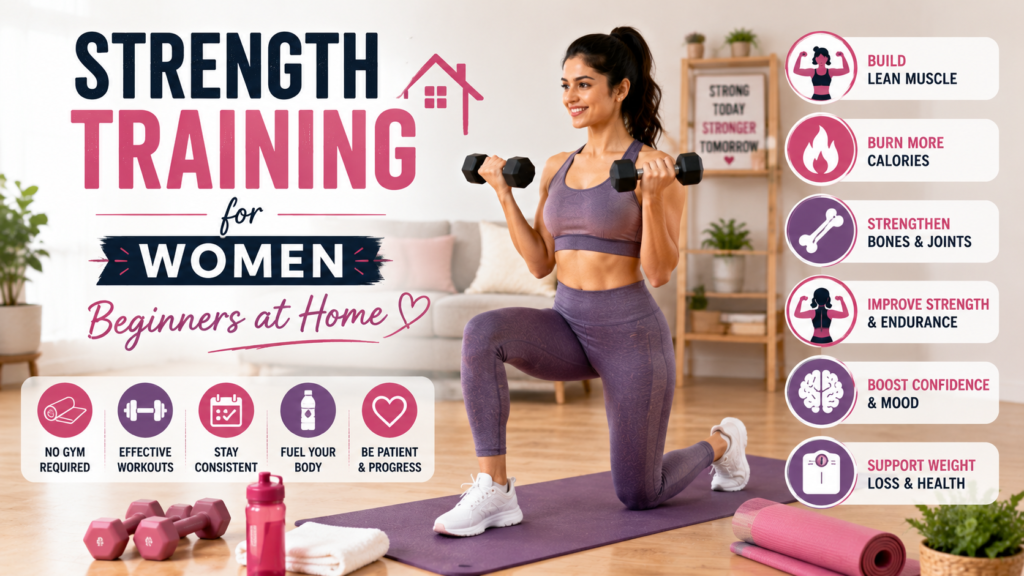
Quick Answer: Strength training for women beginners at home needs no equipment and no gym. Start with two or three 20-minute sessions a week using bodyweight moves such as squats, push-ups, glute bridges, and rows, with one rest day between sessions. Focus on slow, controlled form, add repetitions gradually, and pair training with enough protein to build strength safely.
Table of Contents
Strength training for women beginners at home is one of the simplest and most effective ways to get stronger, protect your bones, and support healthy weight loss without ever joining a gym. If the words strength training bring to mind heavy barbells, crowded weight rooms, or the fear of getting bulky, this guide will change that picture. Real beginner strength training starts in your living room, with your own body weight, in about 20 minutes, and the only equipment you truly need is a clear patch of floor and a chair for balance.
Many women put off strength training for years because they think they need to be fit first, buy equipment first, or learn complicated exercises first. None of that is true. You build fitness by training, not before it. A beginner routine uses simple, natural movements you already know how to do: squatting to sit down, pushing yourself up, hinging at the hips, and holding your body steady. The goal of the first month is not to lift heavy or feel exhausted. It is to learn the movements, build a habit, and finish each session feeling stronger than when you started.
This guide covers everything a complete beginner needs: why strength training matters so much for women, exactly what you need to start, a full 20-minute no-equipment routine with form cues for every move, how often to train, how to progress safely, and what to eat to support your training. It also covers the mistakes that cause most beginners to quit or get sore, so you can avoid them from day one. If you are starting a wider weight loss plan at the same time, our guide on weight loss tips for women explains how strength training fits alongside food, walking, sleep, and stress.
Why Strength Training Matters for Women
Strength training means working your muscles against resistance, and your own body weight counts as resistance. When you squat, push, pull, or hold a position, your muscle fibres work harder than they do in everyday life, and your body responds by making those fibres stronger. That response is the whole point. Stronger muscles make daily life easier: carrying shopping, climbing stairs, lifting a child, and getting up from the floor all become less effort. For women, the benefits go further than convenience, because muscle and bone health are closely linked to long-term independence and health.
One of the most important benefits is muscle preservation during weight loss. When you eat fewer calories than you burn, your body loses a mix of fat and muscle. Without strength training, a large share of that loss can be muscle, which lowers your strength and makes it harder to keep the weight off later, because muscle tissue burns more energy at rest than fat tissue does. Strength training changes that balance. Research consistently shows that people who combine a modest calorie deficit with resistance training lose more fat and keep more muscle than people who diet alone. A deficit of 300 to 500 calories a day, enough for about 0.5 to 1 lb of weight loss a week, works best alongside two or three strength sessions a week.
Bone health is the second major reason strength training matters for women. Bone is living tissue that responds to loading: when muscles pull on bones during exercise, bones become denser and stronger. Women lose bone density faster than men, especially after menopause, when falling estrogen levels speed up bone loss. Weight-bearing and resistance exercise is one of the few proven ways to slow that loss. Health authorities, including the World Health Organization and the Centers for Disease Control and Prevention, recommend muscle-strengthening activities on two or more days a week for adults, alongside 150 minutes of moderate aerobic activity, precisely because of these effects on muscle, bone, and everyday function.
Strength training also supports blood sugar control, balance, mood, and sleep. Muscle is the largest site in the body for using glucose from the blood, so more active muscle helps keep blood sugar steadier after meals. Stronger legs and a stronger core improve balance, which lowers the risk of falls as you age. Many women also find that a short strength session improves their mood and sleep on the same day, partly because the effort is absorbing and satisfying in a way that a long, boring workout is not. You do not need to become an athlete to get these benefits. Two short sessions a week, done consistently for months, deliver far more than an intense week followed by quitting.
Finally, strength training will not make you bulky. That fear stops many women from starting, but it is based on a misunderstanding. Building large muscles requires years of heavy lifting, a large calorie surplus, and high levels of testosterone, which women naturally have far less of than men. What strength training does for most women is different: firmer arms and legs, a stronger core, better posture, clothes that fit better, and a body that can do more. The change you see in the mirror after a few months is usually a leaner, more defined shape, not a bigger one.
Strength Training for Women Beginners at Home: What You Need to Start
Strength training for women beginners at home asks for very little. You need a clear space about the size of a yoga mat, a floor that is not slippery, comfortable clothes you can move in, and supportive shoes or bare feet on a non-slip surface. A sturdy chair is useful for balance during single-leg moves and for modified push-ups. A wall helps for wall push-ups and wall sits. A towel and a bottle of water complete the kit. That is the whole list. You do not need dumbbells, resistance bands, a bench, or a mat to begin, although a mat makes floor work more comfortable and a set of light dumbbells is a sensible purchase later, once the habit is set.
Before your first session, take five minutes to set yourself up for success. Pick three days a week with at least one rest day between them, for example Monday, Wednesday, and Friday, and put them in your calendar like appointments. Choose a time of day when you have the most energy and the fewest interruptions, and keep the same time each session so it becomes a habit. Tell someone in your household what you are doing so they give you 20 uninterrupted minutes. Keep your workout space ready rather than setting it up from scratch each time, because every small barrier makes skipping easier.
A short warm-up matters more than beginners expect. Cold muscles are stiffer and less coordinated, so jumping straight into squats raises the chance of a strain or an awkward movement. Spend three to five minutes warming up: march in place for a minute, roll your shoulders, swing your arms gently, do ten slow bodyweight squats to half depth, and walk around the room. You should feel slightly warmer and looser, not tired. Save stretching for the end, when your muscles are warm, and keep it gentle.
| What you need | Why it helps | Cost to start |
|---|---|---|
| Clear floor space (about 2 by 1.5 metres) | Room to squat, lunge, and lie down safely | Free |
| Sturdy chair | Balance support and modified push-ups | Free, already at home |
| Comfortable clothes and shoes | Free movement without slipping | Free |
| Water bottle and towel | Stay hydrated and comfortable | Free |
| Exercise mat (optional) | Comfort for floor moves such as bridges and planks | Low cost, buy later if you like |
| Light dumbbells (optional, later) | Extra resistance once bodyweight gets easy | Low cost, only after 4 to 6 weeks |
If you have a health condition, are pregnant, have joint pain, or have not exercised for a long time, talk to your doctor before starting a new exercise routine. This is especially important if you have high blood pressure, heart disease, diabetes, osteoporosis, or a recent injury. A short conversation can confirm that bodyweight training is safe for you and flag any moves to change. Pain is also a signal worth respecting: muscle effort and mild soreness the day after a first session are normal, but sharp pain, joint pain, dizziness, or chest pain are reasons to stop and seek medical advice.
The 20-Minute No-Equipment Starter Routine
This routine takes about 20 minutes, including a warm-up and a cool-down, and it works your whole body: legs, glutes, chest, back, arms, and core. Do it two or three times a week, with at least one rest day between sessions, so your muscles have time to recover and grow stronger. Rest about 30 to 60 seconds between exercises, and about 60 seconds between rounds. Perform each repetition slowly: two seconds to lower, a brief pause, then two seconds to lift or push. Slow, controlled movement builds more strength and control than fast, bouncy repetitions, and it is much kinder to your joints.
Start with one round of the circuit in week one, and add a second round in week two or three, when the first round feels comfortable. If you cannot finish the listed repetitions, do as many as you can with good form and stop there; finishing eight good squats is far better than doing twelve sloppy ones. If the listed repetitions feel too easy after a few weeks, add two more repetitions before you add a third round. Write down what you do each session, because a short note is the simplest way to see progress over a month.
| Order | Exercise | Repetitions | Muscles worked | Rest after |
|---|---|---|---|---|
| Warm-up | March in place, arm circles, half squats | 3 to 5 minutes | Whole body | None |
| 1 | Bodyweight squat | 10 | Legs, glutes | 30 seconds |
| 2 | Wall or knee push-up | 8 | Chest, arms, core | 30 seconds |
| 3 | Glute bridge | 12 | Glutes, hamstrings, core | 30 seconds |
| 4 | Chair-assisted row (towel row) | 10 | Back, arms | 30 seconds |
| 5 | Standing calf raise | 12 | Calves, ankles | 30 seconds |
| 6 | Dead bug | 8 each side | Deep core | 30 seconds |
| 7 | Modified plank | 20 seconds | Core, shoulders | 60 seconds |
| Cool-down | Gentle stretches, slow breathing | 3 minutes | Whole body | Done |
Do the exercises in order, moving from one to the next with a short rest. The order is deliberate: large leg muscles first, while you are freshest, then pushing, then the glutes, then pulling, then calves and core. A full round takes about 10 to 12 minutes once you know the moves. Two rounds take about 18 minutes plus the warm-up and cool-down, which is a complete session. If you are short on time on a busy day, one round still counts. A short session you actually do is worth far more than a perfect session you skip.
How to Do Each Move With Good Form
Good form is the difference between strength training that helps you and strength training that hurts you. Form means the position of your body, the path of the movement, and the control you keep throughout. Every exercise below has one clear form cue to remember, one common mistake to avoid, and one easier version to use while you are learning. Learn the easier version first. There is no prize for struggling through the hard version with poor form, and there is a real cost: sore knees, an aching lower back, and a session you will not want to repeat.
Bodyweight squat: sit back, knees track over toes
Stand with your feet about shoulder-width apart, toes pointing slightly outward. Push your hips back and down as if you are sitting into a chair, keeping your chest up and your weight through your whole foot, not just your toes. Lower until your thighs are near parallel to the floor, or as far as feels comfortable, then press through your heels to stand. Keep your knees pointing in the same direction as your toes throughout; they should not cave inward. The most common mistake is letting the knees collapse inward or lifting the heels off the floor. If your heels lift, place a folded towel under them or squat to a chair and stand up again, which is a perfect beginner version. Aim for a smooth two-second lowering and a strong stand.
Wall or knee push-up: straight line from head to knees
Start with wall push-ups if a floor push-up feels too hard: stand an arm’s length from a wall, place your palms flat on it at shoulder height, and bend your elbows to bring your chest toward the wall, then push back. Keep your body in a straight line from head to heels, with your core tight and your hips not sagging. When wall push-ups feel easy, move to knee push-ups on the floor, with the same straight line from head to knees. The common mistake is letting the hips sag or flaring the elbows wide out to the sides. Keep your elbows at roughly 45 degrees from your body, lower your chest, not your chin, and breathe out as you push.
Glute bridge: squeeze at the top, ribs down
Lie on your back with your knees bent and your feet flat on the floor, about hip-width apart and close enough that your fingertips can almost touch your heels. Press through your heels to lift your hips until your body forms a straight line from shoulders to knees, squeezing your glutes hard at the top for one second. Lower slowly without letting your hips touch the floor between repetitions if you can. The common mistake is arching the lower back to get higher; if your ribs flare up and your back arches, you have gone too far. Keep your ribs down and think about pushing the floor away with your heels. This move is one of the best for women who sit a lot, because it wakes up glutes that spend the day switched off.
Chair-assisted row: pull with your back, not your arms
Rows balance all the pushing in the routine and protect your posture, so do not skip them. Hold a sturdy table edge or a towel looped around a fixed post at waist height, lean back with straight arms, and pull your chest toward your hands by squeezing your shoulder blades together, then lower slowly. Keep your body straight and your core tight, like a leaning plank. The common mistake is shrugging the shoulders up toward the ears or yanking with the arms; think about pulling your elbows back and down, as if you are putting them in your back pockets. If the move feels too hard, stand more upright. If it feels too easy, walk your feet further forward.
Calf raises, dead bug, and plank: small moves, real value
For calf raises, stand tall holding a chair lightly, rise onto the balls of your feet over two seconds, pause at the top, and lower slowly over two seconds. Do not bounce. For the dead bug, lie on your back, raise your arms toward the ceiling and your knees above your hips, then slowly extend one arm and the opposite leg toward the floor while keeping your lower back pressed gently into the mat, and return. It looks easy and it is not; it trains the deep core without straining the neck, which is why it suits beginners far better than sit-ups. For the modified plank, rest on your forearms and knees with a straight line from head to knees, squeeze your glutes, and breathe normally for 20 seconds. Stop if your lower back sags or your shoulders ache; a short, strong plank beats a long, sagging one every time.
How Often to Train and How to Progress
Two or three sessions a week is the sweet spot for a beginner. Muscles do not get stronger during the workout itself; they get stronger in the recovery afterwards, when the body repairs the tiny stress the workout caused. Training every day without rest days interrupts that repair and leaves you tired and sore instead of stronger. With one rest day between sessions, most women feel fresh for the next workout and notice real progress within four to six weeks: more repetitions, better balance, and less effort on the same moves.
Progress by changing one thing at a time, and only when the current level feels comfortable. The simplest path is to add repetitions first: when you can finish all sets of squats with good form and two repetitions left in the tank, add two repetitions next session. Then add a second round. Then slow the lowering phase to three seconds, which makes the same move harder without any equipment. Only after four to six weeks of consistent bodyweight training should you think about adding weight, such as holding a filled water bottle or a backpack with books during squats and bridges. Small, steady steps protect your joints and keep you training, which is the whole game.
Expect some muscle soreness after the first two or three sessions, especially in the thighs and glutes. This delayed soreness usually peaks a day or two after training and fades within a few days. Gentle walking, light movement, and sleep help it pass faster than sitting still does. Soreness should get milder each week as your body adapts. If soreness is so strong that you cannot walk normally after three days, or a joint hurts sharply, you probably did too much too soon; take an extra rest day and return with fewer repetitions.
Track progress in a way you can see. Once a week, write down how many repetitions you did, how many rounds, and how the session felt on a scale of one to ten. After a month, compare the first entry with the latest. Most women are surprised: the squats that felt hard in week one feel easy in week five, the wall push-ups have become knee push-ups, and the 20-second plank has become 40 seconds. That visible progress is the best motivation there is, and it is also the proof that the routine is working, even if the bathroom scale has barely moved, because early strength gains often come with small changes in body shape rather than weight.
What to Eat to Support Strength Training
Training provides the signal to build muscle, but food provides the material. Protein is the most important nutrient here: your body uses it to repair and build the muscle fibres you worked. A practical target is 30 to 40 grams of protein per meal, which for most women means a palm-and-a-half of chicken, fish, eggs, Greek yogurt, lentils, or tofu at each main meal. Spread it across the day rather than eating it all at dinner, because your body uses protein best in regular doses. Our guide on how much protein you need explains the daily target in detail.
You do not need a special diet to start strength training, and you do not need expensive supplements. Eat normally, with a little more attention to protein, and drink water before you feel very thirsty. A small meal or snack with protein and carbohydrate within a couple of hours after training supports recovery, but the exact timing matters far less than your total intake across the day. If you are also trying to lose weight, keep the same modest deficit of 300 to 500 calories a day and never drop below 1,200 calories a day without medical supervision; a larger deficit makes it much harder to recover from training and to keep muscle. For meal timing ideas around your sessions, see our guide on what to eat after a workout.
Sleep is part of the nutrition picture too, because most muscle repair happens overnight. Women who sleep seven to nine hours recover better and feel stronger in the next session than women who sleep five or six hours, even on the same training plan. If you train in the evening, finish at least two hours before bed so your body temperature and energy settle, and keep the bedroom cool and dark. A regular bedtime helps more than any recovery product.
Common Beginner Mistakes to Avoid
Most beginners do not fail because the exercises are too hard. They fail because of avoidable mistakes that make training painful, boring, or easy to skip. The list below covers the ones that matter most, and every one of them has a simple fix.
- Do: learn form first, add repetitions slowly, rest one day between sessions, breathe steadily, and track what you do.
- Do: warm up for three to five minutes, cool down with gentle stretches, and keep the same training days each week.
- Do: eat 30 to 40 grams of protein per meal, drink water, and sleep seven to nine hours so your muscles recover.
- Avoid: copying heavy workouts from social media, holding your breath during lifts, or training through sharp joint pain.
- Avoid: skipping the warm-up, rushing repetitions, or adding weight before your bodyweight form is clean.
- Avoid: training every day without rest, or quitting after one sore week, when soreness is a normal sign of adapting.
- Avoid: comparing your first month with someone else’s third year, and judging progress by the scale alone.
The biggest mistake is doing too much in the first week. Enthusiasm is useful, but your tendons, joints, and balance need time to catch up with your motivation. One round, two or three days a week, is a real training plan, not a half-hearted one. The second biggest mistake is the opposite: training once, feeling sore, and deciding strength training is not for you. Soreness in week one is your body adapting, not a sign of damage, and it fades as you keep going. The third mistake is chasing the perfect routine instead of doing a good one consistently. A simple routine done for three months beats a perfect routine done for three days.
Frequently Asked Questions
Can a complete beginner do strength training at home with no equipment?
Yes. Bodyweight moves such as squats, push-ups, glute bridges, and rows are real strength training, and they are enough for the first four to six weeks. You only need extra weight once these moves become easy, and even then a filled water bottle or a backpack works.
How long does it take to see results from beginner strength training?
Most women feel stronger within two to three weeks and see visible changes in four to eight weeks, such as firmer arms, better posture, and easier stairs. Real muscle growth is slower, but strength, balance, and energy improve much sooner.
Will strength training make me bulky?
No. Building large muscles takes years of heavy lifting, a calorie surplus, and high testosterone levels. For most women, strength training leads to a firmer, leaner shape, better posture, and stronger bones, not a bulky build.
How many days a week should a woman beginner strength train?
Two or three days a week, with at least one rest day between sessions, is ideal. This matches the guidance from the World Health Organization and the Centers for Disease Control and Prevention, and it gives muscles time to recover and grow stronger.
Is strength training safe for women over 40 or over 50?
Yes, and it is especially valuable after 40, when muscle and bone loss speed up. Start with bodyweight moves, progress slowly, and talk to your doctor first if you have osteoporosis, joint problems, high blood pressure, or a recent injury.
Should I do cardio or strength training first for weight loss?
Both help, and they work best together. Strength training protects muscle while you lose weight, and walking or other cardio burns extra calories and supports heart health. If you have limited time, do two or three strength sessions a week and walk daily.
Final Verdict
Strength training for women beginners at home is simpler than it looks: two or three 20-minute sessions a week, six bodyweight moves, slow and controlled form, and a little more protein at each meal. You do not need a gym, expensive equipment, or prior fitness. You need a clear patch of floor, a regular time slot, and the patience to let small weekly progress add up. Start with one round this week, add a second round when it feels comfortable, and keep going for at least a month before you judge the results. Your future self, stronger, steadier, and more energetic, will be glad you started today. For more practical health guides, visit HealthSpots and explore the Fitness and Exercise section.
Sources
- World Health Organization — Physical activity fact sheet and guidelines on muscle-strengthening activity: who.int
- Centers for Disease Control and Prevention — Physical Activity Basics and muscle-strengthening guidance: cdc.gov
- American College of Sports Medicine — Resistance training recommendations for adults: acsm.org
- Mayo Clinic — Strength training: Get stronger, leaner, healthier: mayoclinic.org