
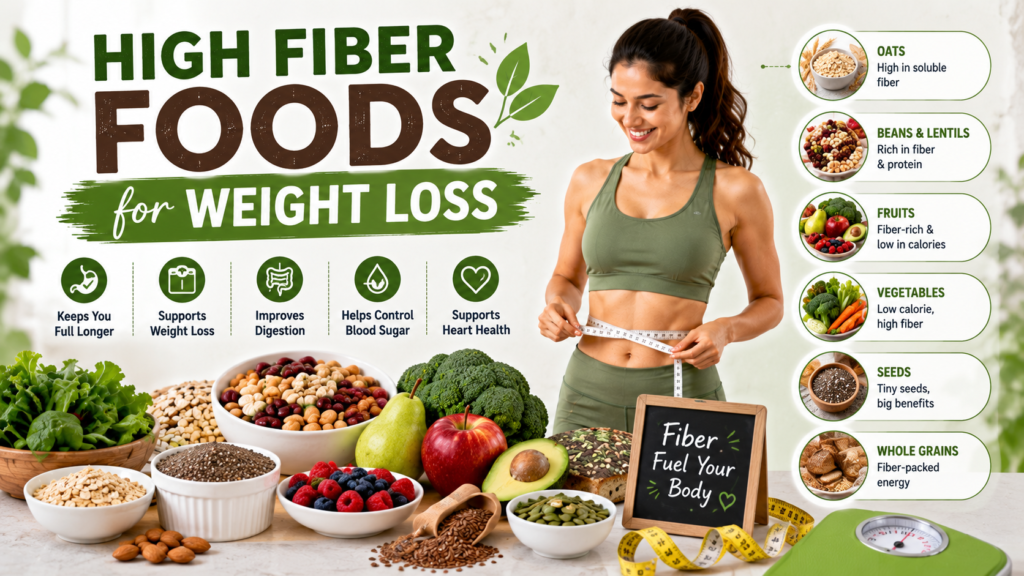
Quick Answer: The best high fiber foods for weight loss are lentils, black beans, chickpeas, raspberries, pears, oats, chia seeds, and broccoli, because they keep you full on fewer calories. Aim for about 25 grams of fiber a day, spread across meals, and add fiber gradually while drinking enough water.
Table of Contents
- Why Fiber Helps Weight Loss
- How Much Fiber Do You Need Each Day?
- High Fiber Foods for Weight Loss: The Ranked List
- How to Add More Fiber Without Feeling Bloated
- A Simple 7-Day Fiber Plan
- Best Choices vs. Foods to Limit
- Mistakes That Waste the Benefits of Fiber
- Frequently Asked Questions
- Final Verdict
If you are looking for high fiber foods for weight loss, you are already asking the right question. Most weight loss advice focuses on eating less, but fiber changes the question entirely: instead of fighting hunger all day, you choose foods that keep you full for longer on fewer calories. That is why fiber is one of the simplest and most reliable tools for steady, sustainable weight loss.
Fiber is the part of plant foods that your body cannot fully digest. It adds bulk to your meals, slows down digestion, and feeds the helpful bacteria in your gut. The result is practical, not abstract: you feel satisfied after a smaller meal, your blood sugar rises more slowly, and you are less likely to reach for a snack an hour later. For women trying to lose weight without a strict diet, that feeling of fullness is often the difference between a plan that lasts and a plan that fails in week two.
This guide ranks the best high fiber foods by the amount of fiber in a normal serving, explains how much you actually need, and shows you how to build a simple day of eating around them. There are no supplements to buy and no complicated rules. You will also find a 7-day plan, a best-versus-limit list, and answers to the questions women ask most about fiber and weight loss. If you are starting your weight loss journey from the beginning, our guide on weight loss tips for women covers the basics that make everything in this article work better.
Why Fiber Helps Weight Loss
Fiber helps weight loss in three clear ways, and each one matters on its own. First, high fiber foods take up space in your stomach. A bowl of lentil soup or a plate of vegetables with beans fills you up with far fewer calories than the same weight of white bread, white rice, or pastries. This is sometimes called volume eating, and it works because your stomach senses fullness partly by how full it is, not only by how many calories you ate.
Second, fiber slows digestion. Soluble fiber, the kind found in oats, beans, lentils, apples, and chia seeds, forms a gel-like substance in your gut that slows the movement of food. Your blood sugar rises more gradually after a fiber-rich meal, which means fewer sharp crashes and fewer sudden cravings. When blood sugar stays steadier, the urge to eat something sweet at 4 p.m. becomes much easier to resist.
Third, fiber supports your gut. The helpful bacteria in your large intestine feed on fiber, especially from beans, lentils, onions, garlic, bananas, and whole grains. A well-fed gut microbiome is linked to better digestion, less bloating over time, and healthier metabolism. This is not a quick fix or a detox claim; it is a slow, steady benefit that builds as fiber becomes a daily habit rather than a one-week experiment.
Soluble fiber vs. insoluble fiber
There are two main types of fiber, and your body needs both. Soluble fiber dissolves in water and helps control blood sugar and cholesterol. Good sources include oats, barley, beans, lentils, apples, pears, citrus fruit, and chia seeds. Insoluble fiber does not dissolve; it adds bulk and helps food move through your digestive system. Good sources include whole wheat bread, brown rice, wheat bran, the skins of fruit and vegetables, and most vegetables.
You do not need to track the two types separately. If you eat a mix of beans, whole grains, fruit, and vegetables every day, you will naturally get both. The practical rule is simple: eat plants at every meal, keep the skins on fruit and vegetables when you can, and choose whole grains over refined ones most of the time.
How fiber fits into a calorie deficit
Weight loss still comes down to a calorie deficit: eating slightly fewer calories than your body burns. A safe deficit is 300 to 500 calories a day, which usually leads to losing about 0.5 to 1 lb a week. Fiber does not replace the deficit, but it makes the deficit comfortable. A 300 to 500 calorie deficit built on low-fiber foods feels like constant hunger. The same deficit built on beans, vegetables, whole grains, and fruit feels like a normal day of eating.
That comfort is the real advantage. Most diets fail not because the science is wrong, but because hunger wins. Fiber, along with protein, is the nutrient that most reliably keeps hunger down. Aim for 30 to 40 grams of protein at each meal alongside your fiber, and you have the two strongest fullness tools working together. Our guide on how much protein you need explains the protein side of this in detail.
How Much Fiber Do You Need Each Day?
For most adult women, the target is about 25 grams of fiber a day. That figure comes from dietary guidelines used in the United States and is a practical goal for most women who are trying to lose weight. Men need more, around 38 grams, but this article is written for women, so 25 grams is the number to remember. Some women do well on a little more, up to 30 grams a day, especially if they are active and eat a lot of plant foods.
The honest truth is that most women eat far less than this. Average intakes in the United States are often around 15 grams a day, which means many women need to add about 10 grams a day to reach the target. That sounds like a lot, but it is surprisingly easy: one cup of cooked lentils alone provides about 15 grams, a bowl of oatmeal with raspberries provides about 8 grams, and an apple with the skin provides about 4 grams. Two or three small swaps a day are usually enough.
| Daily fiber goal | What it looks like |
|---|---|
| Minimum target | 25 grams a day for most adult women |
| Typical current intake | About 15 grams a day |
| Gap to close | About 10 grams a day, from 2–3 food swaps |
| Upper comfortable range | Up to 30 grams a day for active women |
| How fast to increase | Add 3–5 grams every few days, not all at once |
| Water to drink with it | About 2.7 litres a day for most women, more when active |
The speed of the increase matters as much as the target. If you jump from 12 grams to 30 grams in a single day, your gut will almost certainly complain with gas and bloating. Add fiber gradually, about 3 to 5 grams every few days, and drink water with it. Fiber absorbs water, so a high-fiber diet without enough water can cause constipation instead of preventing it. Give your gut a week or two to adjust, and the bloating usually settles as your gut bacteria adapt.
High Fiber Foods for Weight Loss: The Ranked List
The table below ranks high fiber foods for weight loss by fiber per normal serving, starting with the highest. Fiber grams are approximate values for standard servings, based on food composition data from the United States Department of Agriculture. Calories are included so you can see the fullness you get for the calories you spend, which is the real test of a weight loss food.
| Rank | Food (serving) | Fiber | Calories | Why it helps |
|---|---|---|---|---|
| 1 | Lentils, cooked (1 cup) | 15.6 g | 230 | Highest fiber plus 18 g protein |
| 2 | Black beans, cooked (1 cup) | 15.0 g | 227 | Fiber and protein together keep you full for hours |
| 3 | Chickpeas, cooked (1 cup) | 12.5 g | 269 | Versatile in salads, curries, and snacks |
| 4 | Chia seeds (2 tbsp) | 9.8 g | 138 | Tiny serving, huge fiber; great in yogurt and oats |
| 5 | Raspberries (1 cup) | 8.0 g | 64 | Most fiber per calorie of any common fruit |
| 6 | Pear, medium (with skin) | 5.5 g | 101 | Easy portable snack with soluble fiber |
| 7 | Avocado, half | 5.0 g | 160 | Fiber plus healthy fats; watch the portion |
| 8 | Broccoli, cooked (1 cup) | 5.1 g | 55 | Very low calorie for the fiber it gives |
| 9 | Oats, cooked (1 cup) | 4.0 g | 166 | Beta-glucan fiber steadies blood sugar |
| 10 | Apple, medium (with skin) | 4.4 g | 95 | Simple snack; most fiber is in the skin |
| 11 | Quinoa, cooked (1 cup) | 5.2 g | 222 | Complete protein plus fiber |
| 12 | Brussels sprouts, cooked (1 cup) | 4.1 g | 56 | High volume, very few calories |
| 13 | Almonds (1 oz, about 23 nuts) | 3.5 g | 164 | Fiber plus protein; keep the portion small |
| 14 | Sweet potato, medium | 3.8 g | 103 | Filling starch with fiber and vitamins |
| 15 | Whole wheat bread (2 slices) | 3.8 g | 160 | Easy swap from white bread |
Beans and lentils: the clear winners
If you remember only one group from this list, make it beans and lentils. A single cup of cooked lentils gives you more than half your daily fiber target, plus about 18 grams of protein, for roughly 230 calories. Black beans and chickpeas are close behind. No fruit or vegetable can match that combination of fiber and protein per calorie, which is exactly why beans are the backbone of so many traditional diets around the world, from South Asian lentil dishes to Latin American bean dishes.
The practical problem is that many women rarely eat beans. The fix is simple: add them to foods you already eat. Stir lentils into soup, add chickpeas to a salad, put black beans in a wrap, or make a bean chili for dinner. Canned beans work fine if you rinse them well to reduce salt; dried beans are cheaper but need soaking and cooking. If beans cause gas at first, start with a small portion, such as half a cup, and increase slowly over two weeks.
Berries, pears, and apples: fiber you will actually enjoy
Raspberries are the surprise star of the fruit list. One cup gives you 8 grams of fiber for only about 64 calories, which is more fiber per calorie than almost any other food. Pears and apples are more practical for most women: a medium pear gives about 5.5 grams, a medium apple about 4.4 grams, and both travel well as snacks. The key detail is the skin. Peeling an apple removes much of its fiber, so wash the fruit well and eat it with the skin on.
Fruit fiber is especially useful for weight loss because fruit also satisfies a sweet craving with natural sugars, water, and fiber together, rather than the fast sugar hit of sweets or juice. Fruit juice, by contrast, has almost no fiber, which is why a glass of orange juice leaves you hungry while an orange keeps you full. Eat the fruit; do not drink it.
Oats, quinoa, and whole grains
Oats deserve their reputation. A cup of cooked oats gives about 4 grams of fiber, including a special soluble fiber called beta-glucan that has been shown to help lower cholesterol and steady blood sugar. Oats also absorb water and expand, so a small amount of dry oats becomes a large, filling bowl. Add raspberries, chia seeds, or a sliced pear and a plain breakfast becomes a fiber-rich meal with 10 grams or more.
Quinoa is the other grain worth knowing. Unlike most grains, it provides all nine essential amino acids, so it counts as a complete protein, and a cup gives about 5 grams of fiber. Brown rice, whole wheat bread, and whole wheat pasta are simpler swaps: they give roughly double the fiber of their white versions for almost the same calories. You do not need to give up bread or rice; you need to upgrade them.
Vegetables that fill the plate
Broccoli, Brussels sprouts, carrots, cauliflower, and sweet potatoes give you fiber for very few calories. A cup of cooked broccoli has about 5 grams of fiber for only 55 calories, which means you can eat a large portion and still stay well within your calorie target. This is why the advice to fill half your plate with vegetables works so well in practice: the vegetables add volume, fiber, and nutrients, and they naturally shrink the space left for higher-calorie foods.
Avocado and nuts are different. They are high in fiber, but they are also high in calories, so the portion matters. Half an avocado or a small handful of almonds is a good serving; a whole avocado with a large handful of nuts can add 400 calories without you noticing. Use them as flavor and fullness boosters, not as unlimited snacks. A salad with chickpeas, vegetables, and a little avocado is a far better weight loss meal than a salad drowned in dressing with no protein or fiber at all. For more salad ideas built this way, see our guide to healthy salads for weight loss.
How to Add More Fiber Without Feeling Bloated
The most common reason women give up on fiber is bloating in the first week. That bloating is usually not a sign that fiber is bad for you; it is a sign that you added too much too fast, or that you added fiber without enough water. Your gut bacteria need time to adjust to a higher fiber intake, and the adjustment usually takes one to two weeks. The steps below make that adjustment much easier.
- Start with one meal. Add fiber to breakfast first, for example oats with berries, and keep lunch and dinner the same for a few days.
- Add 3 to 5 grams at a time. One extra serving of beans, one extra piece of fruit, or a switch from white to whole wheat bread is enough for one step.
- Drink water with every fiber-rich meal. Aim for about 2.7 litres a day in total, and carry a bottle so you sip through the day rather than drinking a large amount at once.
- Chew well and eat slowly. Eating fast swallows air and makes bloating worse, especially with beans and raw vegetables.
- Soak and rinse beans. Rinsing canned beans and soaking dried beans reduces the compounds that cause gas.
- Keep moving. A short walk after a meal helps digestion and reduces the heavy feeling that sometimes follows a high-fiber lunch.
- Be patient for two weeks. If bloating is mild and improving, it is usually adjustment. If it is severe or painful, or you have a digestive condition, talk to your doctor before pushing further.
One more honest point: fiber supplements are not a substitute for fiber-rich food. A supplement can add a few grams, but it does not give you the protein, vitamins, minerals, and fullness that real food gives. Food first is the rule here. Supplements have their place for some people, but they should be discussed with a doctor or dietitian, not bought because a social media post promised fast weight loss.
A Simple 7-Day Fiber Plan
You do not need a complicated meal plan to reach 25 grams of fiber a day. The table below shows one simple day that adds up to about 28 grams, using foods from the ranked list above. Repeat the pattern with different foods through the week, and the target takes care of itself.
| Meal | What to eat | Fiber |
|---|---|---|
| Breakfast | Oats cooked with water or milk, topped with raspberries and 1 tbsp chia seeds | About 9 g |
| Snack | Medium pear with skin | About 5.5 g |
| Lunch | Chickpea and vegetable salad with whole wheat bread | About 8 g |
| Snack | Carrot sticks with hummus | About 3 g |
| Dinner | Lentil soup with broccoli and a small portion of brown rice | About 10 g |
| Daily total | One normal day of eating | About 35 g |
Notice that this day is not a diet of salads and sadness. It includes bread, rice, soup, and snacks. The fiber comes from normal foods, not from special products. If you prefer different foods, swap freely: black beans for chickpeas, an apple for a pear, quinoa for brown rice, or broccoli for Brussels sprouts. The numbers stay roughly the same as long as every meal includes at least one high-fiber food.
A week of easy fiber swaps
- Monday: white bread to whole wheat bread at lunch.
- Tuesday: add a cup of berries to breakfast.
- Wednesday: add half a cup of beans to dinner.
- Thursday: swap white rice for brown rice or quinoa.
- Friday: add a vegetable soup as a starter before dinner.
- Saturday: try a lentil dish for lunch.
- Sunday: keep the swaps you liked and drop the ones you did not.
That one-swap-a-day approach is deliberate. Changing everything at once is the fastest way to quit. Changing one thing a day builds a habit that is still there in a month, and a habit that lasts a month is worth far more than a perfect week followed by a return to old foods. Weight loss at 0.5 to 1 lb a week is slow, but it is the pace that keeps the weight off, and fiber is one of the tools that makes that pace comfortable.
Best Choices vs. Foods to Limit
No food needs to be banned completely, but some foods make a high-fiber day easy and others make it almost impossible. The two lists below are a quick guide for shopping and cooking.
Best choices for a high-fiber day
- Lentils, black beans, chickpeas, and kidney beans
- Oats, quinoa, brown rice, and whole wheat bread
- Raspberries, pears, apples, and bananas
- Broccoli, Brussels sprouts, carrots, and sweet potatoes
- Chia seeds, flaxseeds, almonds, and walnuts in small portions
- Vegetable soups, salads with beans, and whole fruit as snacks
Foods to limit
- White bread, white rice, and refined pasta most of the time
- Fruit juice and smoothies with the fiber strained out
- Sugary cereals and pastries that list little or no fiber
- Crisps, biscuits, and other snacks with almost no fiber per calorie
- Highly processed ready meals that contain little vegetable or bean content
- Large portions of cheese or fatty meat with no vegetables or whole grains alongside
The pattern is clear: the foods to limit are not bad because they contain a single ingredient, but because they fill you up with calories and almost no fiber, so you are hungry again within an hour. The best choices do the opposite. You do not need to be perfect. If most of your meals include a fiber-rich food and most of your snacks are fruit, nuts, or yogurt with seeds, you are already doing far better than average.
Mistakes That Waste the Benefits of Fiber
- Adding fiber without water. Fiber needs water to do its job. Without enough fluid, a high-fiber diet can cause constipation and bloating instead of preventing them.
- Adding everything at once. A sudden jump from 12 grams to 30 grams in one day is the most common cause of gas and discomfort, and the most common reason women quit.
- Peeling fruit and vegetables. Much of the fiber in apples, pears, potatoes, and carrots sits in or just under the skin. Wash them well and keep the skin on.
- Choosing juice over whole fruit. A glass of juice has the sugar of several pieces of fruit and almost none of the fiber. Eat the fruit instead.
- Forgetting protein. Fiber alone is not enough. Without 30 to 40 grams of protein at each meal, hunger returns faster and you may lose muscle along with fat.
- Eating too little overall. A diet below 1,200 calories a day is not safe without medical supervision, and it makes it very hard to get enough fiber, protein, and nutrients. A 300 to 500 calorie deficit is enough.
- Expecting fiber alone to cause weight loss. Fiber helps you stay in a calorie deficit, but it does not burn fat by itself. The deficit, the protein, the daily movement, and the sleep all matter together.
Frequently Asked Questions
How much fiber should a woman eat a day for weight loss?
About 25 grams a day is the standard target for most adult women. That amount is enough to improve fullness, steady blood sugar, and support digestion. Increase gradually by 3 to 5 grams every few days, and drink enough water with it.
Which food has the most fiber for weight loss?
Lentils have the most fiber per serving of the common foods in this guide, with about 15.6 grams per cooked cup, plus about 18 grams of protein. Black beans and chickpeas are close behind. Raspberries are the best fruit choice, with about 8 grams per cup for only 64 calories.
Can fiber alone help me lose belly fat?
Fiber alone cannot target belly fat, because no food can burn fat from one place only. Fiber helps by making a calorie deficit easier to keep, and belly fat shrinks as total body fat falls. For the full picture, see our guide on how to lose belly fat naturally, which covers diet, walking, strength training, sleep, and stress together.
Does fiber cause bloating?
It can in the first week or two, especially if you increase your intake quickly or drink too little water. Add fiber gradually, drink about 2.7 litres of water a day, chew well, and walk after meals. Mild bloating usually settles as your gut adjusts. Severe or persistent pain should be discussed with a doctor.
Is it better to get fiber from food or supplements?
Food is better for most people. Fiber-rich foods also give you protein, vitamins, minerals, and the feeling of fullness that a supplement cannot match. Supplements can help some people reach their target, but talk to a doctor or dietitian first rather than relying on them alone.
Can I eat too much fiber?
Yes, very high intakes, usually well above 40 to 50 grams a day from food plus supplements, can cause gas, bloating, and cramps, and can interfere with absorbing some minerals. For most women, 25 to 30 grams a day from food is a comfortable and safe range. More is not automatically better.
Final Verdict
High fiber foods for weight loss work because they solve the hardest part of weight loss: hunger. Lentils, beans, chickpeas, oats, berries, pears, and broccoli let you eat satisfying meals on a modest 300 to 500 calorie deficit, losing about 0.5 to 1 lb a week without feeling deprived. Aim for about 25 grams of fiber a day, add it gradually, drink enough water, and keep protein at 30 to 40 grams per meal. Start with one swap tomorrow, such as oats with berries for breakfast or lentils at dinner, and build from there. Small, steady changes are the ones that last, and fiber is one of the easiest small changes you can make. For more practical, research-based weight loss guides, visit the HealthSpots homepage.
Medical Disclaimer: This article is for general information only and is not medical advice. It does not replace guidance from your doctor or a registered dietitian. If you have diabetes, thyroid disease, PCOS, heart disease, irritable bowel syndrome, or any other medical condition, or if you are pregnant or breastfeeding, talk to your healthcare provider before changing your diet. Do not follow a diet below 1,200 calories a day without medical supervision.