
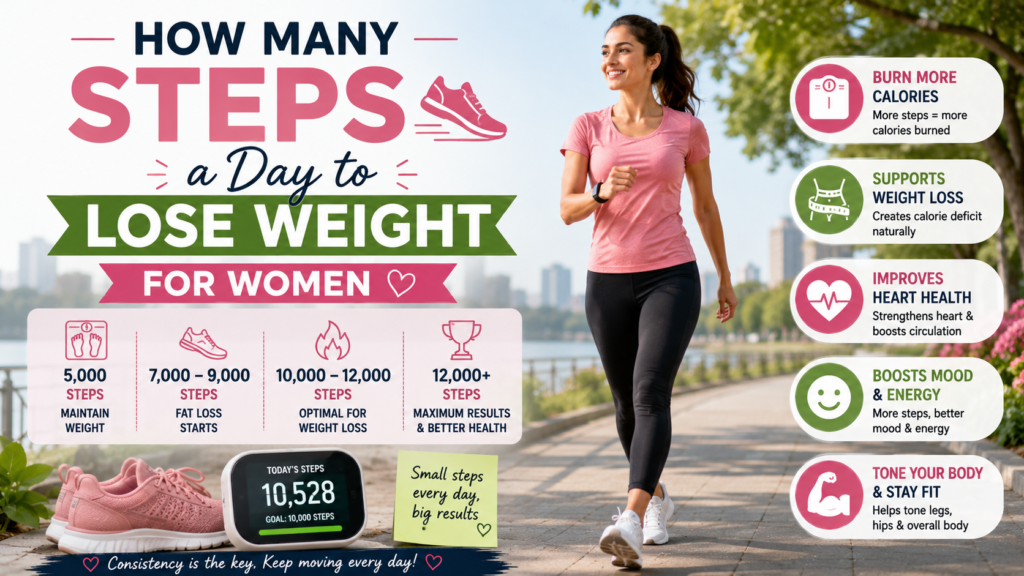
Quick Answer: How many steps a day to lose weight for women? Aim for 8,000 to 10,000 steps a day, combined with a modest calorie deficit of 300 to 500 calories. Start from your current daily average, add about 1,000 steps a week, and build up slowly. Walking works best as a daily habit, not a short burst.
Table of Contents
How many steps a day to lose weight for women is one of the most searched weight loss questions, and the reason is simple: walking is the easiest exercise in the world. It needs no gym, no special clothes, no skill, and no recovery day. You can do it in any weather, at any age, and at any fitness level, and you can build it into a life that already feels full. Yet the advice around step counts is confusing. Some sources say 10,000 steps or nothing, others say 5,000 is enough, and the number on your phone can feel like a judgment rather than a tool. This guide gives you a clear, honest answer, shows you how to find your own starting point, and lays out a week-by-week plan that takes you from wherever you are now to a daily step count that actually supports weight loss.
Walking works for weight loss because it burns calories without making you very hungry, which is the problem with many harder workouts. A long run can leave you ravenous and undo its own calorie burn at dinner. A walk rarely does that. Walking also lowers stress, improves sleep, helps blood sugar after meals, and protects your joints and muscles while you lose weight. Most importantly, it is sustainable: a woman who walks every day for a year burns far more calories in total than a woman who does two weeks of intense exercise and then stops. If you are building a wider weight loss plan, our guide on weight loss tips for women explains how daily walking fits with food, strength training, sleep, and stress.
Why Walking Works for Weight Loss
Weight loss comes down to a calorie deficit: using more energy than you take in from food, day after day, so your body draws on stored fat. Exercise is one side of that equation, and walking is one of the most reliable ways to increase the energy you use. A 70 kg woman walking at a brisk pace burns roughly 200 to 300 calories an hour, depending on speed, weight, and terrain. Walk an hour a day and that is 1,400 to 2,100 extra calories a week, roughly the same as a 300-calorie daily deficit on its own. Combine walking with modest food changes and the deficit becomes enough for steady loss of about 0.5 to 1 lb a week, the pace most health professionals consider safe and sustainable.
Walking has a second advantage that rarely gets mentioned: it is low impact and low stress on the body. Running, jumping, and heavy gym sessions all have their place, but they also raise appetite, need recovery time, and carry a higher injury risk for beginners. Walking does the opposite. It is gentle on knees and ankles, it can be done every day without a rest day, and it actually helps recovery between strength sessions by moving blood through tired muscles. For women over 40, women returning to exercise after a long break, and women with joint pain, walking is often the safest way to start moving more.
There is also a mental side. Walking, especially outdoors, reduces stress and improves mood in a way that screen-based exercise rarely matches. Stress matters for weight loss because the stress hormone cortisol encourages fat storage around the belly and drives cravings for sweet, salty foods. A 20-minute walk after a stressful day can break that cycle before it reaches the kitchen. Walking after meals has a specific benefit too: research shows that a short walk after eating helps blunt the rise in blood sugar, which keeps energy steadier and reduces the crash that often leads to snacking an hour later.
Finally, walking protects muscle while you lose weight. Dieting alone tends to cost muscle as well as fat, and lost muscle lowers the number of calories your body burns at rest. Daily walking, especially brisk walking and walking uphill, keeps leg muscles active and, combined with two or three strength sessions a week, helps ensure that most of what you lose is fat. Walking is not a magic solution, and on its own, without any attention to food, it rarely produces large weight loss. But as part of a plan with a small calorie deficit, enough protein, and strength training, it is the most dependable exercise most women will ever do.
How Many Steps a Day to Lose Weight for Women: The Direct Answer
For most women, the target is 8,000 to 10,000 steps a day. That range is not a magic threshold where fat loss suddenly starts, but it is the level where walking contributes enough calories to matter for weight loss, alongside a modest food deficit. Below 5,000 steps a day, most adults are classed as sedentary, and walking alone is unlikely to move the scale. Between 5,000 and 7,500 steps, you are lightly active, which is a good foundation. At 8,000 to 10,000 steps, you are active enough that walking becomes a real weight loss tool. Above 10,000 steps, the benefits continue, but the extra calorie burn gets smaller relative to the extra time, and the risk of sore feet, tired legs, and boredom grows.
Where did 10,000 steps come from? It began as a marketing slogan for a Japanese pedometer in the 1960s, not as a scientific finding, and that is worth knowing, because it means 10,000 is not a law of nature. Modern research paints a more useful picture: the health benefits of walking rise steeply from very low step counts up to about 7,000 to 8,000 steps a day, then level off more gradually. For weight loss specifically, the number that matters is your total daily energy use, not a single round figure. A woman who currently walks 3,000 steps a day and increases to 8,000 will see a far bigger change than a woman who already walks 9,000 and pushes to 11,000, because the first woman has added 5,000 steps of new activity.
Your personal target should therefore depend on your starting point, your weight, and your food. A heavier woman burns more calories per step than a lighter woman, so she may lose weight at a slightly lower step count. A woman who is already eating in a 300 to 500 calorie deficit may only need 7,000 to 8,000 steps to reach a healthy rate of loss. A woman who prefers not to change her food much will need more steps to create the same deficit. The honest rule is this: use 8,000 to 10,000 steps as your goal, but treat the increase from your baseline as the real achievement. Going from 3,000 to 7,000 steps is a bigger win than going from 9,000 to 10,000, and it deserves to be treated that way.
| Daily steps | Activity level | What it means for weight loss |
|---|---|---|
| Under 5,000 | Sedentary | Too little movement to support weight loss on its own |
| 5,000 to 7,499 | Low active | A good base; add steps and watch food portions |
| 7,500 to 9,999 | Somewhat active | Walking starts to make a real difference |
| 10,000 to 12,499 | Active | Strong support for a 0.5 to 1 lb weekly loss with a small deficit |
| 12,500 or more | Highly active | Helpful, but watch for tiredness and sore feet; food still matters |
How Many Calories Do Your Steps Burn?
Step counts are a proxy for energy, and the conversion depends on your weight and your pace. Roughly speaking, 1,000 steps burn about 30 to 40 calories for most women, which means 10,000 steps burn about 300 to 400 calories. Walking faster burns more per minute, and walking uphill or on soft ground burns more still, but the difference between a slow stroll and a brisk walk is bigger than most people expect: a brisk pace, where you can talk but not sing, burns roughly a third more calories per hour than a slow amble.
| Daily steps | Approximate calories burned | Time needed (brisk pace) |
|---|---|---|
| 5,000 | 150 to 200 calories | About 50 minutes |
| 7,500 | 225 to 300 calories | About 75 minutes |
| 8,000 | 240 to 320 calories | About 80 minutes |
| 10,000 | 300 to 400 calories | About 100 minutes |
| 12,000 | 360 to 480 calories | About 2 hours |
These figures are estimates, not exact measurements, because stride length, weight, speed, and terrain all change the number. Do not chase precision. The useful fact is the scale of it: 10,000 steps is roughly 300 to 400 calories, which over a week is 2,100 to 2,800 calories, or about half a pound to three quarters of a pound of fat, if food stays the same. Add a small food deficit of 200 to 300 calories a day and you reach the 0.5 to 1 lb a week range that is widely recommended. That is also why crash dieting is unnecessary: walking plus modest food changes gets you to the same place more comfortably than either one pushed to an extreme.
Find Your Baseline and Build Up 1,000 Steps a Week
The most common mistake with step goals is starting at 10,000 on day one. If your current average is 3,000 steps, jumping to 10,000 means adding more than an hour of walking overnight, which leads to sore legs, blisters, exhaustion, and quitting by Thursday. The plan that works is slower and far more boring, which is exactly why it works: find your baseline, then add about 1,000 steps a week until you reach your target.
Step 1: Measure your baseline for three normal days
For three ordinary days, carry your phone or wear your tracker as usual and do not try to walk more. Write down the step count each evening and take the average. Do not measure on a holiday, a sick day, or a day with an unusual outing, because those distort the average. Most women who work at a desk and drive to work land between 2,500 and 4,500 steps. Women with active jobs or young children often land between 6,000 and 8,000 already. Your baseline is information, not a verdict. Whatever it is, it is your honest starting line.
Step 2: Add 1,000 steps a week
Each week, add about 1,000 steps a day to your baseline. One thousand steps is roughly ten minutes of walking, or about 800 metres, so it is one short extra walk a day, not a lifestyle overhaul. A woman starting at 3,000 steps reaches 8,000 in five weeks and 10,000 in seven weeks, which is fast enough to see progress and slow enough for feet, knees, and schedules to adapt. If a week feels hard, stay at the same level for another week instead of pushing on. Progress is not a straight line, and a week spent consolidating is still a week spent walking more than you did a month ago.
| Week | Daily step target (from a 3,000 baseline) | One way to add the steps |
|---|---|---|
| Week 1 | 4,000 | One 10-minute walk after lunch |
| Week 2 | 5,000 | Walk after lunch and after dinner |
| Week 3 | 6,000 | Park further away or get off the bus one stop early |
| Week 4 | 7,000 | Add a 10-minute morning walk before work |
| Week 5 | 8,000 | Stretch one daily walk to 20 minutes |
| Week 6 | 9,000 | Take phone calls while walking |
| Week 7 | 10,000 | Combine the habits above into your normal day |
Step 3: Track simply, and review weekly
Check your steps once a day, in the evening, and write the number down or glance at your weekly average. A weekly average is more honest than a single day, because one busy day or one rainy day tells you nothing about the trend. If your weekly average is rising by roughly 1,000 steps, the plan is working. If it stalls for two weeks, look for the reason: a change in routine, bad weather, tiredness, or sore feet. Each has a fix, and none of them means you have failed. A fitness tracker is helpful but not essential; your phone already counts steps, and the free step counter in most phones is accurate enough for this purpose.
How to Fit More Steps Into a Normal Day
The women who reach 10,000 steps a day are rarely the ones who set aside two hours for exercise. They are the ones who attach walking to things they already do. The most reliable trick is the after-meal walk: ten minutes after breakfast, lunch, and dinner adds about 3,000 steps, helps blood sugar, and breaks up the day. Walking while talking is the second trick: take phone calls on foot, walk during a meeting that does not need a screen, or walk with a friend instead of sitting for coffee. Walking while waiting is the third: arrive ten minutes early and walk around the block, or walk while the children finish their activity instead of sitting in the car.
- After meals: a 10-minute walk after each main meal adds about 3,000 steps and steadies blood sugar.
- Errands on foot: walk to the nearest shop instead of driving, and carry a small bag to add effort.
- Stairs instead of lifts: one flight of stairs adds steps and works your legs and glutes.
- Park further away: parking at the far end of the car park adds several hundred steps each trip.
- Walking meetings and calls: every call taken on foot is 500 to 1,500 steps you would not otherwise have.
- Evening walk: a 20-minute walk after dinner is the easiest single habit for reaching your target and sleeping better.
- Weekend walks: one longer weekend walk of 45 to 60 minutes can add 5,000 to 6,000 steps and lifts your weekly average.
Comfort matters more than motivation when you start walking more. Wear supportive shoes that fit well, with socks that do not rub, and break new shoes in with short walks before a long one. Walk on even ground where you can, and watch for uneven pavements. In hot weather, walk early or late in the day and carry water; in cold weather, layer up and warm up for a few minutes first. If your feet hurt, check your shoes before you blame your body: worn-out soles and unsupportive flats are the most common cause of walking pain in beginners, and a decent pair of walking shoes is the best money a new walker can spend.
Walking, Belly Fat, and Strength Training
Walking helps reduce belly fat, but not by targeting the belly. No exercise burns fat from one place only, and walking is no exception. What walking does is lower total body fat through a calorie deficit, and belly fat, especially the deeper visceral fat around the organs, is often the first to shrink when total fat falls. That is why many women notice their waist getting smaller in the first few weeks of a walking routine, even before the scale moves much. Our guide on walking and belly fat explains the full natural plan, of which daily walking is only one part.
To get the most from your steps, pair them with two or three strength sessions a week. Walking alone burns calories, but it does little to build or protect muscle, and muscle is what keeps your metabolism from slowing as you lose weight. A simple home routine, such as the one in our guide to strength training for beginners, takes 20 minutes and protects the muscle that dieting alone would cost you. Brisk walking also complements strength training well: walk on rest days, and keep strength days for strength, so the two support each other instead of competing for your energy.
If you enjoy running, you may wonder whether you should switch. Running burns more calories per minute than walking, but it is harder on the joints, needs more recovery, and makes many women much hungrier afterwards, which can cancel out the extra burn. For most women aiming to lose weight, brisk walking is the better default, with running as an option to try later if you enjoy it. Our comparison of walking vs running looks at both in detail, including calories, joint impact, and which one people actually stick with.
Mistakes That Stall Step-Based Weight Loss
- Do: build up by 1,000 steps a week, walk briskly enough to feel warm, and keep your food portions steady as steps rise.
- Do: eat 30 to 40 grams of protein per meal to protect muscle, and add two or three strength sessions a week.
- Do: judge progress by your weekly step average and your waist measurement, not by one day or one weigh-in.
- Avoid: jumping from 3,000 to 10,000 steps in a day, which causes sore feet, tired knees, and quitting.
- Avoid: eating more because you walked more; a walk does not earn a large snack, and the extra food often exceeds the calories burned.
- Avoid: counting only formal exercise and ignoring the rest of the day; sitting for ten hours cancels much of a morning walk.
- Avoid: trusting the step count blindly; a phone in a bag or a loose wrist can undercount, so use the weekly trend, not one number.
The most damaging mistake is the reward trap: walking 10,000 steps and then eating an extra 400 calories because you feel you have earned it. Walking burns roughly 300 to 400 calories at that level, so one large snack can erase the entire deficit. That does not mean you cannot eat after a walk; it means the food should be part of your normal plan, not a bonus on top of it. A glass of water and your usual meal is enough after most walks. The second mistake is sitting for the rest of the day. A morning walk followed by ten hours in a chair is far less useful than the same steps spread across the day, because long sitting slows blood sugar control and stiffens the body. Stand up, stretch, and walk for two minutes every hour if your work allows it.
Frequently Asked Questions
Is 10,000 steps a day enough to lose weight?
For most women, 10,000 steps a day burns about 300 to 400 calories, which supports weight loss when combined with a modest food deficit of 300 to 500 calories a day. Steps alone, without any attention to food, usually produce slow loss, but steps plus small food changes reliably produce 0.5 to 1 lb a week.
How many steps a day should a woman walk to lose belly fat?
Aim for 8,000 to 10,000 steps a day as part of a plan that includes a calorie deficit, enough protein, and strength training. Walking does not target belly fat directly, but belly fat is often the first to shrink when total body fat falls.
Can I lose weight walking 5,000 steps a day?
Yes, if your food creates a calorie deficit, but 5,000 steps is a low activity level, and weight loss will be slower. Raising your count toward 8,000 steps adds roughly 100 extra calories burned a day and makes the deficit much easier to hold.
Does walking speed matter for weight loss?
Yes, moderately. Brisk walking, where you can talk but not sing, burns about a third more calories per hour than a slow stroll and improves heart fitness more. Any walking helps, but a brisk pace gives you more return for the same time.
Should I walk every day or take rest days?
Walking is gentle enough to do every day, and daily walking builds the habit that matters most. If your legs feel very tired, walk more slowly or shorten the walk rather than skipping it entirely, and keep rest days for strength training, not for walking.
Is a treadmill as good as walking outside?
Yes, for calories and step count, a treadmill is just as good. Outdoor walking has extra benefits for mood, vitamin D, and varied terrain, but a treadmill removes weather and safety barriers, so the best choice is the one you will actually use every day.
Final Verdict
How many steps a day to lose weight for women comes down to a simple answer: aim for 8,000 to 10,000 steps a day, start from your real baseline, and add about 1,000 steps a week until you get there. Walking will not transform your body in a week, and it will not make up for a diet that is far above your needs, but combined with a modest calorie deficit, enough protein, and two or three strength sessions a week, it is the most reliable exercise for steady loss of 0.5 to 1 lb a week. Start today: measure your baseline, add one ten-minute walk after your next meal, and repeat it tomorrow. For more practical health guides, visit HealthSpots and explore the Fitness and Exercise section.
Disclaimer: This article is for general information only and is not medical advice. Talk to your doctor before starting a new exercise programme, especially if you are pregnant, have a health condition, take regular medication, or have a recent injury. Stop exercising and seek medical advice if you feel chest pain, dizziness, severe breathlessness, or sharp joint pain. Never eat below 1,200 calories a day without medical supervision.
Sources
- World Health Organization — Physical activity fact sheet: who.int
- Centers for Disease Control and Prevention — Physical Activity Basics: cdc.gov
- Harvard Health Publishing — Walking for health: health.harvard.edu
- Mayo Clinic — Walking: Trim your waistline, improve your health: mayoclinic.org