
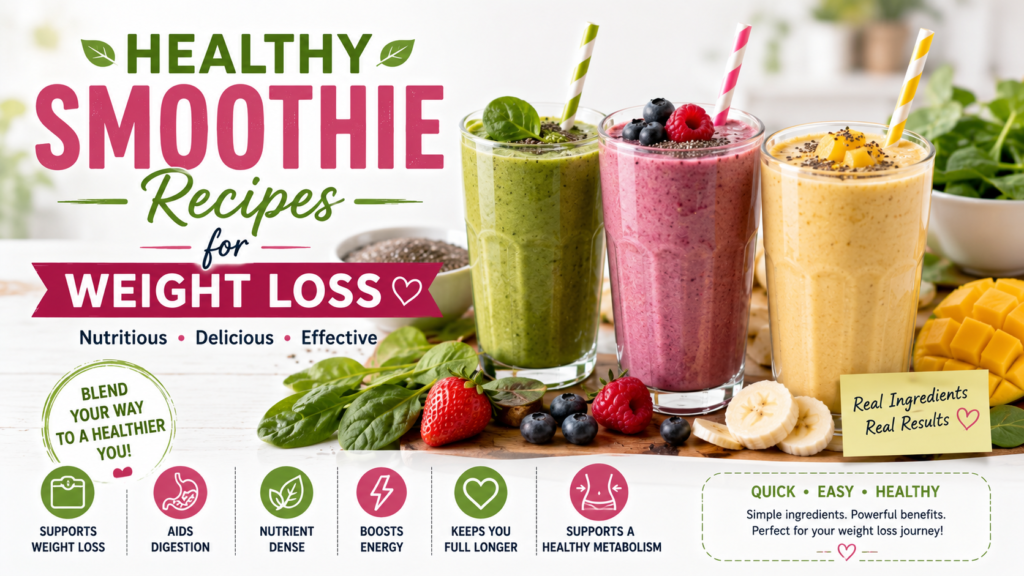
Quick Answer: Healthy smoothie recipes for weight loss work best when each smoothie stays under 300 calories and combines 15 to 25 grams of protein with fiber from fruit, vegetables, oats, or seeds. Blend a protein base with one fruit, one vegetable, and a small healthy fat, and skip juice, honey, and sweetened yogurt.
Table of Contents
Healthy smoothie recipes for weight loss sound like the easiest breakfast in the world: throw fruit in a blender, press a button, and drink your way to a smaller waist. In real life, many smoothies do the opposite. A large smoothie made with juice, banana, peanut butter, honey, and sweetened yogurt can pass 600 calories without ever feeling like a meal, and leave you hungry again within an hour.
The difference between a smoothie that helps weight loss and one that quietly works against it comes down to structure. A good weight-loss smoothie is built like a meal: enough protein to keep you full, enough fiber to slow digestion, and a controlled number of calories. When those three things are in place, a smoothie can replace breakfast or a snack and genuinely support a calorie deficit of 300 to 500 calories a day, which is the pace linked to losing about half a pound to one pound a week.
This guide gives you a simple formula you can use with any ingredients you already have, then 10 complete recipes, each under 300 calories, with calories and protein listed per serving. Nothing here needs a special powder or an expensive blender. If you are new to weight loss in general, our guide on weight loss tips for women covers the basics that make every recipe in this article work better.
Why Smoothies Can Help or Hurt Weight Loss
Smoothies have one real advantage over many breakfasts: they let you eat a large volume of food for relatively few calories. A blender full of spinach, berries, Greek yogurt, and ice looks generous and feels filling, yet it can contain fewer calories than a single pastry. That volume matters, because feeling full is what keeps a calorie deficit comfortable instead of miserable.
Research on satiety consistently points in the same direction. Protein is the most filling nutrient, fiber slows digestion and stretches the stomach, and foods with high water content add bulk without adding many calories. A smoothie can deliver all three at once, which is why it can work so well as a weight-loss breakfast. The problem starts when the balance tips: too much fruit and sweetener, too little protein, and no fiber-rich base turns a meal into a sweet drink.
Blending also changes how fast you eat. A smoothie can disappear in two minutes, and your brain needs more time than that to register fullness. Drinking slowly, using a straw, or pairing your smoothie with something to chew, like a small handful of nuts or a boiled egg, helps the meal feel like a meal. It is a small habit, but it makes a noticeable difference to how long you stay full.
Another honest point: smoothies do not burn fat, and no single food does. They help weight loss only when they keep your total daily calories in a modest deficit. A 250-calorie smoothie that keeps you full until lunch is a genuine help. A 550-calorie smoothie that leaves you hungry at 10 a.m. is not, even if every ingredient in it is healthy. Calories still count, and this article keeps every recipe honest about them.
Healthy Smoothie Recipes for Weight Loss: The Protein and Fiber Formula
Every recipe in this article follows the same five-part formula. Learn the formula and you can build your own smoothies long after you have tried all ten recipes, using whatever is in your fridge.
- Protein base (15 to 25 grams): plain Greek yogurt, cottage cheese, milk, soy milk, or plain protein powder. This is the part that keeps you full.
- One fruit (about 1 cup): berries, half a banana, mango, peach, or apple. Fruit adds sweetness and fiber, and one cup is enough.
- One vegetable (a generous handful): spinach, kale, cucumber, or cauliflower. You will barely taste it, and it adds volume and fiber for very few calories.
- Fiber booster (1 tablespoon): oats, chia seeds, flaxseed, or psyllium husk. This slows digestion and stretches fullness by an hour or more.
- Small healthy fat (1 teaspoon to 1 tablespoon): peanut butter, almond butter, avocado, or seeds. A little fat improves flavor and helps absorb vitamins, but measure it, because fats are calorie-dense.
Use water, unsweetened milk, or ice as your liquid. Fruit juice adds 100 or more calories of sugar with almost no fiber, so it has no place in a weight-loss smoothie. Sweeten with fruit only. If a smoothie tastes too sharp, add half a banana or a few more berries rather than reaching for honey or maple syrup.
Smoothie nutrition at a glance
| Smoothie | Calories | Protein | Fiber |
|---|---|---|---|
| Berry Protein Smoothie | 240 kcal | 24 g | 7 g |
| Green Garden Smoothie | 210 kcal | 18 g | 8 g |
| Peanut Butter Banana Smoothie | 280 kcal | 20 g | 6 g |
| Tropical Mango Smoothie | 260 kcal | 16 g | 6 g |
| Chocolate Protein Smoothie | 250 kcal | 25 g | 7 g |
| Strawberry Oat Smoothie | 270 kcal | 18 g | 8 g |
| Avocado Spinach Smoothie | 280 kcal | 14 g | 9 g |
| Pumpkin Spice Smoothie | 230 kcal | 20 g | 7 g |
| Blueberry Almond Smoothie | 260 kcal | 17 g | 7 g |
| Cucumber Mint Cooler Smoothie | 190 kcal | 18 g | 5 g |
Calorie and protein figures are estimates based on standard serving sizes, and they will shift slightly with the exact brands and portions you use. The important pattern is consistent: every smoothie stays under 300 calories while delivering real protein and fiber.
10 Healthy Smoothie Recipes for Weight Loss Under 300 Calories
Each recipe makes one serving and takes about five minutes. Blend the liquid and leafy ingredients first, then add the rest and blend until smooth. If you like a thicker smoothie, use frozen fruit and less liquid; if you prefer it thinner, add water a little at a time.
1. Berry Protein Smoothie (240 kcal, 24 g protein)
This is the simplest recipe in the list and the one to try first. Mixed berries are low in calories and high in fiber, and plain Greek yogurt supplies most of the protein. Blend 1 cup of mixed berries, 3/4 cup of plain Greek yogurt, 1/2 cup of water or unsweetened milk, 1 tablespoon of oats, and a handful of ice. The oats disappear into the texture and add staying power without changing the flavor. If fresh berries are expensive, frozen berries work just as well and are often cheaper, and they make the smoothie thick and cold without extra ice. This smoothie suits a busy morning because every ingredient keeps well in the fridge or freezer, and it pairs well with a boiled egg on days when you want a bigger breakfast.
2. Green Garden Smoothie (210 kcal, 18 g protein)
If the idea of a green smoothie puts you off, this one is the recipe that changes minds. The spinach is almost undetectable once blended with sweet fruit. Blend 2 big handfuls of baby spinach, 1 cup of frozen pineapple chunks, 1/2 cup of plain Greek yogurt, 1/2 cup of water, 1 tablespoon of chia seeds, and juice from half a lemon. The pineapple gives it a fresh, sweet flavor, the lemon keeps it bright, and the chia seeds add fiber and a small amount of healthy fat. Drink it within 20 minutes for the best texture, because chia seeds thicken the smoothie as they sit. At 210 calories with 8 grams of fiber, this is the lightest recipe in the collection and a good choice for a light breakfast or an afternoon snack. For more filling snack ideas that follow the same protein and fiber logic, see our guide to healthy snacks for weight loss.
3. Peanut Butter Banana Smoothie (280 kcal, 20 g protein)
Peanut butter smoothies have a bad reputation in weight-loss circles, and it is usually deserved, because most versions use three or four tablespoons of peanut butter. This version uses one tablespoon, which gives you the flavor without the calorie overload. Blend half a banana, 1 tablespoon of natural peanut butter, 3/4 cup of plain Greek yogurt, 1/2 cup of unsweetened milk, 1 tablespoon of oats, and ice. The result tastes like a treat and delivers 20 grams of protein. The key is measuring the peanut butter with a tablespoon rather than pouring from the jar, because one extra spoonful adds about 90 calories. Use a frozen banana if you want a milkshake texture, and skip any sweetener, because the banana is sweet enough on its own.
4. Tropical Mango Smoothie (260 kcal, 16 g protein)
Mango makes a smoothie feel like a holiday, and this version keeps it sensible by pairing the fruit with cucumber and yogurt instead of juice and coconut cream. Blend 1 cup of frozen mango chunks, 1/2 cup of plain Greek yogurt, 1/2 cucumber, peeled and chopped, 1/2 cup of water, 1 tablespoon of flaxseed, and a squeeze of lime. The cucumber adds freshness and volume for almost no calories, and the flaxseed adds fiber and healthy fats. This smoothie works well as a post-walk drink on warm days, when something cold and fruity feels more appealing than a hot breakfast. If you are building a protein-first morning routine, it also pairs naturally with the ideas in our high protein breakfast guide.
5. Chocolate Protein Smoothie (250 kcal, 25 g protein)
This recipe is for the mornings when you want chocolate and you want to stay on plan at the same time. Blend 1 tablespoon of unsweetened cocoa powder, 3/4 cup of plain Greek yogurt, 1/2 cup of unsweetened milk, half a banana, 1 tablespoon of oats, and ice. The cocoa gives a rich chocolate flavor for about 10 calories, and the yogurt and milk together deliver 25 grams of protein, the highest in this collection. A pinch of cinnamon adds warmth and makes the chocolate taste sweeter without any sugar. Avoid chocolate-flavored syrups and sweetened protein powders here, because they can add 50 to 100 calories of sugar and turn a sensible breakfast into a dessert. If you use a protein powder, choose a plain or unsweetened one and count its calories honestly.
6. Strawberry Oat Smoothie (270 kcal, 18 g protein)
Oats make a smoothie feel like a real breakfast rather than a drink, and strawberries keep it light and sweet. Blend 1 cup of strawberries, 1/4 cup of rolled oats, 3/4 cup of plain Greek yogurt, 1/2 cup of unsweetened milk, and 1 teaspoon of vanilla extract. Let the oats soak in the milk for five minutes before blending if you want a smoother texture, or blend them dry if you like a little more body. The oats contribute slow-digesting carbohydrates and fiber, which is why this smoothie tends to keep people full for three to four hours. It is a good choice for mornings when lunch will be late, and it travels well in a sealed bottle for the commute.
7. Avocado Spinach Smoothie (280 kcal, 14 g protein)
Avocado gives this smoothie a creamy texture that no other ingredient can match, and the trick is using a quarter of an avocado rather than a whole one. Blend 1/4 avocado, 2 handfuls of baby spinach, 1/2 cup of plain Greek yogurt, 1 cup of frozen mixed berries, 1/2 cup of water, and 1 tablespoon of chia seeds. The berries hide the green color and flavor of the spinach, the avocado supplies satisfying healthy fats, and the result is thick, creamy, and filling. At 9 grams of fiber, this is the highest-fiber smoothie in the collection, which makes it a strong choice if staying full is your biggest challenge. Because avocado is calorie-dense, measure the portion rather than guessing, and save the rest of the avocado for a salad later in the day.
8. Pumpkin Spice Smoothie (230 kcal, 20 g protein)
Pumpkin puree is one of the most underused smoothie ingredients. It is low in calories, high in fiber, and rich in vitamin A, and with cinnamon and nutmeg it tastes like autumn in a glass. Blend 1/2 cup of plain pumpkin puree, 3/4 cup of plain Greek yogurt, 1/2 cup of unsweetened milk, 1 tablespoon of oats, 1/2 teaspoon of cinnamon, a pinch of nutmeg, and ice. Make sure you buy plain pumpkin puree, not pumpkin pie filling, because the pie filling is sweetened and can contain as much sugar as a dessert. This smoothie works in any season, not just autumn, and it is a useful option when you are tired of berry flavors. Canned pumpkin keeps for months in the cupboard, which makes this one of the most convenient recipes here.
9. Blueberry Almond Smoothie (260 kcal, 17 g protein)
Blueberries are small, sweet, and packed with fiber and plant compounds, and almond butter gives this smoothie a gentle nutty flavor. Blend 1 cup of blueberries, 1 tablespoon of almond butter, 3/4 cup of plain Greek yogurt, 1/2 cup of unsweetened milk, 1 tablespoon of flaxseed, and ice. Almond butter costs more than peanut butter, so if budget matters, peanut butter is a fine swap at a similar calorie count. The flaxseed adds fiber and healthy fats, and the blueberries give the smoothie a deep purple color that makes it feel like more of a treat than it is. Frozen wild blueberries are a good budget option and blend into a thicker texture than fresh ones.
10. Cucumber Mint Cooler Smoothie (190 kcal, 18 g protein)
This is the lightest smoothie in the collection and the most refreshing. Blend 1 whole cucumber, peeled and chopped, a small handful of fresh mint leaves, 3/4 cup of plain Greek yogurt, 1/2 cup of water, juice from half a lime, 1 tablespoon of chia seeds, and ice. The cucumber and mint make it taste like a spa drink, while the yogurt keeps the protein at 18 grams, so it still counts as a meal rather than flavored water. It is a good choice for hot days, for a light lunch, or for evenings when you want something small but still want protein. If you find it too sharp, add a few grapes or half a green apple rather than any sweetener.
Smoothie Mistakes That Quietly Add Calories
Most smoothie mistakes are small and easy to miss, which is exactly why they matter. A smoothie that should be 250 calories becomes 450 calories through three careless spoonfuls, and because it is a drink, you may not even notice. The most common mistake is using fruit juice as the liquid. One cup of orange juice adds about 110 calories and 20 grams of sugar with almost no fiber, and it does nothing for fullness. Water, unsweetened milk, or plain yogurt are better in every way.
The second mistake is unmeasured nut butter. Two tablespoons of peanut butter is a reasonable amount; four tablespoons is a meal on its own. Measure it with a tablespoon, every time, until you can judge the portion by eye. The third mistake is sweetener. Honey, maple syrup, and agave are often described as natural, but your body treats their sugar much like any other sugar, and one tablespoon adds about 60 calories. If a smoothie needs sweetness, add more fruit instead.
The fourth mistake is portion size. A smoothie made in a large blender jug can easily become two servings, and drinking the whole jug means drinking twice the calories you planned. Blend one serving at a time, or pour half into a bottle for tomorrow. The fifth mistake is treating a smoothie as a drink alongside breakfast rather than as breakfast itself. A smoothie plus toast plus eggs is a large meal, not a light one. If your smoothie has protein, fiber, and 200 to 300 calories, it is the meal.
Best Ingredients vs. Ingredients to Limit
- Best protein bases: plain Greek yogurt, cottage cheese, milk, soy milk, plain protein powder
- Best fruits: berries, half a banana, mango, peach, apple, pineapple
- Best vegetables: spinach, kale, cucumber, cauliflower, carrots
- Best fiber boosters: oats, chia seeds, flaxseed, pumpkin puree
- Best small fats: 1 tablespoon of peanut butter, almond butter, avocado, or seeds
- Best flavor: cinnamon, vanilla, cocoa powder, lemon, lime, mint, ginger
- Limit fruit juice: adds sugar and calories with almost no fiber
- Limit honey, maple syrup, and agave: about 60 calories per tablespoon of added sugar
- Limit sweetened yogurt and flavored milk: often contains as much sugar as a dessert
- Limit large amounts of nut butter: measure one tablespoon, not a free pour
- Limit dried fruit and sweetened coconut: concentrated sugar in a small portion
- Limit oversized portions: one serving is one glass, not a full blender jug
Practical Tips: Shopping, Prep, and Storage
Smoothies only become a habit when they are easy. The simplest system is to keep a small set of staples always in stock: frozen berries, frozen mango, bananas, baby spinach, plain Greek yogurt, milk, oats, chia seeds, and one nut butter. With those nine items, you can make most of the recipes in this article without a special shopping trip. Buy frozen fruit in large bags, because it is usually cheaper than fresh, lasts for months, and makes smoothies thick without ice.
Prep smoothie bags on Sunday if mornings are rushed. For each recipe, put the fruit, vegetables, oats, and seeds in a freezer bag, label it, and freeze it. In the morning, empty one bag into the blender, add yogurt and liquid, and blend. The whole process takes under two minutes. Smoothies are best drunk fresh, but a sealed bottle will keep in the fridge for up to 24 hours; shake it well before drinking, because the fiber settles. Avoid keeping a smoothie with banana for more than a day, because it browns and the flavor changes.
Clean your blender straight after use. Rinse it, add a drop of dish soap and warm water, blend for ten seconds, and rinse again. A blender left unwashed for hours is the fastest way to stop making smoothies. If you are buying a blender for smoothies, a basic model that crushes ice is enough; you do not need the most expensive machine to make any recipe here.
Frequently Asked Questions
Can I replace breakfast with a smoothie for weight loss?
Yes, if the smoothie is built like a meal, with 15 to 25 grams of protein, fiber, and 200 to 300 calories. A smoothie made only from fruit and juice is not a meal and will leave you hungry. Use the formula in this article, and add a boiled egg or a small handful of nuts on days when you need more staying power.
Are smoothies better than juice for weight loss?
Yes. Smoothies keep the fiber from the whole fruit and vegetables, while juice removes most of the fiber and concentrates the sugar. A smoothie also lets you add protein, which juice cannot do. For weight loss, a smoothie built with the protein and fiber formula is the better choice every time.
Can I drink a smoothie every day?
Yes, a daily smoothie is fine as long as the rest of your diet includes a variety of foods. Rotate the recipes rather than drinking the same one every day, so you get a wider range of nutrients. Chewing still matters, so make sure your other meals include solid food and plenty of vegetables.
Should I add protein powder to my smoothie?
You do not need protein powder if you use Greek yogurt, cottage cheese, or milk, which already supply 15 to 25 grams of protein. Protein powder is useful if you avoid dairy or want a higher-protein smoothie, but choose a plain or unsweetened powder and count its calories. Sweetened powders can add a lot of sugar.
Why is my smoothie not keeping me full?
It usually needs more protein or more fiber. Add Greek yogurt, a tablespoon of oats, or a tablespoon of chia seeds, and check that you are not using juice as the liquid. Drinking slowly also helps. If you still feel hungry, your smoothie may simply be too small, and a 300-calorie smoothie with an egg is a better fit than a 150-calorie smoothie alone.
Can I make smoothies ahead for the week?
Freezer bags of dry ingredients keep for weeks and are the best make-ahead method. Blended smoothies keep in the fridge for up to 24 hours in a sealed bottle. Beyond that, the texture and flavor decline, especially with banana or avocado. Blend fresh when you can, and use the freezer-bag method to make that easy.
Final Verdict
Healthy smoothie recipes for weight loss work when they follow a simple rule: under 300 calories, 15 to 25 grams of protein, and real fiber from fruit, vegetables, oats, or seeds. Start with the Berry Protein Smoothie or the Green Garden Smoothie, measure your nut butter, skip the juice and the sweetener, and drink slowly. A smoothie is not a shortcut, but built the right way, it is one of the easiest breakfasts to keep doing for months, and that consistency is what turns a small daily calorie deficit into steady weight loss. For more practical, research-based weight loss guides, visit the HealthSpots homepage.
Medical Disclaimer
This article is for general information only and is not medical advice. It does not replace guidance from your doctor or a registered dietitian. If you have diabetes, kidney disease, thyroid disease, or any other medical condition, or if you are pregnant or breastfeeding, talk to your healthcare provider before changing your diet. Do not follow a diet below 1,200 calories a day without medical supervision.
Written by Hassan Shamshad. Last reviewed 24 November 2026.
Sources
- Harvard T.H. Chan School of Public Health — The Nutrition Source: Protein and fiber guidance
- Centers for Disease Control and Prevention — Healthy weight, nutrition, and physical activity
- National Institutes of Health — Dietary fiber and satiety research