
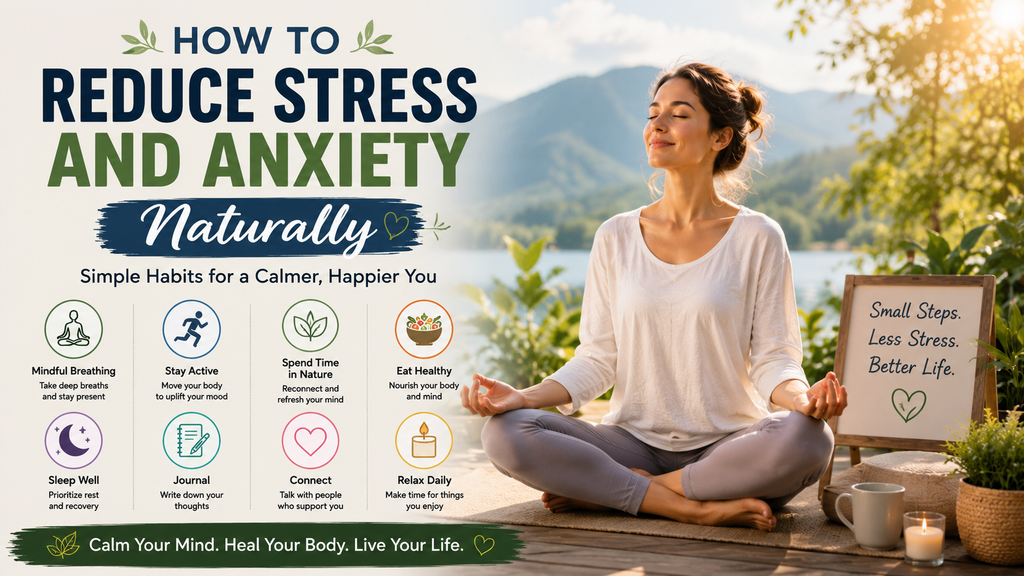
Quick Answer: To reduce stress and anxiety naturally, use slow breathing, daily walking, regular sleep, and short breaks from screens and news. A simple daily toolkit — breathing, movement, rest, limits on caffeine, and time with people you trust — lowers stress and calms a racing mind within days, and it works best when you use it every day.
Table of Contents
If you want to know how to reduce stress and anxiety naturally, you are not alone. Most women juggle work, family, money worries, and a phone that never stops buzzing — and the result is a body that stays switched on long after the stressful moment has passed. Your shoulders sit near your ears, your sleep gets lighter, and small problems start to feel much bigger than they are.
Here is the honest truth up front: there is no single trick that removes stress for good. Stress is part of life. What you can change is how your body responds to it, and how fast you recover. That is what this guide is about — a practical daily toolkit of ten natural tools that work together. None of them needs special equipment, a gym membership, or a product. Most of them take ten minutes or less.
This article explains what stress and anxiety do inside your body, then walks through the toolkit step by step: breathing, movement, sleep, food, and daily habits that lower your baseline stress over time. You will also find a simple table that matches each tool to the moment it helps most, and a short section on when stress needs professional support rather than self-help alone.
If you are starting from the beginning with your health, our guide on weight loss tips for women covers the basics — steady eating, daily walking, and better sleep — that make every tool in this article work better.
What Stress and Anxiety Actually Do to Your Body
Stress is your body’s alarm system. When your brain senses a threat — a deadline, an argument, a bill you cannot pay — it releases stress hormones, mainly cortisol and adrenaline. Your heart beats faster, your muscles tense, your breathing turns shallow, and your digestion slows down. This response is useful in a real emergency. It becomes a problem when the alarm stays on for weeks or months.
Anxiety is what happens when that alarm keeps firing even when there is no immediate danger. You worry about what might happen tomorrow, replay what happened yesterday, and feel on edge for no clear reason. The two often travel together: long-term stress raises anxiety, and anxiety keeps stress hormones high.
The physical effects are real, and they add up. Chronic stress is linked to poor sleep, headaches, tense muscles, upset stomach, higher blood pressure, weaker immunity, and weight gain around the waist. Cortisol encourages fat storage around the middle, which is one reason stress and belly fat are so closely connected. Stress also changes appetite — some people eat much more when stressed, while others forget to eat entirely.
The good news is that the stress response is flexible. Your body also has a built-in calm system, the parasympathetic nervous system, sometimes called the rest-and-digest system. Slow breathing, gentle movement, rest, and social connection all switch it on. Every tool in this article works by activating that calm system, or by removing the things that keep the alarm switched on.
Stress vs. anxiety: the difference
Stress usually has a clear trigger and fades when the trigger passes. Anxiety often continues after the trigger is gone, or appears without an obvious cause. Both feel similar in the body — racing heart, tight chest, restless mind — but anxiety tends to focus on the future and on “what if” thoughts. The natural tools in this article help with both, because they calm the same alarm system. If worry is constant, hard to control, and starts to interfere with work, sleep, or relationships, that is a sign to talk to a doctor or a mental health professional.
Why quick fixes do not work
Stress relief that only works for ten minutes is not useless — sometimes ten minutes is exactly what you need. But if your baseline stress stays high all day, a single deep breath will not fix it. Lasting change comes from small habits repeated daily: regular sleep, regular movement, and regular breaks. Think of it like brushing your teeth. One session does not protect you for a month, but two minutes twice a day keeps problems away for years. The toolkit below is built on that idea.
| Tool | Best moment to use it | Time needed |
|---|---|---|
| Slow breathing | Right now, when stress spikes | 2–5 minutes |
| Walking | After a tense meeting or meal | 10–20 minutes |
| Writing worries down | Evening, before bed | 5–10 minutes |
| Stretching | Morning or after sitting all day | 5–10 minutes |
| Limiting caffeine | All day, especially after noon | No extra time |
| Phone and news break | When scrolling makes you tense | 30–60 minutes |
| Talking to someone | When a problem loops in your head | 10–30 minutes |
| Regular sleep schedule | Every night | No extra time |
| Time outdoors | Midday, when energy dips | 10–20 minutes |
| One small pleasure daily | Evening, as a reward | 10–30 minutes |
How to Reduce Stress and Anxiety Naturally: The 10-Tool Daily Toolkit
There is no single best tool for everyone. The toolkit works because the tools cover different parts of the stress response: breathing calms the body in the moment, movement burns off stress hormones, sleep resets the system overnight, and limits on caffeine and screens remove fuel from the fire. Pick three tools to start with, use them every day for two weeks, and then add more.
Tool 1 — Slow breathing
When you are stressed, your breathing becomes fast and shallow, which tells your brain that danger is still present. Slow breathing reverses the signal. Breathe in through your nose for four counts, hold for four counts, and breathe out slowly through your mouth for six counts. Repeat for two to five minutes. The long exhale is the important part — it is what switches on the calm system. Use this tool anywhere: before a difficult call, in traffic, or when you wake up worrying at night.
Tool 2 — A daily walk
Walking is one of the most reliable natural stress relievers, and it is almost free. A brisk ten-minute walk lowers stress hormones, clears the mind, and improves mood. It works even better outdoors, where daylight and fresh air add to the effect. Aim for a walk after lunch and another after dinner if you can. If ten minutes feels like too much, start with five. The goal is a daily habit, not a perfect workout.
Tool 3 — Write worries down
A racing mind at night is often a mind that has not had a chance to process the day. Spend five minutes each evening writing down whatever is on your mind — tasks, worries, things you cannot control. You do not need neat sentences. Getting thoughts onto paper tells your brain it does not have to keep holding them. If a worry has a next step, write that too. If it has no next step, write “no action needed today” and let it wait until tomorrow.
Tool 4 — Stretch and release tension
Stress lives in the body as much as in the mind. Your jaw clenches, your shoulders rise, and your neck stiffens without you noticing. A short daily stretch breaks that pattern. Roll your shoulders, stretch your neck slowly from side to side, open your chest, and unclench your jaw. Do it once in the morning and once in the evening. You can also try progressive muscle relaxation: tense each muscle group for five seconds, then release it, working from your feet up to your face.
Tool 5 — Limit caffeine
Caffeine and anxiety feel very similar: racing heart, jittery hands, restless mind. For many people, too much coffee or energy drinks makes anxiety noticeably worse. You do not have to quit completely. Try keeping caffeine to one or two cups in the morning and switching to water or herbal tea after noon. If you feel calmer within a week, caffeine was part of the problem. Sugary drinks and heavy late-night meals can also disturb sleep and raise next-day stress.
Tool 6 — Take breaks from your phone and the news
Constant bad news and social media comparison keep the stress alarm switched on. Try a simple rule: no news or social media for the first hour after waking and the last hour before bed. If that feels hard, start with thirty minutes. Turn off notifications that are not from real people. You will still know what is happening in the world — you will just stop hearing about it every ten minutes.
Tool 7 — Talk to someone you trust
Talking about a worry out loud makes it smaller. A problem that loops endlessly in your head often sounds manageable once you say it to a friend, a family member, or a support group. You do not need advice — sometimes you just need to be heard. If you feel isolated, even a short daily call or message helps. Human connection is one of the strongest natural buffers against stress, and it is free.
Tool 8 — Keep a regular sleep schedule
Sleep and stress feed each other in both directions: stress ruins sleep, and poor sleep makes the next day far more stressful. Going to bed and waking up at the same time every day — including weekends — is the single most powerful sleep habit. Your body clock learns the pattern within a week or two, and falling asleep becomes easier. Our guide on how to sleep better naturally goes through the full sleep routine step by step.
Tool 9 — Spend time outdoors
Daylight is a natural mood and sleep regulator. Even ten to twenty minutes outside in the morning helps set your body clock, which improves both sleep and daytime energy. If you work indoors all day, eat lunch outside when you can, or take a short walk in the fresh air. Nature itself has a calming effect — trees, parks, and open sky lower stress more than the same walk indoors.
Tool 10 — One small pleasure every day
When life is stressful, pleasure is usually the first thing people cut. That is a mistake. A small enjoyable thing each day — a warm bath, a chapter of a book, music you love, time in the garden — reminds your nervous system that life is not only pressure. It does not have to be big or expensive. It has to be yours, and it has to happen most days.
Breathing Techniques That Calm You in Minutes
Breathing is the fastest tool in the kit because you can use it anywhere, and it works within minutes. The key principle is simple: a slow exhale calms you down. Most calming techniques are just different ways of making the exhale longer than the inhale.
Box breathing is a good starting point. Breathe in for four counts, hold for four, breathe out for four, and hold empty for four. Repeat four times. It is used by athletes and soldiers before stressful moments because it is easy to remember under pressure.
The 4-7-8 technique is better for sleep. Breathe in for four counts, hold for seven, and breathe out slowly for eight. The long exhale and the hold make most people feel drowsy within a few rounds, which is why it works well at bedtime. Do not force the counts — if seven and eight feel too long, use three, five, and six instead. The ratio matters more than the exact numbers.
Belly breathing, also called diaphragmatic breathing, trains you to breathe deeply instead of shallowly. Place one hand on your chest and one on your belly. Breathe in slowly through your nose and let your belly rise while your chest stays fairly still. Breathe out slowly through your mouth. Practise for five minutes a day when you are calm, so the skill is ready when you need it under stress.
A common mistake is breathing too fast during these exercises. If you feel light-headed, slow down and breathe normally for a minute. Breathing exercises should feel comfortable, never strained. If you have a breathing condition such as asthma, use gentle techniques and talk to your doctor if anything feels wrong.
Movement: The Fastest Natural Stress Reliever
Exercise is one of the most studied natural treatments for stress and anxiety, and the evidence is strong. Movement lowers cortisol, releases endorphins, improves sleep, and gives your mind a break from looping thoughts. You do not need intense exercise — moderate movement works just as well for stress, and it is easier to keep doing.
Walking is the easiest starting point, and it counts. A brisk twenty-minute walk after a stressful day can change your whole evening. If you want more, add two or three strength sessions a week — bodyweight squats, push-ups, and rows at home are enough. Strength training also protects muscle and supports healthy weight, which is why our guide on how to lose belly fat naturally for women recommends it as part of a balanced plan.
Yoga and gentle stretching combine movement with slow breathing, which makes them especially good for anxiety. Even ten minutes of stretching in the morning can set a calmer tone for the day. Dancing, gardening, swimming, and cycling all work too — the best exercise for stress is the one you will actually do tomorrow.
The main rule is consistency over intensity. Three short walks a week will help you more than one exhausting workout that leaves you too sore to move for days. Start small, do it daily, and build up slowly. If you currently do almost no exercise, begin with ten minutes a day and add five minutes each week.
Sleep and Stress: Breaking the Cycle
Stress and sleep are locked in a loop. A stressful day makes it hard to fall asleep. A bad night makes the next day feel far more stressful than it is. Breaking the loop starts with protecting your sleep, even when the day was hard.
Keep the same bedtime and wake time every day, including weekends. Your body clock is the strongest sleep signal you have, and a regular schedule makes falling asleep easier within one to two weeks. Aim for seven to nine hours of sleep a night — most adults need that much, even if they feel they can survive on less.
Create a wind-down routine for the last thirty to sixty minutes before bed. Dim the lights, put the phone away, and do something calm: a warm shower, light reading, gentle stretching, or writing worries down. Avoid heavy meals, bright screens, and stressful conversations in that final hour.
Your bedroom matters too. Keep it cool, dark, and quiet. A temperature around 18–20°C (65–68°F) works for most people. If noise is a problem, try earplugs or a white noise machine. Reserve the bed for sleep — if you work or scroll in bed, your brain stops associating it with rest.
If you lie awake for more than twenty minutes, get up and do something calm in dim light until you feel sleepy, then return to bed. Lying awake and worrying about not sleeping only makes it worse.
Food, Caffeine, and Alcohol: What Helps and What Hurts
What you eat will not cure anxiety, but it can make it better or worse. A steady blood sugar level keeps your mood steadier too. Long gaps between meals, very sugary snacks, and heavy late-night eating all make the next few hours harder.
| Helps calm and steady energy | Tends to make stress and anxiety worse |
|---|---|
| Regular meals with protein at each meal | Skipping meals, then overeating later |
| Vegetables, fruit, whole grains, beans | Large amounts of sugar and refined snacks |
| Water through the day | Too much caffeine, especially after noon |
| A small handful of nuts or seeds | Alcohol in the evening |
| Oats, yogurt, eggs, fish, lentils | Very heavy, fatty meals close to bedtime |
| Herbal tea in the evening | Energy drinks and sugary sodas |
Aim for 30–40 grams of protein at each meal, as in our weight loss guides. Protein keeps you full and keeps your energy steady, which means fewer crashes and fewer cravings. A safe calorie deficit of 300–500 calories a day, if you are trying to lose weight, is enough to lose about 0.5–1 lb a week without adding extra stress to your body. Never drop below 1,200 calories a day without medical supervision — very low calorie intake raises stress hormones and makes anxiety worse.
Alcohol deserves a special note. It can feel relaxing for an hour, but it disturbs sleep, raises next-day anxiety, and makes stress harder to handle. Many people notice that their anxiety is much worse the morning after drinking. If you drink, keep it moderate and avoid alcohol in the hours before bed.
Daily Habits That Lower Stress Over Time
Quick tools help in the moment, but the biggest change comes from daily habits that lower your baseline stress. These habits take a little more effort to set up, but they pay off for months.
Start your day with a calm first hour. Instead of checking your phone the moment you wake up, drink water, stretch, eat breakfast, and get some daylight. The first hour sets the tone for the day, and a rushed, screen-filled start raises stress before anything has even happened.
Set one clear priority for the day. Stress often comes from feeling pulled in ten directions at once. Each morning, choose the one thing that matters most and do it first. Everything else becomes easier once the biggest task is done. Saying no to extra commitments is part of this — a full calendar is a common source of chronic stress.
Take real breaks during the day. A five-minute break every hour — standing up, stretching, looking out of a window, drinking water — keeps stress from building up all day and exploding in the evening. If you work at a desk, set a reminder. Your body needs breaks the same way it needs food.
Build a small evening routine that signals the day is over. Change your clothes, go for a short walk, cook a simple meal, or spend time with family. A clear boundary between work and rest helps your mind switch off, which improves both sleep and next-day energy.
Keep a simple stress diary for two weeks. Each evening, write down what stressed you most, what helped, and how you slept. Patterns appear quickly: maybe meetings after lunch are the problem, or maybe late coffee is ruining your sleep. Once you see the pattern, you can fix the cause instead of fighting the symptom.
When Stress Becomes Anxiety: Signs to Watch For
Self-help tools are powerful, but they have limits. It is time to seek professional help if worry is constant and hard to control, if it interferes with work, school, or relationships, or if it has lasted for weeks without improving. Other warning signs include panic attacks, avoiding places or people because of fear, trouble sleeping most nights, and physical symptoms such as a racing heart or stomach problems that do not go away.
Seeking help is not a sign of weakness — it is a practical step, like seeing a doctor for a broken arm. A doctor or a mental health professional can check whether anxiety, depression, or another condition is involved, and can suggest talking therapy, lifestyle changes, or other support. If you ever feel you might harm yourself, or you feel unsafe, please contact a mental health crisis line in your country or go to your nearest emergency department right away.
You do not have to wait until things get severe. Many people get help early, learn a few extra skills, and feel much better within a few months. The natural tools in this article still help alongside professional support — they are not a replacement for it.
Frequently Asked Questions
What is the fastest way to reduce stress and anxiety naturally?
Slow breathing is the fastest tool — a long, slow exhale calms your body within two to five minutes. A short walk is the next best step, because movement lowers stress hormones and clears a looping mind. For lasting relief, combine breathing and walking with regular sleep and limits on caffeine.
Can walking really help with anxiety?
Yes. Regular walking lowers stress hormones, improves mood, and helps you sleep better, and better sleep lowers next-day anxiety. A brisk ten to twenty minute walk most days is enough to notice a difference within one to two weeks. Walking outdoors in daylight works even better than walking indoors.
How long does it take for natural stress relief to work?
Breathing and walking help within minutes. Sleep and caffeine changes usually show results within one to two weeks. Deeper habits, such as a regular sleep schedule and daily movement, take three to four weeks to feel like a real change. If you feel no improvement after a month of consistent habits, talk to a doctor.
Does caffeine make anxiety worse?
For many people, yes. Caffeine raises heart rate and can mimic the physical feelings of anxiety, such as a racing heart and restlessness. Try keeping caffeine to the morning only, and switch to water or herbal tea after noon. If your anxiety drops within a week, caffeine was part of the problem.
What should I do when I feel anxious at night?
Get out of bed if you are awake for more than twenty minutes, and do something calm in dim light, such as reading or slow breathing. Write down the worry on paper so your brain can let go of it. Avoid your phone, because bright screens and news make the mind more alert, not less.
Is stress really linked to weight gain?
Yes. Long-term stress raises cortisol, which encourages fat storage around the waist and increases cravings for sugary and fatty foods. Poor sleep makes it worse by raising hunger the next day. Managing stress is therefore a real part of healthy weight loss, not just a nice extra.
Final Verdict
Learning how to reduce stress and anxiety naturally is not about finding one magic technique. It is about building a small daily toolkit — slow breathing, walking, regular sleep, limits on caffeine and screens, time outdoors, and time with people you trust — and using it every day, not only on bad days. Start with three tools, practise them for two weeks, and add more when the first three feel easy.
Be patient with yourself. Stress built up over months will not disappear in a weekend. But most people notice real change within two to four weeks of steady habits: calmer mornings, easier sleep, and problems that feel smaller than they did before. And if worry stays constant, interferes with your daily life, or lasts for weeks, please talk to a doctor or a mental health professional — asking for help is a strong and sensible step.
For more practical health guides from HealthSpots, visit HealthSpots and explore the Mental Health and Weight Loss sections.
Disclaimer
This article is for general information only and is not medical advice. It does not replace professional diagnosis or treatment. If you have a health condition, take regular treatment, or feel your symptoms are severe or getting worse, please talk to a qualified healthcare professional before changing your routine. If you are in crisis or feel you may harm yourself, contact a mental health crisis line in your country or seek emergency help immediately.
Written by Hassan Shamshad. Last reviewed: 24 November 2026.
Sources
- National Institute of Mental Health (NIMH) — Anxiety Disorders: nimh.nih.gov
- American Psychological Association — Stress effects on the body: apa.org
- Centers for Disease Control and Prevention (CDC) — Coping with Stress: cdc.gov
- National Health Service (NHS) — Breathing exercises for stress: nhs.uk