
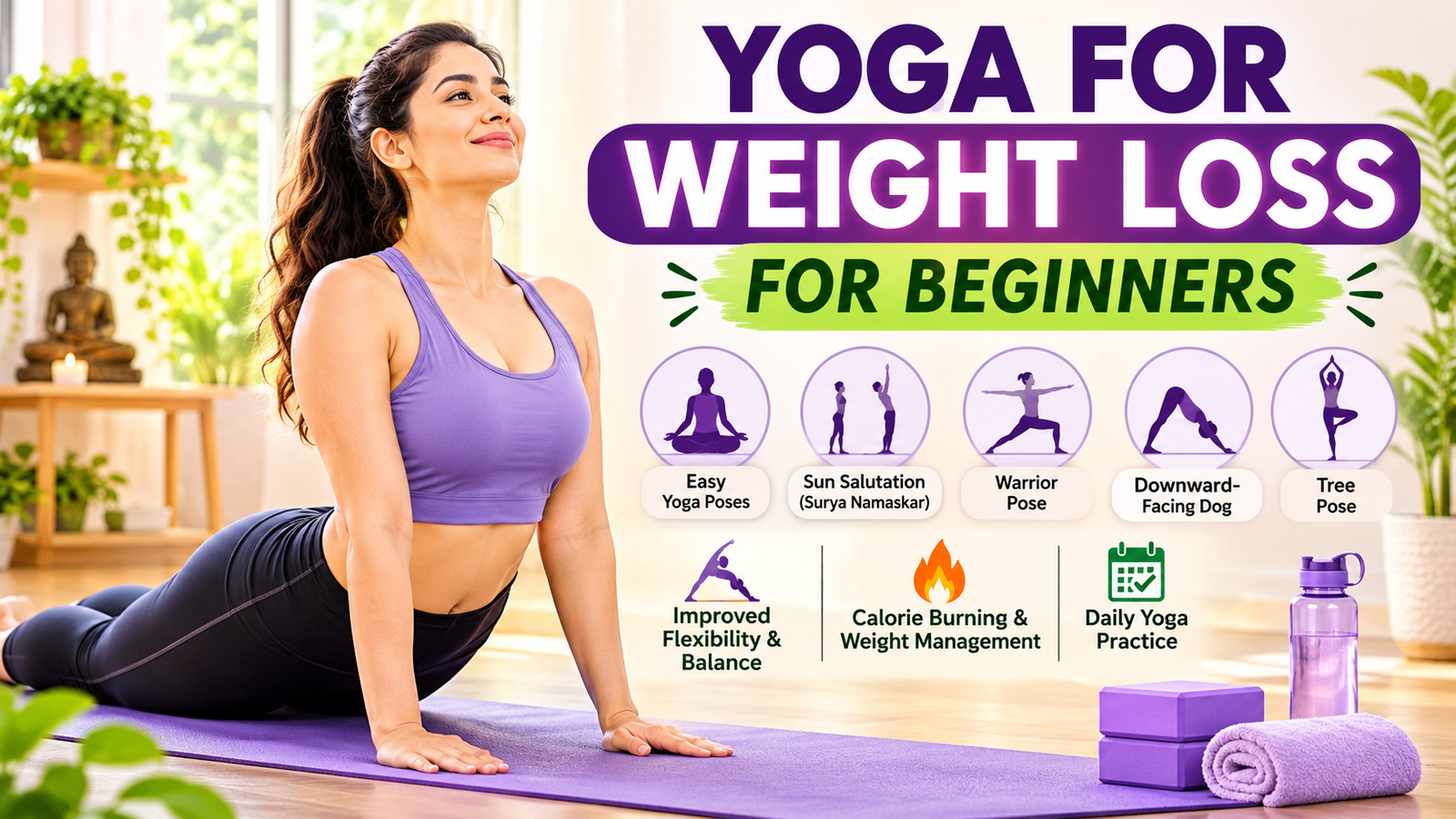
Quick Answer: Yoga for weight loss for beginners works best as gentle, regular movement combined with healthy eating: two or three 20 to 30 minute sessions a week of basic poses, breathing, and relaxation. Yoga burns fewer calories than brisk walking, but it lowers stress, improves sleep and flexibility, and helps you eat more mindfully, which supports steady weight loss.
Table of Contents
Yoga for weight loss for beginners is a gentle place to start moving more, and it is one of the few forms of exercise that helps your mind at the same time as your body. If you have ever felt that exercise means sweating in a gym or running until you are out of breath, yoga offers a different path: slow movements, deep breathing, and a quiet room where the only competition is your own balance. It is low impact, kind to the joints, and suitable for almost any age or fitness level, which is why so many women choose it as their first step back into regular movement.
At the same time, yoga is surrounded by exaggerated claims. Some sources present it as a fast way to burn fat, and others dismiss it as useless for weight loss because it burns so few calories. Both views are wrong. Yoga will not melt fat on its own, and it burns fewer calories per hour than brisk walking or strength training. But it changes the conditions that make weight loss possible: it lowers stress, improves sleep, builds body awareness, and helps many women eat more mindfully and move more often. This guide explains honestly what yoga can and cannot do, gives you a simple 20-minute beginner routine you can do at home, and shows you how to combine it with walking and strength work for real, steady weight loss. If you are building a wider plan, our guide on weight loss tips for women explains where yoga fits alongside food, walking, sleep, and stress.
Can Yoga Really Help You Lose Weight?
The honest answer is yes, but indirectly. Weight loss comes from a calorie deficit, using more energy than you take in, and yoga on its own creates only a small deficit. A gentle yoga session burns roughly 120 to 180 calories an hour for most women, compared with about 200 to 300 calories for an hour of brisk walking and more for strength training. If you did yoga alone and changed nothing about your food, you would lose weight very slowly, if at all. That is the fact the sceptics point to, and it is true as far as it goes.
What the sceptics miss is everything else yoga changes. Research on yoga and weight has found that regular yoga practice is linked to less weight gain over time, better body awareness, and healthier eating patterns, even when the calories burned in class are modest. The mechanism is not mysterious. Yoga lowers the stress hormone cortisol, which is linked to fat storage around the belly and to cravings for sweet and salty food. It improves sleep, and better sleep means steadier hunger hormones and fewer late-night snacks. It builds mindfulness, the habit of noticing what your body actually feels, which makes it easier to notice fullness and stop eating before you are stuffed. And it gets people moving who would otherwise not move at all, which matters enormously, because the best exercise for weight loss is the one you will actually do for months.
Yoga also builds strength and flexibility in a way that supports other exercise. Holding poses such as chair pose, warrior, and plank builds endurance in the legs, core, and arms. Better flexibility and balance make walking more comfortable and strength training safer. Many women find that a few weeks of yoga makes them more confident about trying a strength routine, because they have already learned to breathe steadily, hold a position, and listen to their body. In that sense, yoga is often the gateway to a more active life, not the whole of it, and that is a valuable role.
What Yoga Can and Cannot Do for Weight Loss
| What yoga can do | What yoga cannot do |
|---|---|
| Lower stress and cortisol, reducing stress eating and belly fat storage | Burn large numbers of calories; gentle yoga burns 120 to 180 calories an hour |
| Improve sleep quality, which steadies hunger hormones | Replace strength training for protecting muscle during weight loss |
| Build body awareness and mindful eating habits | Target fat loss from one body part, such as the belly |
| Improve flexibility, balance, and posture | Produce fast weight loss on its own without food changes |
| Build gentle strength in legs, core, and arms | Undo a large calorie surplus from food |
| Get inactive women moving regularly and safely | Replace medical care for pain, injury, or health conditions |
Keeping this table in mind protects you from two common disappointments. The first is expecting yoga alone to produce fast weight loss and then quitting when the scale barely moves in a month. The second is dismissing yoga entirely because it does not burn many calories, and missing out on the stress, sleep, and habit benefits that make all the other parts of weight loss easier. The right way to use yoga is as one part of a plan: yoga for stress, sleep, and flexibility, plus brisk walking for daily calorie burn, plus two or three strength sessions a week to protect muscle, plus a modest calorie deficit of 300 to 500 calories a day. Together, those parts produce steady loss of about 0.5 to 1 lb a week.
Different styles of yoga burn different amounts of energy. Gentle styles such as hatha and restorative yoga are slow, relaxing, and best for stress and sleep. Vinyasa and power yoga link poses in a flowing sequence and raise the heart rate more, burning roughly 250 to 400 calories an hour, closer to brisk walking. Hot yoga, done in a heated room, makes you sweat heavily, but most of the weight lost in a session is water, not fat, and it is not suitable for everyone. As a beginner, start with gentle hatha or beginner vinyasa, and only try faster styles once you are comfortable with the basic poses and your body has adapted.
Yoga for Weight Loss for Beginners: The 20-Minute Routine
This routine takes about 20 minutes and needs only a mat or a soft rug, comfortable clothes, and a quiet corner. Do it two or three times a week, ideally on days when you are not doing strength training, or as a gentle session in the evening. Move slowly, breathe deeply, and never force a pose. A gentle stretch is good; sharp pain is a signal to stop and ease off. Hold each pose for the time shown, breathe normally, and rest in child’s pose whenever you need a break.
| Order | Pose | Hold | What it works |
|---|---|---|---|
| 1 | Easy seated breathing | 2 minutes | Calm breathing, focus |
| 2 | Cat-cow stretch | 5 slow rounds | Spine mobility, gentle core |
| 3 | Downward facing dog | 30 seconds | Shoulders, hamstrings, calves |
| 4 | Mountain pose to chair pose | 30 seconds | Legs, glutes, balance |
| 5 | Warrior I (each side) | 30 seconds each | Legs, hips, core stability |
| 6 | Warrior II (each side) | 30 seconds each | Legs, hips, arms, focus |
| 7 | Tree pose (each side) | 20 seconds each | Balance, ankles, focus |
| 8 | Bridge pose | 30 seconds, twice | Glutes, back, hips |
| 9 | Seated forward fold | 1 minute | Hamstrings, lower back, calm |
| 10 | Supine twist (each side) | 30 seconds each | Spine, digestion, relaxation |
| 11 | Final relaxation (savasana) | 3 minutes | Rest, breathing, recovery |
If 20 minutes feels like a lot on your first day, do the first six poses only and add the rest over two weeks. There is no benefit in rushing through poses you do not understand, and a short session you enjoy is far more likely to be repeated than a long session that leaves you sore and confused. As the poses become familiar, you can hold them a little longer, add a second round of the standing poses, or try a beginner vinyasa class online. Keep your practice regular rather than intense: three gentle sessions a week for a month will change how you feel far more than one hard session.
The Beginner Poses, Explained Simply
Yoga poses have unfamiliar names, but the movements themselves are simple and natural. You do not need to be flexible to start; flexibility is something yoga builds, not something it requires. The notes below explain the key poses in plain language, with one form tip for each.
Cat-cow and downward facing dog: warm up the spine
Cat-cow is done on hands and knees: breathe in, drop your belly and lift your head, then breathe out, round your spine and tuck your chin. Move slowly with your breath for five rounds, and your spine will feel looser and warmer. Downward facing dog is an inverted V shape: from hands and knees, tuck your toes, lift your hips up and back, and press your heels gently toward the floor. Keep your knees slightly bent if your hamstrings are tight, which is normal for beginners, and let your head hang relaxed between your arms. Do not worry about touching your heels to the floor; very few beginners can, and it does not matter.
Chair pose and warrior poses: build leg strength
Chair pose is a standing squat with arms raised: feet together, bend your knees and push your hips back as if sitting in an invisible chair, and reach your arms up. Hold for 30 seconds and feel your thighs working; this is real strength training, done slowly. Warrior I is a strong lunge with arms raised: step one foot back, bend the front knee, keep the back leg straight, and reach up. Warrior II opens the arms wide to the sides in the same lunge, which works the legs and hips while training focus and balance. Keep your front knee pointing over your toes and your back foot firm on the floor. If balance is hard, stand near a wall or a chair and touch it lightly.
Tree pose and bridge pose: balance and the back body
Tree pose is a standing balance: shift your weight onto one foot, place the other foot on your ankle or calf, never on the knee, and bring your hands together at your chest. Pick one spot on the floor to look at, breathe steadily, and accept the wobble; wobbling is how balance improves. Bridge pose is done lying on your back with knees bent: press through your heels to lift your hips, squeeze your glutes, and hold. It strengthens the glutes and lower back and gently opens the hips, which is helpful for women who sit for long hours.
Breathing and Relaxation: The Quiet Half of Yoga
Half of yoga is not poses at all. It is breathing and relaxation, and for weight loss, this half may matter more than the poses. Slow, deep breathing activates the body’s rest-and-digest response, lowering heart rate and stress hormones. Five minutes of slow breathing a day can reduce the urge to eat when stressed, and many women find it easier to fall asleep after an evening yoga session. Try this simple pattern: breathe in through your nose for four counts, hold gently for two counts, and breathe out slowly through your nose for six counts. Repeat for two minutes, keeping your shoulders down and your jaw relaxed. If you feel dizzy, return to normal breathing.
Final relaxation, savasana, is the pose at the end of every practice: lie flat on your back, arms at your sides, palms up, and let your whole body soften for three minutes. It looks like doing nothing, and beginners often skip it, but it is when your nervous system settles and your muscles recover. Think of it as the cool-down that makes the session complete. Sleep is closely linked to this: poor sleep raises hunger hormones and cravings the next day, and regular yoga, especially in the evening, is one of the simplest ways to improve sleep without any product. Our guide on sleep and weight loss explains the connection in more detail, and our guide on stress and weight gain covers the stress side of the same story.
Your First 4 Weeks of Yoga
Progress in yoga is measured in comfort and consistency, not in dramatic poses. The plan below takes you from your first session to a steady habit in a month, and it combines yoga with walking so that weight loss keeps moving while yoga does its quieter work.
| Week | Yoga | Walking and other movement |
|---|---|---|
| Week 1 | Two 15-minute sessions, first six poses only, slow and gentle | Daily walking, aim for your current baseline plus 500 steps |
| Week 2 | Two 20-minute sessions, full routine, hold poses a little longer | Daily walking, add 1,000 steps to your baseline |
| Week 3 | Three 20-minute sessions, add a second round of standing poses | Daily walking toward 8,000 steps; one strength session |
| Week 4 | Three 20 to 30 minute sessions, try a beginner vinyasa video | Daily walking, 8,000 to 10,000 steps; two strength sessions |
After a month, most women notice better flexibility, easier balance, less stiffness in the morning, and calmer evenings. Weight change in the first month is usually modest, because yoga alone burns few calories, and that is normal. The real test is whether you are eating more mindfully, sleeping better, and moving more often than before. If those three things are improving, weight loss will follow as the other parts of your plan, walking, strength, and a modest calorie deficit of 300 to 500 calories a day, take effect. Never eat below 1,200 calories a day without medical supervision, and remember that steady loss of 0.5 to 1 lb a week is the healthy pace.
Beginner Mistakes to Avoid
- Do: start with gentle poses, breathe slowly, rest in child’s pose when needed, and practise two or three times a week.
- Do: use a mat or rug, wear comfortable clothes, and keep the room warm enough to relax.
- Do: combine yoga with brisk walking and strength training, and hold a small calorie deficit for real weight loss.
- Avoid: forcing your body into deep poses, bouncing into stretches, or comparing yourself with flexible people in videos.
- Avoid: holding your breath during poses, skipping the final relaxation, or practising on a full stomach.
- Avoid: expecting fast weight loss from yoga alone, or buying expensive gear before you know you enjoy it.
- Avoid: practising advanced poses such as headstands in your first months; they need strength and guidance first.
The most common beginner mistake is pushing too far, too fast. Yoga rewards patience: a pose held gently for 30 seconds builds more flexibility and strength than a pose forced for five seconds. The second mistake is practising once, feeling awkward, and deciding yoga is not for you. Everyone feels awkward at first, including the calm-looking people in videos, who have usually practised for years. The third mistake is choosing the wrong style: a fast, hot, advanced class will put most beginners off, while a gentle beginner class feels welcoming and doable. Start easy, stay regular, and let the practice grow with you.
Frequently Asked Questions
How often should a beginner do yoga for weight loss?
Two or three sessions a week of 20 to 30 minutes is a good start. Combine yoga with daily walking and two strength sessions a week, because yoga alone burns too few calories for fast weight loss, while the combination works well.
Which type of yoga is best for weight loss?
Vinyasa and power yoga burn more calories than gentle hatha, because they link poses in a flowing sequence. As a beginner, start with gentle hatha to learn the poses safely, then try vinyasa once you are comfortable.
Can yoga help with belly fat?
Yoga cannot target belly fat directly, and no exercise can. It helps indirectly by lowering stress, improving sleep, and encouraging mindful eating, which support overall fat loss, including belly fat, when combined with a calorie deficit.
Do I need to be flexible to start yoga?
No. Flexibility is the result of yoga, not a requirement for it. Beginners use bent knees, blocks, cushions, and chairs to make poses comfortable, and flexibility improves steadily over a few weeks of regular practice.
Is yoga safe for women over 50?
Yes, gentle yoga is one of the safest forms of exercise for women over 50, and it helps balance, flexibility, and bone health. Start slowly, avoid deep twists and inversions, and talk to your doctor first if you have osteoporosis or a recent injury.
Can I do yoga at home without a teacher?
Yes, a simple beginner routine at home is safe for most healthy women if you move slowly and never force a pose. A beginner video from a qualified teacher helps with form, and a live class, even occasionally, is useful for correcting mistakes.
Final Verdict
Yoga for weight loss for beginners is best understood as a foundation, not a shortcut. Two or three gentle 20-minute sessions a week will not burn as many calories as brisk walking, and they will not replace strength training, but they will lower your stress, improve your sleep, loosen stiff joints, and help you notice hunger and fullness more clearly. Those changes make every other part of weight loss easier, and they are the reason many women who start with yoga are still exercising a year later. Start this week with the routine above, walk daily, add strength sessions as you feel ready, and keep a small calorie deficit. For more practical health guides, visit HealthSpots and explore the Fitness and Exercise section.
Disclaimer: This article is for general information only and is not medical advice. Talk to your doctor before starting a new exercise programme, especially if you are pregnant, have a health condition, take regular medication, or have a recent injury. Stop exercising and seek medical advice if you feel chest pain, dizziness, severe breathlessness, or sharp joint pain. Never eat below 1,200 calories a day without medical supervision.
Sources
- Harvard Health Publishing — Yoga for weight loss: health.harvard.edu
- National Center for Complementary and Integrative Health — Yoga: What You Need To Know: nccih.nih.gov
- Mayo Clinic — Yoga: Fight stress and find serenity: mayoclinic.org
- World Health Organization — Physical activity fact sheet: who.int