
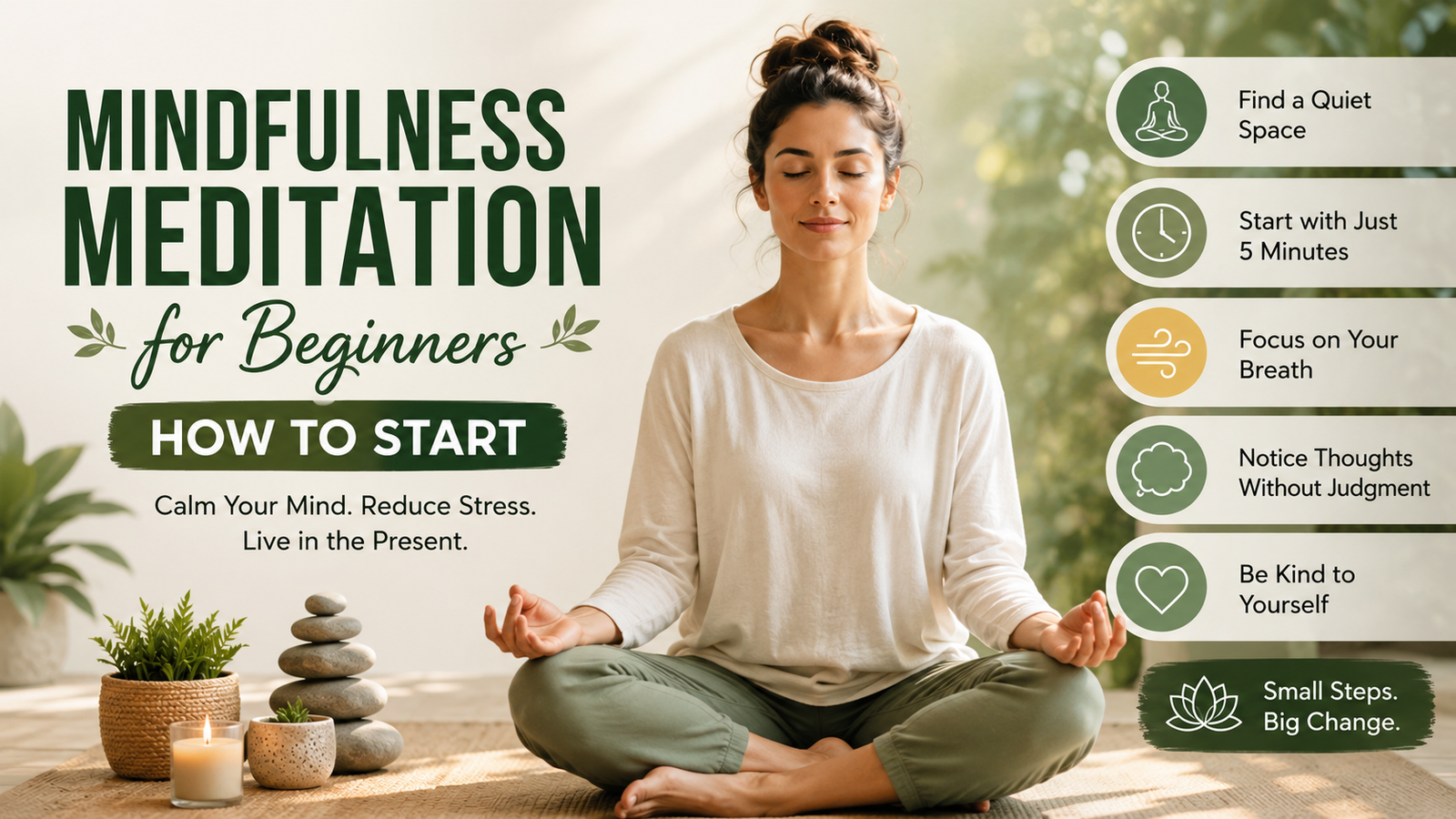
Quick Answer: Mindfulness meditation for beginners — how to start is simple: sit comfortably, close your eyes, and focus on your breathing for five minutes a day. When your mind wanders, notice it gently and return to the breath. No app, special cushion, or experience is needed, and most people feel calmer within two weeks of daily practice.
Table of Contents
Mindfulness meditation for beginners — how to start is a question many women ask, and then put off, because meditation looks complicated from the outside. People imagine sitting cross-legged for an hour, emptying the mind completely, and reaching some calm state they have never felt before. The reality is much simpler, and much kinder: five minutes a day, sitting in a chair, paying attention to your breath.
Mindfulness simply means paying attention to the present moment without judging it. You notice your breath, the sounds around you, and the thoughts passing through your mind — and you let them pass without chasing them. That is the whole practice. It is not about stopping thoughts, feeling peaceful all the time, or becoming a different person. It is about training your attention, the same way walking trains your legs.
This guide explains what mindfulness meditation actually is, then walks you through your first five-minute practice step by step, with no app and no special equipment. You will learn what to do when your mind wanders (it will — that is normal), how to build a daily habit that sticks, the mistakes most beginners make, and how meditation helps stress, sleep, and mood over time.
If stress is the reason you are here, our guide on how to reduce stress and anxiety naturally gives you a full daily toolkit, and meditation is one of its strongest tools. And if you are new to healthy living in general, our guide on weight loss tips for women explains how calm, sleep, and daily movement work together for your health.
What Mindfulness Meditation Actually Is
Mindfulness is attention, practised on purpose. When you eat mindfully, you notice the taste and texture of your food instead of scrolling through your phone. When you walk mindfully, you notice your feet, your breathing, and the air on your skin. Meditation is simply a set time when you practise this attention on purpose, usually by focusing on your breath.
The key idea is that your attention is like a muscle. Every time you notice your mind has wandered and you gently bring it back to the breath, that muscle gets a little stronger. Over weeks, this shows up in daily life: you notice stress earlier, you react less quickly to annoyance, and you can return to the present moment instead of replaying the past or worrying about the future.
Meditation is not a religion, and it does not require any belief. It is a practical mental skill, studied in hospitals and universities around the world. Research has found that regular mindfulness practice can lower stress, improve sleep, reduce symptoms of anxiety and low mood, and even lower blood pressure. The effects are modest and gradual — this is not a quick fix — but they are real, and they grow with practice.
It also helps to know what meditation is not. It is not emptying your mind — thoughts will come, and that is fine. It is not feeling calm every time — some sessions feel restless, and they still count. It is not escaping from life — it is training yourself to meet life with a clearer head. If you sit down expecting instant peace, you will be disappointed. If you sit down expecting to practise returning to the breath, you will succeed every time.
Mindfulness vs. other kinds of meditation
| Type | What you focus on | Good for beginners? |
|---|---|---|
| Mindfulness of breath | Your breathing, in and out | Yes — simplest to learn |
| Body scan | Sensations in each part of the body | Yes — good before sleep |
| Loving-kindness | Wishing well to yourself and others | Yes — good for low mood |
| Guided meditation | A voice leading you through it | Yes — helpful at first |
| Mantra meditation | Repeating a word or sound | Sometimes — needs a teacher |
| Silent sitting, no focus | Open awareness of everything | Better after some practice |
For this guide, we will use mindfulness of breath, because it is the simplest, needs nothing but a chair, and is the best studied. Once you are comfortable with it, you can try a body scan or a guided session.
Mindfulness Meditation for Beginners How to Start
Starting is the hardest part, so make it as easy as possible. You need three things: a quiet place, five minutes, and a chair. You do not need an app, a cushion, special clothes, or a silent room. A bedroom, a corner of the living room, or even a parked car will do, as long as you will not be interrupted for five minutes.
Pick a regular time. Most beginners do best in the morning, before the day gets busy, because the mind is fresher and the habit is easier to keep. After breakfast or before your morning walk both work well. Evening practice is fine too, but it is easier to fall asleep, so sit upright rather than lying down.
Set a gentle timer for five minutes. A phone timer works, but put the phone face down and on silent so notifications do not disturb you. Five minutes is the right length to start: long enough to practise, short enough that you will actually do it tomorrow. Do not start with twenty minutes — that is the most common reason beginners quit.
Sit comfortably and upright. You can sit in a chair with your feet on the floor, or on a cushion on the floor if that is comfortable. Keep your back straight but not stiff, your hands resting in your lap, and your shoulders relaxed. Close your eyes, or look softly at a spot on the floor a few feet in front of you. Either is fine — closing your eyes makes it easier to focus inward.
That is all the preparation you need. The practice itself is in the next section, and it is simpler than you think.
Your First 5-Minute Practice, Step by Step
Follow these steps slowly. Read them once, then put the guide aside and try them.
Step 1 — Settle and breathe naturally
Sit down, close your eyes, and take three slow breaths. Breathe in through your nose and out through your mouth. Do not force the breath — just let it slow down on its own. Feel your feet on the floor and your body in the chair. You are here, in this room, for five minutes. Nothing else needs your attention right now.
Step 2 — Choose your anchor
An anchor is the one thing you will keep returning to. The simplest anchor is your breath. Notice the feeling of air coming in through your nose, and the feeling of it going out. You can also notice your belly rising and falling. Pick one — the nose or the belly — and stay with it. If you like, you can count your breaths: one on the in-breath, two on the out-breath, up to ten, then start again at one.
Step 3 — Notice when your mind wanders
Within seconds, your mind will wander. You will think about lunch, a message you forgot to send, or a worry about tomorrow. This is not failure — this is the practice. The moment you notice you have wandered, you have succeeded, because noticing is the skill you are training.
Step 4 — Return gently to the breath
When you notice the wandering, do not scold yourself. Say silently, “thinking,” and return your attention to the breath. Be kind about it, the way you would guide a child. You may need to return ten times in five minutes. That is normal, and it means you practised ten times. A session with many returns is a good session.
Step 5 — Close gently
When your timer sounds, do not jump up. Open your eyes slowly, take one deep breath, and notice how your body feels. You may feel calmer, or you may feel exactly the same — both are fine. The benefit of meditation builds over weeks, not in a single session. Stand up slowly and carry on with your day.
| Minute | What to do |
|---|---|
| 0–1 | Settle, three slow breaths, feel your feet on the floor |
| 1–2 | Focus on the breath, count 1 to 10 if it helps |
| 2–4 | Keep returning to the breath each time the mind wanders |
| 4–5 | Stay with the breath, notice your body, prepare to finish |
| 5 | Open your eyes slowly, one deep breath, stand up gently |
What to Do When Your Mind Wanders
A wandering mind is not a problem to solve — it is the whole point of the practice. If your mind never wandered, there would be nothing to train. Every beginner believes they are uniquely bad at meditation because their mind wanders constantly. In reality, every mind wanders constantly, including the minds of people who have meditated for years. The difference is only that experienced meditators notice sooner and return more gently.
Here are the most common wandering patterns and what to do about each one.
Planning thoughts are the most common: “I need to buy milk, call the school, finish that report.” When they appear, you do not need to solve them now. Notice the thought, and remind yourself that you can plan after the session. If the thought is truly urgent, open your eyes, write it down on paper, and return to the practice. Writing it down frees your mind from holding it.
Worrying thoughts feel heavier: “What if the test results are bad? What if I lose my job?” These are harder to let go of, because they feel important. The trick is to notice the worry without following it into a full story. Say silently, “worrying,” and return to the breath. You are not ignoring the problem — you are choosing to think about it later, when you are rested and clear-headed. Our guide on how to stop overthinking at night uses the same skill at bedtime, and it works there too.
Sleepiness is also common, especially in the evening. If you keep nodding off, try meditating earlier in the day, sitting more upright, or opening your eyes and looking softly at the floor. A few slow breaths can help too. Do not fight sleepiness harshly — just adjust and continue.
Boredom and restlessness are normal in the first weeks. Your brain is used to constant stimulation, and five minutes of quiet can feel strange. The restlessness usually fades after a week or two of daily practice, once your brain learns that quiet is safe. If five minutes feels too long, start with three. A short session you actually do is worth far more than a long session you avoid.
Building a Daily Habit That Sticks
Meditation helps when it is daily, even if it is short. Five minutes every day beats thirty minutes once a week, because the benefit comes from training your attention regularly, the same way walking every day beats one long walk on Sunday. The challenge is not the practice — it is remembering to do it.
Attach meditation to something you already do every day. This is called habit stacking, and it works better than willpower. Meditate right after brushing your teeth, right after breakfast, or right before your morning walk. When the existing habit happens, the new one follows automatically. After two or three weeks, it starts to feel strange to skip it.
Keep the same time and place. Your brain loves routine, and a regular time and place remove the daily decision of when and where to meditate. Morning is best for most people, because the day has not yet filled up with demands. If mornings are chaotic, choose a quiet moment in the afternoon — after lunch, or during a break.
Track your streak simply. Put a tick on a calendar each day you meditate. Seeing a row of ticks is surprisingly motivating, and it makes the habit visible. If you miss a day, do not try to make it up with a double session — just meditate the next day. Missing one day is normal. Missing three days in a row is where habits break, so get back quickly and keep the streak going.
Increase the time slowly. After two weeks of five minutes a day, try seven minutes. After another two weeks, try ten. Most of the research on meditation uses ten to twenty minutes a day, but there is no rush to get there. A comfortable ten-minute daily practice that you keep for a year is far better than a twenty-minute practice you quit after a month.
A 4-week starter plan
| Week | Daily practice | What to notice |
|---|---|---|
| Week 1 | 5 minutes, breath focus | How often your mind wanders — it is a lot, and that is fine |
| Week 2 | 5 minutes, breath focus | Whether you notice wandering a little sooner |
| Week 3 | 7–10 minutes, breath or body scan | Whether you feel calmer after the session |
| Week 4 | 10 minutes, breath or body scan | Whether you catch stress earlier in the day |
Common Beginner Mistakes
Most beginners make the same few mistakes, and all of them are easy to fix. Knowing them in advance saves weeks of frustration.
The first mistake is trying to empty the mind. You cannot empty your mind, and trying only creates tension. Thoughts will come. The practice is noticing them and returning to the breath, not stopping them. If you sit down and think a hundred thoughts, and you notice and return a hundred times, you have had an excellent session.
The second mistake is judging the session. “That was a bad meditation” is a thought, not a fact. Some sessions feel calm, some feel restless, and some feel boring. All of them train your attention. The only bad session is the one you did not do. Judge your practice by whether you sat down, not by how it felt.
The third mistake is starting too long. Twenty minutes sounds impressive, but it is hard to keep up, and a hard practice is one you will avoid. Five minutes a day for a month builds a habit. Twenty minutes a day for three days builds nothing. Start small and grow slowly.
The fourth mistake is needing the perfect conditions. You do not need silence, a special room, or a particular time of day. A noisy house, a busy mind, and a chair are enough. If you wait for perfect conditions, you will never start. Meditate in the conditions you have.
The fifth mistake is using meditation to avoid real problems. Meditation helps you face problems with a clearer mind, but it does not solve them by itself. If you are struggling with debt, a difficult relationship, or a health problem, meditation can help you think clearly — and you still need to take practical steps, or talk to someone who can help.
How Meditation Helps Stress, Sleep, and Mood
Meditation helps stress first, because it trains the skill stress takes away: noticing what is happening right now instead of spiralling into the past or the future. When you practise returning to the breath, you are also practising returning from a stressful thought to the present moment. Over time, this makes you less reactive — you still feel stress, but you catch it earlier and recover faster.
Sleep improves next, for two reasons. First, meditation lowers the stress hormones that keep you alert at night. Second, the skill of noticing a thought and letting it pass is exactly the skill you need when your mind races in bed. Many people find that a short evening meditation, or even five minutes of slow breathing, helps them fall asleep faster. Our guide on how to sleep better at night naturally covers the full sleep routine, and meditation fits naturally into the wind-down hour.
Mood improves more slowly, usually over several weeks. Mindfulness helps you notice low moods earlier, before they deepen, and it reduces the habit of replaying negative thoughts over and over. It also builds a small daily moment of calm that belongs to you alone, which matters on hard days. Meditation is not a treatment for depression on its own, and it should never replace professional help — but as part of a healthy routine with movement, sleep, and connection, it supports a steadier mood.
The physical effects are worth knowing too. Regular meditation is linked to lower blood pressure, a calmer heart rate, and better immune function. These changes are modest, and they take weeks to appear, but they are part of why doctors increasingly recommend mindfulness as part of a healthy lifestyle. A safe calorie deficit of 300–500 calories a day and a pace of about 0.5–1 lb a week remain the right numbers for weight loss, and meditation supports that goal indirectly — by lowering stress eating, improving sleep, and making it easier to stick to healthy habits.
Frequently Asked Questions
How long should a beginner meditate each day?
Five minutes a day is the right start. It is long enough to practise and short enough to keep up. After two weeks, try seven to ten minutes. Most research uses ten to twenty minutes a day, but a short daily practice you keep is far better than a long practice you quit.
Do I need an app to meditate?
No. An app can be helpful at first, especially a guided session that talks you through the steps, but it is not required. All you need is a chair, a quiet few minutes, and your breath. Many people prefer meditating without an app once they know the steps, because the phone itself is a source of distraction.
What if I cannot stop thinking during meditation?
You are not supposed to stop thinking. Thoughts will come, and the practice is noticing them and returning to the breath. If your mind wanders a hundred times, you have practised returning a hundred times. That is a successful session, not a failed one.
Is mindfulness meditation a religion?
No. Mindfulness meditation is a practical mental skill, and it is used in hospitals, schools, and workplaces around the world without any religious content. Some meditation traditions come from religious backgrounds, but the breath-focused practice in this guide needs no belief of any kind.
When is the best time to meditate?
Morning works best for most beginners, because the mind is fresh and the habit is easier to keep before the day fills up. Evening practice is fine too, but it is easier to fall asleep, so sit upright. The best time is the time you will actually do every day — pick one and keep it.
How long does it take to feel the benefits?
Most people notice small changes within two weeks of daily practice — slightly calmer reactions, easier sleep, or catching stress a little earlier. Bigger changes in stress, sleep, and mood usually take four to eight weeks. The benefits build slowly, so keep going even if the first week feels like nothing is happening.
Final Verdict
If you searched for mindfulness meditation for beginners how to start, the short answer is simple: sit comfortably, focus on your breath for five minutes a day, and return gently to the breath every time your mind wanders. No app, special cushion, or experience is needed. Five minutes a day is enough to begin, and the habit matters far more than the length of any single session.
Start tomorrow morning. Set a timer for five minutes, sit in a chair, and breathe. Your mind will wander, and that is fine — noticing and returning is the practice. Within two weeks you will likely feel a little calmer, and within a month or two you may notice real changes in stress, sleep, and mood. If low mood or constant worry lasts for weeks despite good habits, please talk to a doctor or a mental health professional — meditation supports good mental health, but it is not a replacement for professional care.
For more practical health guides from HealthSpots, visit HealthSpots and explore the Mental Health and Weight Loss sections.
Disclaimer
This article is for general information only and is not medical advice. It does not replace professional diagnosis or treatment. If you have a health condition, take regular treatment, or feel your symptoms are severe or getting worse, please talk to a qualified healthcare professional before changing your routine. Meditation is a supportive practice, not a treatment for mental health conditions — if you are struggling, please seek professional help.