
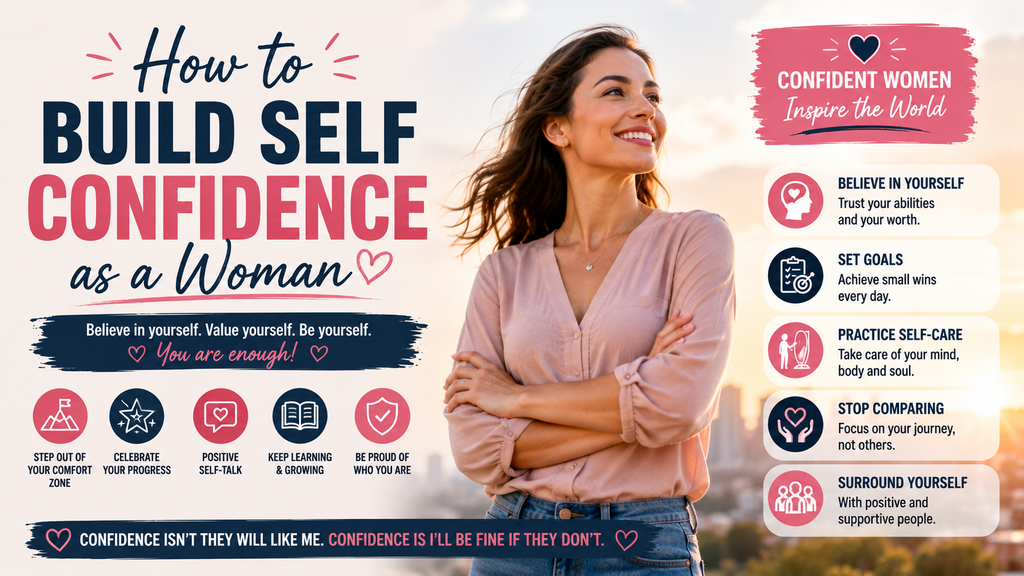
Quick Answer: How to build self confidence as a woman starts with action, not feeling: confidence grows when you keep small promises to yourself, speak kindly to yourself, stand and move like someone who belongs, and set clear boundaries. Practice one small brave step daily, track your wins, and build real skills — confidence follows evidence, not affirmations alone.
Table of Contents
Confidence is one of the most misunderstood qualities there is. Most women think confident people are born that way — that they woke up one morning feeling sure of themselves and never looked back. The truth is almost the opposite: confidence is built, slowly, from evidence. Every time you do something hard and survive it, your brain records a small piece of proof that you can handle difficult things. How to build self confidence as a woman is therefore a practical question, not a personality question, and the answer is a set of small daily habits that anyone can practice.
This guide explains what confidence really is, where low confidence comes from, and the specific steps that research shows actually work — from the way you talk to yourself to the way you stand, from keeping small promises to setting boundaries that protect your time and energy. None of it requires you to become a different person. It requires you to act, in small ways, like the person you already want to be. If stress and worry are part of what holds you back, our guide on How to Reduce Stress and Anxiety Naturally covers the daily tools that calm the mind first.
What Self-Confidence Actually Is
Self-confidence is not the belief that you will succeed at everything. It is the belief that you can handle whatever happens — that you will cope, learn, and recover even if things go wrong. Psychologists call this self-efficacy: the trust that you can influence the outcome of your life through your own actions. A confident woman is not fearless. She feels the same nerves as everyone else, but she has enough evidence from her own life to believe she can act anyway.
That distinction matters, because it changes the goal. You do not need to eliminate self-doubt before you act — you need to act while the doubt is still there, and let the result teach your brain something new. Waiting until you feel confident is a trap, because the feeling only arrives after the action. Every confident person you know built their confidence the same way: by doing the thing before they felt ready, surviving it, and doing it again.
Where Low Confidence Comes From
Low confidence rarely has a single cause. For many women, it starts early: girls are often praised for being good, quiet, and helpful, while boys are praised for being brave and bold. Over years, that pattern teaches many women to wait for permission, to apologize before speaking, and to treat their own needs as less important than everyone else’s. Social media adds a second layer — a daily feed of people who seem more beautiful, more successful, and more certain than you, usually showing only their best moments.
Past experiences matter too. A harsh comment from a teacher, a rejection, a relationship that made you small, a workplace that talked over you — each one leaves a mark, and the brain treats those marks as predictions about the future. The good news is that predictions can be updated. New experiences, repeated often enough, rewrite old ones. That is why the steps in this guide are built around action: your brain changes its mind about you when you give it new evidence.
The Confidence Loop: Action Before Feeling
Think of confidence as a loop: a small action leads to a small result, the result becomes evidence, the evidence raises your belief, and the higher belief makes the next action easier. The loop works in both directions — avoiding a challenge also creates evidence, and the evidence it creates is that the challenge was too much for you. Breaking the loop is simple in theory and hard in practice: do one small brave thing today, even while you feel unsure.
The key word is small. A brave step does not have to be a career change or a public speech. It can be speaking first in a meeting, saying no to a request you do not have time for, wearing the outfit you like instead of the one you think is safe, or asking a question you were afraid would sound silly. Small steps are repeatable, and repeatable steps are what build the loop. One big leap once a year changes nothing; one small step every day changes everything.
How to Build Self Confidence as a Woman: Seven Practical Steps
1. Keep small promises to yourself
Confidence is trust in yourself, and trust is built the same way in any relationship: by keeping promises. Most women keep promises to everyone except themselves. Start tiny: a ten-minute walk after lunch, one page of a book before bed, a glass of water before coffee. Each kept promise is a small piece of evidence that your word to yourself means something. After a month of small kept promises, your brain starts to believe you when you say you will do something bigger. Gentle movement is one of the easiest promises to keep, and our guide to Yoga for Weight Loss for Beginners offers simple home routines that take ten minutes and leave you feeling stronger.
2. Change the way you talk to yourself
Listen to the voice in your head for one day. Most women would never speak to a friend the way they speak to themselves. “I always mess this up.” “Everyone thinks I am stupid.” “I do not belong here.” These sentences feel like facts, but they are habits — and habits can be questioned. When a harsh thought appears, ask three questions: Is it true? Is it helpful? Would I say it to a friend? If the answer is no, replace it with something accurate and kind: “I made a mistake and I can fix it.” “I am learning, and learning is slow.” Self-talk does not need to be cheerful; it needs to be fair.
3. Stand and move like you belong
Your body and your mind talk to each other in both directions. Slumped shoulders, a quiet voice, and eyes on the floor do not just show low confidence — they feed it. Research on posture and mood finds that standing tall, breathing deeply, and moving at a steady pace can shift how you feel within minutes. Before a difficult moment, take two minutes: stand tall, shoulders back, chin level, breathe slowly, and walk into the room at your normal pace. It will feel strange at first. Do it anyway — the feeling follows the posture more often than the posture follows the feeling.
4. Set one clear boundary a week
Every time you say yes when you mean no, you teach yourself that your needs come last. Boundaries are not selfish; they are the proof that you respect yourself. Start with something small and concrete: “I cannot take that on this week.” “I need an hour before I can answer that.” “I am not available on Sunday evenings.” Say it once, plainly, without a long apology or explanation. The first boundary is the hardest. The fifth one is easy, and by then you will notice something important: the people who respect you will respect the boundary, and the ones who do not were never respecting you anyway.
5. Build one real skill
Confidence that lasts is built on competence. Pick one skill that matters to you — public speaking, cooking, a language, a work skill, driving, swimming — and practice it in small, regular sessions. Twenty minutes, three times a week, for two months will change how you see yourself in that area. The skill itself matters less than the proof: you set out to learn something, you practiced, and you improved. That proof transfers. A woman who taught herself to swim at thirty knows she can learn hard things, and that knowledge shows up everywhere else in her life.
6. Keep a wins list
Your brain has a built-in bias: it remembers failures and forgets successes. A wins list corrects that bias. Every evening, write down three things you did well that day — no matter how small. Handled a difficult call. Cooked a proper meal. Went for a walk when you wanted to stay in bed. Finished a task you had been avoiding. After a month, you will have ninety pieces of evidence that you are capable, and on a bad day you can open the list and read the truth your memory keeps hiding from you.
7. Stop comparing your behind-the-scenes with someone else’s highlight reel
Comparison is the fastest way to destroy confidence, and social media is comparison on demand. The woman whose life looks perfect online also has bad days, arguments, and doubts — she just does not post them. If an account regularly makes you feel small, mute it or unfollow it. Your feed is your environment, and you are allowed to choose an environment that supports you. Replace scrolling time with something that builds you: a walk, a chapter of a book, a call with a friend who makes you feel like yourself.
Confidence and Body Image
For many women, confidence and body image are tangled together, and the tangle starts with a false idea: that confidence arrives when the body is fixed. In reality, the women who feel most comfortable in their bodies are rarely the ones who look a certain way — they are the ones who stopped waiting for permission to live in the body they have. You do not need to love every part of your body today. You need to stop letting its size decide what you are allowed to do, wear, or enjoy.
That said, taking care of your body does support confidence, because it gives you energy, better sleep, and the evidence that you keep promises to yourself. Regular movement, enough sleep, and steady eating all help. If weight loss is part of your goal, keep it gentle and sustainable: a modest 300–500 kcal/day deficit, 30–40 grams of protein per meal, and a steady loss of about 0.5–1 lb/week, and never below 1,200 calories a day without medical supervision. Crash diets do the opposite of building confidence — they leave you tired, hungry, and frustrated. Our guide on How to Lose Belly Fat Naturally for Women explains the steady approach in detail, and our High Protein Breakfast Ideas for Weight Loss shows how a protein-rich morning sets the whole day up well.
Confidence at Work and in Relationships
At work, confidence often comes down to two habits: speaking early and owning your work. In meetings, try to speak within the first few minutes — ask a question, agree with a point, or offer an idea. The longer you wait, the harder it becomes. When you finish good work, say so plainly: “I completed the report, and the results are strong.” No apology, no minimizing. Women are often taught to soften their achievements with words like “just” and “only” — remove them and let the work speak.
In relationships, confidence looks like honesty about what you need. A confident woman does not expect others to guess her needs, and she does not apologize for having them. She says what she wants, listens to the answer, and accepts it without shrinking. If a relationship consistently makes you feel small, that is information, not a verdict on your worth. Confidence grows fastest around people who want you to grow — and it withers around people who need you small. Choose your circle accordingly.
What to Do on a Bad Confidence Day
Bad days will still come. Confidence is not a straight line — it dips after a rejection, a criticism, or a bad night’s sleep, and that is normal. The mistake is treating a bad day as proof that nothing has changed. On a bad day, shrink the task: do the smallest version of the brave thing. If you cannot speak in the meeting, ask one question. If you cannot go to the gym, walk around the block. Small actions on bad days matter more than big actions on good days, because they teach your brain that a bad mood does not get to cancel your life.
Take care of the basics first on a bad day, because low confidence is often low energy in disguise. Sleep, food, water, and movement all affect how you feel about yourself. A tired, hungry, dehydrated brain will tell you that you are not good enough — and it will sound convincing. Eat a proper meal with protein, drink water, go outside for ten minutes, and then see how the problem looks. Food and mood are closely connected: what you eat affects your gut, and your gut affects your mood through the gut-brain connection. Our guide to the Best Foods for Gut Health and Digestion explains which foods support that connection.
When Low Confidence Needs More Support
Self-help tools are powerful, but they have limits. If low confidence comes with constant self-criticism, anxiety that interferes with daily life, or a sadness that has lasted for weeks, it may be more than a confidence problem. Talking to a doctor, a counselor, or a therapist is not a sign of failure — it is a practical step, the same as seeing a doctor for a sore knee. A professional can help you untangle old patterns, challenge distorted thoughts, and build skills faster than doing it alone.
You do not have to wait until things are severe. Many people seek support early, learn a few tools, and feel better within a few months. If you ever feel you might harm yourself, or you feel unsafe, please contact a mental health crisis line in your country or go to your nearest emergency department right away. Asking for help is one of the bravest things a person can do — and it is itself an act of confidence.
Frequently Asked Questions
How long does it take to build self confidence?
Small changes usually show within two to four weeks of daily practice — a steadier voice, an easier no, a little less dread before difficult moments. Deeper confidence takes three to six months of consistent action, because it is built on accumulated evidence. There is no finish line: confidence is a practice, not a destination, and even confident people keep practicing.
Can you build confidence without changing your personality?
Yes. Confidence is not about becoming loud or outgoing. Quiet women can be deeply confident — they speak when they have something to say, they keep their promises, and they trust their own judgment. The goal is not a new personality; it is trusting the one you already have.
Do affirmations really work?
Affirmations alone rarely work, because your brain does not believe statements that contradict its evidence. Saying “I am confident” while avoiding every challenge changes nothing. Affirmations work best when they describe what you are doing, not what you wish you were: “I am practicing speaking up” is believable, and it points to action. Pair any affirmation with a small step, and the step does the real work.
Why is my confidence lower around certain people?
Confidence is partly situational. Around people who criticize, interrupt, or dismiss you, your brain correctly reads the environment as unsafe, and it pulls back to protect you. That is not weakness — it is information. Notice which people bring out your confident self and which ones shrink it, and spend more time with the first group. You cannot always avoid the second group, but you can prepare: decide what you want to say beforehand, and bring an ally when you can.
Does exercise help with confidence?
Yes. Regular movement improves mood, sleep, and energy, and it gives you regular proof that your body can do hard things. Strength training is especially useful, because progress is easy to see — a heavier weight, one more repetition, a longer walk. You do not need a gym: bodyweight exercises and walking at home are enough to start.
What should I do if I fail at something important?
Treat it as data, not as a verdict. Ask what happened, what you can change, and what you would do differently next time. Then do the next small thing. Confident people fail too — the difference is that they fail, learn, and try again, while low confidence turns one failure into a reason to stop trying. A single failure says nothing about your worth; it says something about one attempt.
Final Verdict
Learning how to build self confidence as a woman is not about becoming fearless or loud — it is about collecting evidence that you can handle hard things, one small step at a time. Keep small promises to yourself, speak to yourself fairly, stand tall, set boundaries, build one real skill, and write down your wins. Start with the smallest brave step you can take today, and repeat it tomorrow. In a month you will have a list of proof. In six months you will have a different relationship with yourself. And if low confidence comes with anxiety or sadness that will not lift, talk to a professional — asking for help is one of the most confident things you can do. For more practical health guides, visit HealthSpots and explore the Mental Health and Weight Loss sections.
Disclaimer
This article is for general information only and is not medical advice. It does not replace professional diagnosis or treatment. If you have a mental health condition, take regular treatment, or feel your symptoms are severe or getting worse, please talk to a qualified healthcare professional. If you are in crisis or feel you may harm yourself, contact a mental health crisis line in your country or seek emergency help immediately.
Sources
1. National Institute of Mental Health (NIMH) — Anxiety Disorders: https://www.nimh.nih.gov/health/topics/anxiety-disorders
2. American Psychological Association — How to build self-confidence: https://www.apa.org/topics/personality/self-confidence
3. National Health Service (NHS) — Raising low self-esteem: https://www.nhs.uk/mental-health/self-help/guides-tools-and-activities/raise-your-self-esteem/
4. Centers for Disease Control and Prevention (CDC) — Coping with Stress: https://www.cdc.gov/mental-health/living-with/index.html