
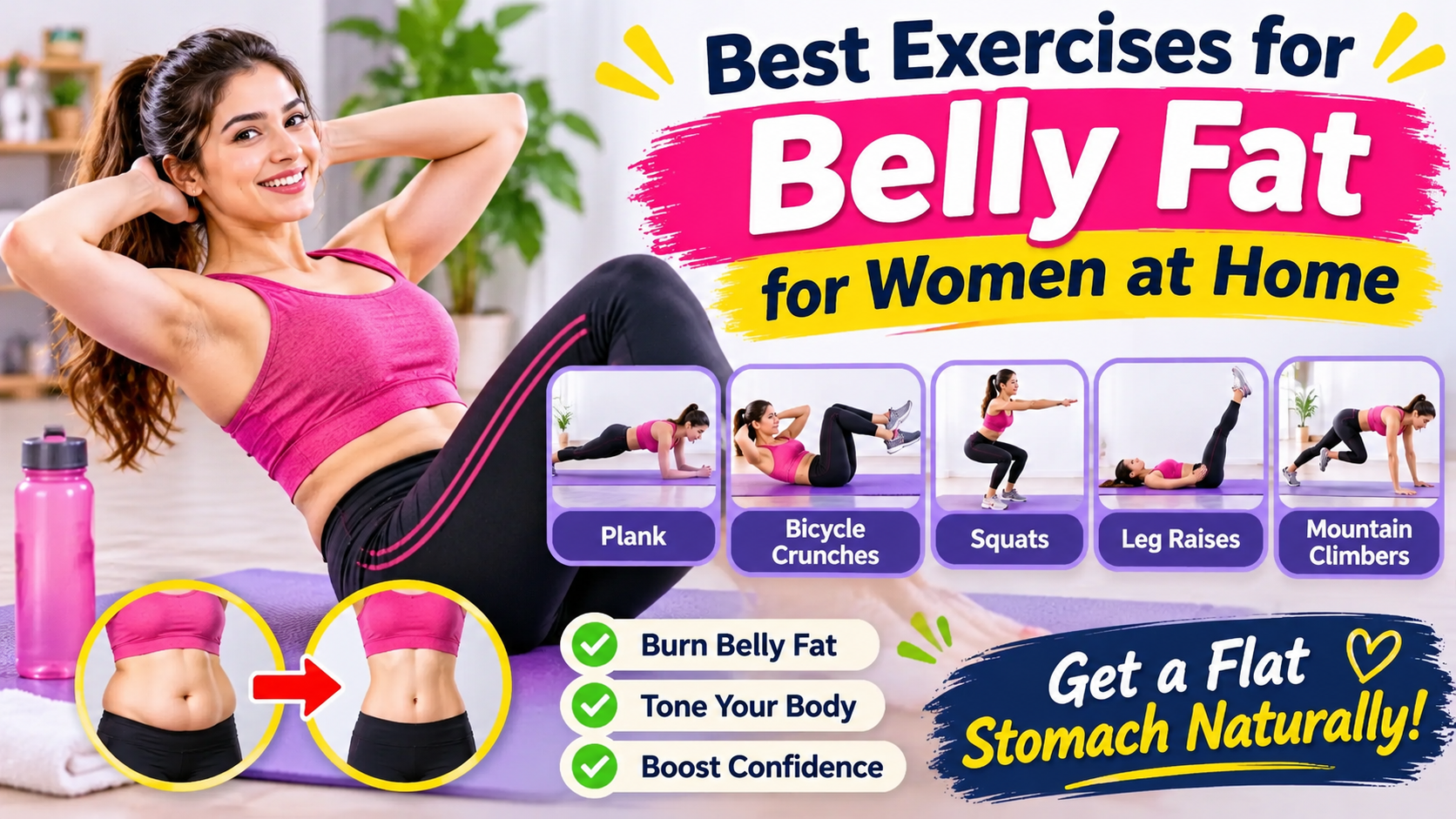
Quick Answer: The best exercises for belly fat for women at home are strength moves, brisk walking, and core work together: squats, push-ups, glute bridges, rows, planks, and 8,000 to 10,000 steps a day. No exercise burns belly fat from one spot only. Fat falls across the whole body through a calorie deficit, while these moves protect muscle and shrink your waist.
Table of Contents
Best exercises for belly fat for women at home are the subject of more bad advice than almost any other fitness topic. Search online and you will find hundreds of videos promising to melt belly fat in seven days with one special move, usually a crunch variation filmed by someone with a flat stomach. It is a tempting promise, and it is false. No exercise burns fat from one part of the body only, and no single move, however hard you do it, can choose where your body loses fat. This article is the honest version: an exercise-only routine built on the three things that genuinely shrink your waist over time, which are strength training, daily walking, and core work, combined with the small calorie deficit that makes fat loss possible at all.
This guide is deliberately about exercise only. It does not repeat a full diet plan, because that plan already exists in our guide on how to lose belly fat naturally, which covers food, sleep, and stress in full. Here, the focus is narrower and more practical: which moves to do, how to do them well, how to put them into a week, and how long it takes before your waist starts to change. You need no gym and no equipment beyond a chair and a clear patch of floor, and the whole routine takes about 25 minutes. If you are new to exercise in general, our guide on weight loss tips for women explains how exercise fits into a wider weight loss plan.
The Truth About Belly Fat and Exercise
Spot reduction is the idea that exercising one part of the body burns fat from that part, and it has been tested many times. In study after study, people who do hundreds of sit-ups lose no more belly fat than people who do none, and tennis players do not have less fat on their playing arm than on their other arm. The reason is simple: fat loss is a whole-body process. When your body needs energy, it draws fat from stores all over the body, not from the muscles you happen to be working. Your genes, hormones, and age decide where fat comes off first, and for most women, belly fat is among the last to go and the first to return, which is frustrating but normal.
There is one piece of good news hidden in that picture. Belly fat comes in two kinds, and the deeper kind, visceral fat around the organs, is the first to shrink when you start losing fat overall. Visceral fat is also the kind most strongly linked to blood sugar problems, high blood pressure, and heart disease, so losing it first is a genuine health win, even if the pinchable layer under the skin takes longer. Many women notice their waist measurement dropping in the first few weeks of a good routine, while the scale moves slowly, and that is usually visceral fat leaving first. A tape measure around your waist, taken once a week at the same place, is therefore a better progress check than the scale alone.
So what does exercise actually do for belly fat? Three things. First, it burns calories, which helps create the calorie deficit of 300 to 500 calories a day that produces steady fat loss of about 0.5 to 1 lb a week. Second, strength training protects muscle while you lose weight, so more of what you lose is fat, and your metabolism stays higher. Third, regular movement lowers stress and improves sleep, both of which reduce the hormonal push toward storing fat around the middle. No single exercise does all three on its own. That is why this routine combines strength, walking, and core work instead of betting everything on one move.
It is also worth saying what exercise cannot do. It cannot undo a large calorie surplus on its own. An hour of hard exercise burns roughly 300 to 500 calories, which is one large snack, so food still matters. It cannot change where your body stores fat, which is set by hormones and genes. And it cannot produce a flat stomach in a week, whatever a video thumbnail promises. What it can do, reliably, is shrink your waist by centimetres over eight to twelve weeks, make your core stronger and your posture better, and improve your health in ways the mirror does not show. That is a fair trade, and it is the one this routine is built for.
Best Exercises for Belly Fat for Women at Home: The 3-Part Formula
The best exercises for belly fat for women at home follow a simple formula with three parts, and each part does a different job. Strength training builds and protects muscle, which keeps your metabolism up and shapes your body as fat falls. Brisk walking burns calories steadily without making you very hungry, and it is the part you can do every day. Core work strengthens the deep muscles that hold your posture and support your back, so your stomach looks and feels flatter as fat falls, even though the core moves themselves burn few calories. Skip any one part and the routine gets weaker: strength without walking burns too few calories, walking without strength loses muscle along with fat, and core work without either changes almost nothing about fat.
| Part | What it does | How much | Example moves |
|---|---|---|---|
| Strength training | Protects muscle, raises metabolism, shapes the body | 2 to 3 sessions a week, 20 to 25 minutes | Squats, push-ups, bridges, rows |
| Brisk walking | Burns calories daily without strong hunger | 8,000 to 10,000 steps a day | After-meal walks, evening walks |
| Core work | Strengthens deep core, improves posture and back support | 5 to 10 minutes, 2 to 3 times a week | Plank, dead bug, bird dog |
The order matters less than the combination. Some women prefer to do strength and core together in one session and walk on the other days. Others walk every morning and do strength in the evening three times a week. Both work. What does not work is doing only abdominal exercises and expecting the belly to shrink, or doing only cardio and expecting muscle to stay. Think of the three parts as a team: strength sets the shape, walking does the daily fat-burning work, and core work holds everything together.
The 25-Minute At-Home Routine
Do this routine two or three times a week, with at least one rest day between sessions, and walk daily in between. Warm up for three to five minutes first with marching in place, arm circles, and half squats. Move through the exercises in order, resting 30 to 60 seconds between them. Perform each repetition slowly, taking about two seconds to lower and two seconds to lift. Cool down with three minutes of gentle stretching and slow breathing. One full round takes about 15 minutes; two rounds take about 25 minutes. Start with one round in week one and add the second round when the first feels comfortable.
| Order | Exercise | Repetitions or time | Main job |
|---|---|---|---|
| Warm-up | March in place, arm circles, half squats | 3 to 5 minutes | Prepare muscles and joints |
| 1 | Bodyweight squat | 12 | Legs and glutes, biggest calorie burn |
| 2 | Wall or knee push-up | 10 | Chest, arms, and core stability |
| 3 | Glute bridge | 15 | Glutes and hamstrings, posture support |
| 4 | Chair-assisted row | 10 | Back and arms, balances pushing |
| 5 | Reverse lunge (hold chair if needed) | 8 each leg | Legs, balance, and coordination |
| 6 | Dead bug | 8 each side | Deep core without neck strain |
| 7 | Modified plank | 30 seconds | Whole core endurance |
| 8 | Bird dog | 8 each side | Core and back stability |
| Cool-down | Gentle stretches, slow breathing | 3 minutes | Recovery |
If you cannot finish the listed repetitions, do as many as you can with good form and stop. Eight good squats beat twelve sloppy ones, and the numbers will rise over a few weeks if you keep showing up. If the routine feels too easy after a month, add two repetitions to each move before adding a third round, and slow the lowering phase to three seconds. Small, steady increases protect your joints and keep progress coming for months.
Strength Moves That Matter Most
Not all strength moves are equal for belly fat. The ones that matter most are the large, multi-joint moves that use many muscles at once, because they burn the most calories, build the most useful strength, and trigger the strongest muscle-protecting signal. A squat uses your legs, glutes, and core together. A push-up uses your chest, arms, shoulders, and core. A row uses your back and arms while your core holds you steady. Small isolation moves, such as arm curls or leg lifts, have their place, but they should never be the main part of a fat-loss routine, because they use too little muscle to matter much for calories or metabolism.
Squats and lunges: the engine of the routine
Squats and lunges deserve first place because your legs and glutes are the largest muscles in your body. Working them burns more energy than any other bodyweight move and builds the strength that makes stairs, carrying, and standing up easier. For a squat, stand with feet shoulder-width apart, push your hips back as if sitting into a chair, keep your chest up and your knees tracking over your toes, and press through your heels to stand. For a reverse lunge, step one foot back, lower until both knees are bent at roughly right angles, and push through the front heel to return. Hold a chair lightly for balance while you learn. The common mistake in both moves is letting the knees cave inward or leaning the chest far forward; slow down, shorten the range, and keep the movement controlled.
Push-ups and rows: balance for posture and the upper body
Push-ups and rows work as a pair. Push-ups strengthen the chest, shoulders, and arms, while rows strengthen the back and improve posture, which matters for how your stomach looks: a rounded, slumped posture pushes the belly outward, while an upright posture with a strong back pulls it in. Start push-ups against a wall, then on your knees, and only later on your toes. For rows, hold a sturdy table edge or a towel around a fixed post, lean back with straight arms, and pull your chest toward your hands by squeezing your shoulder blades together. Keep your body in a straight line and your elbows close to your sides. Our full beginner guide to strength training for beginners explains the form of each of these moves in detail.
Glute bridges: posture, back support, and glutes
Glute bridges look simple and work harder than they look. Lying on your back with knees bent, press through your heels to lift your hips until your body forms a straight line from shoulders to knees, squeeze your glutes at the top, and lower slowly. Strong glutes support the lower back and pelvis, which reduces the aching lower back that many women blame on belly fat, and they improve posture in a way that makes the waist look smaller. Keep your ribs down and do not arch your back to lift higher; the squeeze at the top is the point, not the height.
Walking: The Quiet Fat Burner
Walking is the most underrated part of any belly fat routine, and it is the part most women skip in favour of harder workouts. A brisk walk burns roughly 200 to 300 calories an hour, depending on your weight and pace, without making you very hungry afterwards, which is the advantage it holds over running and intense gym sessions. It also lowers stress, which matters because the stress hormone cortisol encourages fat storage around the middle, and it improves blood sugar control, especially when you walk for ten minutes after a meal. Aim for 8,000 to 10,000 steps a day, and build up by about 1,000 steps a week from your current average rather than jumping to 10,000 overnight.
The simplest way to reach your step target is to attach walking to meals: ten minutes after breakfast, lunch, and dinner adds about 3,000 steps and helps your body handle each meal better. Add an evening walk of 20 minutes, take phone calls on foot, use the stairs instead of the lift, and park further away. On strength days, walk more gently; on rest days, walk a little longer. Walking is gentle enough to do every day, and it helps your muscles recover between strength sessions instead of tiring them further. If your knees or feet hurt, check your shoes first: worn-out soles and flat, unsupportive shoes are the most common cause of walking pain in beginners.
Core Work That Actually Helps (and What Does Not)
Core work is the most misunderstood part of this routine, so it deserves a plain explanation. Your core is not just the six-pack muscle on the front of your stomach. It is a whole system of deep muscles around your trunk, including the deep abdominal muscle that acts like a corset, the muscles along your spine, the diaphragm, and the pelvic floor. When these muscles are strong, they hold your posture upright, support your back, and keep your stomach from pushing outward. When they are weak, your belly can look larger even at the same body fat level, simply because nothing is holding it in well.
The core moves that help most are the ones that teach your core to hold steady while your arms or legs move. The plank does this by asking you to hold a straight line from head to knees for 20 to 30 seconds without letting your hips sag. The dead bug does it by asking you to keep your lower back pressed into the floor while you slowly extend one arm and the opposite leg. The bird dog does it on hands and knees, extending one arm and the opposite leg while keeping your hips level. These moves are quiet, unglamorous, and very effective, and they are far better for beginners than sit-ups.
Sit-ups and crunches are the moves to limit, not because they are useless, but because they are poor value for beginners: they burn very few calories, they mostly work the surface abdominal muscle, they often strain the neck and lower back when done badly, and they create the false impression that you are burning belly fat directly. If you enjoy them, a small number with good form is fine, but they should never be the main part of your routine. The same applies to waist trainers, vibration belts, and creams that claim to burn belly fat: there is no good evidence that any of them reduce belly fat, and the money is better spent on walking shoes.
Your Weekly Plan
A week of this routine is simple to follow and easy to repeat. Three strength days, daily walking, and rest days that are genuinely restful for your muscles but still include walking. Keep the same days each week so the routine becomes a habit, and keep a short note of what you did, because seeing the numbers rise is the best motivation there is.
| Day | Strength routine | Walking target |
|---|---|---|
| Monday | 25-minute routine, 1 to 2 rounds | 8,000 to 10,000 steps |
| Tuesday | Rest from strength | 8,000 to 10,000 steps, slightly longer walk |
| Wednesday | 25-minute routine, 1 to 2 rounds | 8,000 to 10,000 steps |
| Thursday | Rest from strength | 8,000 to 10,000 steps, slightly longer walk |
| Friday | 25-minute routine, 1 to 2 rounds | 8,000 to 10,000 steps |
| Saturday | Rest from strength | One longer walk, 45 to 60 minutes |
| Sunday | Rest from strength | Easy walking, aim for 7,000 steps or more |
Expect visible change on a realistic timetable. In the first two to three weeks, you will feel stronger and your balance will improve, but your waist may change little. Between weeks four and eight, most women who follow the routine and hold a small calorie deficit notice their clothes fitting looser and their waist measurement dropping by a centimetre or two. By twelve weeks, the change is usually obvious to other people as well. If your waist has not changed after eight weeks, the most likely reason is food, not exercise: check portions, liquid calories, and late-night snacking, and remember that the full food side of the plan is covered in our guide on how to lose belly fat naturally.
- Do: combine strength, walking, and core work; train two or three times a week; walk 8,000 to 10,000 steps daily; and measure your waist weekly.
- Do: keep repetitions slow and controlled, rest between sessions, eat 30 to 40 grams of protein per meal, and sleep seven to nine hours.
- Do: progress gradually, adding repetitions or a second round only when good form is comfortable.
- Avoid: doing only crunches and expecting belly fat to fall, or buying waist trainers and creams that promise spot reduction.
- Avoid: training through sharp joint pain, skipping warm-ups, or judging progress after one week.
- Avoid: rewarding a workout with a large snack that cancels the calories you burned.
Frequently Asked Questions
What exercise burns the most belly fat?
No single exercise burns belly fat specifically, because fat loss happens across the whole body. The most effective combination is strength training plus brisk walking, which together burn calories, protect muscle, and lower total body fat, including belly fat.
Do crunches reduce belly fat?
No. Crunches strengthen the abdominal muscles, but they burn very few calories and do not reduce the fat layer over them. Planks, dead bugs, and bird dogs build a stronger core with less strain, while strength training and walking do the fat-burning work.
How long does it take for belly fat exercises to work?
Most women feel stronger within two to three weeks and see waist changes within four to eight weeks, if they also hold a small calorie deficit of 300 to 500 calories a day. Visible change for other people usually takes about twelve weeks of consistent training.
Can I lose belly fat by walking only?
Walking alone can help, because it burns calories and lowers stress, but it works much better with strength training, which protects muscle and keeps your metabolism higher. Aim for 8,000 to 10,000 steps a day plus two or three strength sessions a week.
How many times a week should I do belly fat exercises?
Two or three strength sessions a week, with at least one rest day between them, is ideal. Walk daily, and do core work as part of your strength sessions rather than every day, so your muscles have time to recover.
Is it safe to do these exercises at home without a trainer?
Yes, for most healthy women, bodyweight moves at home are safe if you start slowly, learn good form, and stop if you feel sharp pain. Talk to your doctor first if you are pregnant, have a health condition, or have a recent injury.
Final Verdict
The best exercises for belly fat for women at home are not a secret move or a seven-day challenge. They are a simple, repeatable combination: two or three strength sessions a week built on squats, push-ups, bridges, rows, and lunges; 8,000 to 10,000 brisk steps a day; and a few minutes of honest core work that strengthens the deep muscles holding your posture together. No exercise burns belly fat from one spot only, and anyone who promises otherwise is selling something. What this routine does, week after week, is lower your total body fat, protect your muscle, and shrink your waist at a safe pace of about 0.5 to 1 lb a week. Start with one round this week, walk after your next meal, and measure your waist again in a month. For more practical health guides, visit HealthSpots and explore the Fitness and Exercise section.
Sources
- Harvard Health Publishing — Abdominal fat and what to do about it: health.harvard.edu
- Mayo Clinic — Belly fat in women: Taking up too much room: mayoclinic.org
- American College of Sports Medicine — Resistance training recommendations for adults: acsm.org
- Centers for Disease Control and Prevention — Physical Activity Basics: cdc.gov