
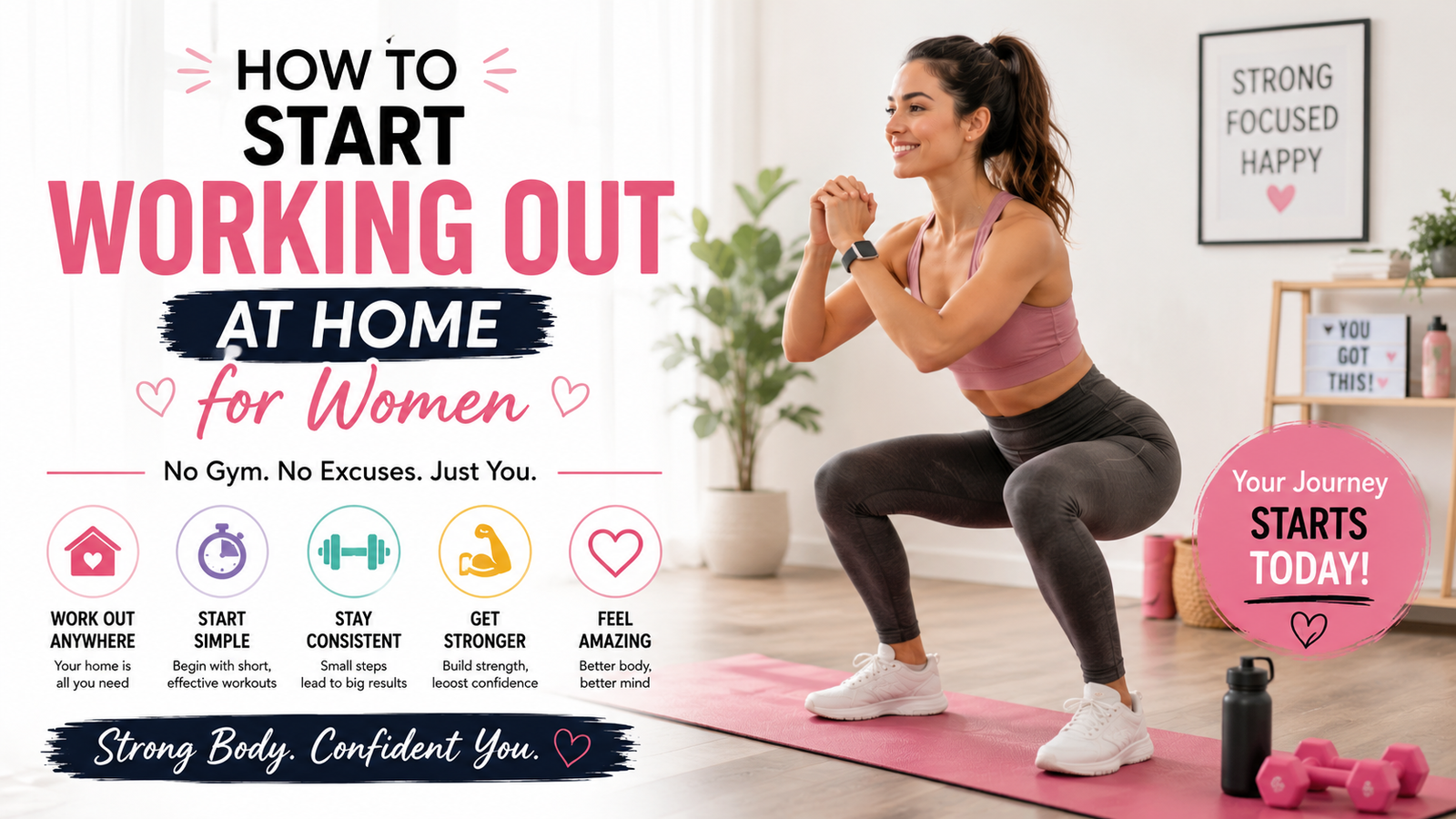
Quick Answer: How to start working out at home for women? Begin with three short sessions a week: a 10-minute walk, five minutes of gentle stretching, and five minutes of bodyweight moves such as squats and wall push-ups. Add five minutes each week, rest between sessions, and build toward 150 minutes of movement a week over your first month.
Table of Contents
How to start working out at home for women is a question asked by millions of women who want to get fitter but have never exercised regularly, do not want to join a gym, and do not know where to begin. If that describes you, this guide is written for you, and it starts with good news: you do not need to be fit to start working out, you do not need equipment, and you do not need an hour a day. You need a plan that starts small enough to succeed, grows slowly enough to stay safe, and fits into a real life with work, family, and limited time. That is exactly what the four-week plan in this article does, and it begins from zero, not from an imaginary level of fitness you are supposed to have already.
Starting at home has real advantages over starting at a gym. There is no travel time, no membership cost, no waiting for equipment, and no feeling of being watched. You can exercise in clothes you already own, at a time that suits you, with music or a video you enjoy, and you can stop the moment you need to. The disadvantage is also real: nobody is watching, so nobody will notice if you skip, which means the plan itself has to make skipping hard. That is why this guide spends as much time on space, schedule, and habit as it does on exercises. The moves are the easy part. Showing up three times a week for a month is the part that changes your life, and it is a skill you can learn like any other. If you are starting a wider weight loss plan at the same time, our guide on weight loss tips for women explains how home workouts fit with food, walking, sleep, and stress.
Why Starting at Home Works
Health authorities recommend that adults do at least 150 minutes of moderate activity a week, such as brisk walking, plus muscle-strengthening activities on two or more days a week. That sounds like a lot when you are starting from zero, and it is, if you try to do it all in week one. But the target is a destination, not a starting line. Research consistently shows that going from no activity to some activity brings the largest health gains of all, larger than the gains from going from some activity to a lot. Even 75 minutes a week, half the target, lowers the risk of heart disease, diabetes, and early death compared with doing nothing. Your first month is therefore not about reaching 150 minutes. It is about going from zero to regular, and regular is what makes 150 minutes possible later.
Home workouts also remove the most common reasons women give for not exercising. Lack of time is the first reason, and a 15-minute session at home, with no travel, answers it directly. Cost is the second, and bodyweight exercise costs nothing. Feeling self-conscious is the third, and exercising alone at home removes it completely. Lack of knowledge is the fourth, and a simple written plan with six basic moves answers it. What remains after those four barriers are removed is the real challenge, which is habit: remembering to do it, finding the energy after a long day, and keeping going when the first excitement fades. The rest of this guide is built around solving that challenge.
There is one more reason to start at home: it teaches you to listen to your own body. In a gym class, it is easy to copy the person next to you and push too hard. At home, at your own pace, you learn what your body can do today, how it feels the day after, and how it changes over weeks. That body awareness is the foundation of safe exercise for life, and it is also the skill that helps with eating: noticing hunger, fullness, tiredness, and stress before they decide for you. Women who learn to move gently at home often find that other healthy habits follow more easily, because they have already proved to themselves that they can change.
How to Start Working Out at Home for Women: Before Your First Session
Before your first session, take 15 minutes to prepare, and do not skip this step. Preparation is what turns a good intention into a real session, and most failed starts fail here, not during the workout. First, talk to your doctor if you have a health condition, are pregnant, have high blood pressure, heart disease, diabetes, osteoporosis, or a recent injury, or if you have not exercised for many years. A short conversation can confirm that gentle home exercise is safe and flag any moves to change. Second, pick your three days and your time, and put them in your calendar as appointments you would not cancel lightly. Third, prepare your space and your clothes, so that when the time comes, you can begin in two minutes.
Choose a time of day that matches your energy and your life. Morning works best for many women, because willpower and energy are highest early and the day has not yet had a chance to interfere. Lunchtime works for women who work from home and need a break from the screen. Evening works for women who need to unwind after work, as long as the session finishes at least two hours before bed so sleep is not disturbed. There is no universally best time; the best time is the one you will actually keep. Try your chosen time for two weeks before deciding it does not work, because the first week always feels harder than the second.
Set a goal for the first month that is about showing up, not about weight or appearance. A good goal is: I will do three short sessions a week for four weeks, twelve sessions in total. That goal is fully in your control, unlike the scale, and it is the goal that produces every other result. Write it down and put it where you will see it. Tell one person about it, a friend, a sister, or a partner, and ask them to check in with you once a week. Social support is one of the strongest predictors of sticking with exercise, and a simple weekly message, did you do your three sessions, is often enough.
| Preparation step | What to do | Time needed |
|---|---|---|
| Health check | Talk to your doctor if you have a condition, are pregnant, or have a recent injury | One appointment |
| Pick your days | Choose three days a week with a rest day between them | 5 minutes |
| Pick your time | Choose the time of day you have the most energy | 2 minutes |
| Prepare your space | Clear a mat-sized area, keep a chair nearby, lay out clothes | 10 minutes |
| Set your goal | Twelve sessions in four weeks; write it down and tell one person | 5 minutes |
| Track simply | Keep a notebook or phone note: date, minutes, how it felt | 1 minute per session |
Your First 4 Weeks: A Week-by-Week Plan
This plan builds gradually, adding about five minutes a week, so your body, your joints, and your schedule can all adapt together. Each week has three workout days, daily walking, and rest days that still include gentle movement. If a week feels hard, repeat it before moving on; there is no deadline, and a week spent consolidating is still progress.
Week 1: Learn the moves, 15 minutes a session
Week one is about learning, not effort. Do three 15-minute sessions: five minutes of gentle walking in place and stretching, five minutes of bodyweight moves, and five minutes of slow stretching and breathing. Do one round of the starter session below, slowly, focusing on form rather than speed. Walk daily, aiming for your current step count plus 500 steps. Expect some muscle soreness after the first two sessions; it peaks a day or two later and fades within a few days, and it should be milder each week. If soreness is so strong that you cannot walk normally after three days, you did too much; take an extra rest day and return with fewer repetitions.
Week 2: Add a second round, 20 minutes a session
In week two, the moves will feel more familiar, so add a second round of the strength moves and stretch the session to 20 minutes. Add about 1,000 steps a day to your baseline, so that a woman starting at 3,000 steps is now aiming for 4,000 to 5,000. This is also the week to check your space and schedule: is your workout time working, is your space ready, is anything making it easy to skip? Fix one small barrier now, such as laying out clothes the night before, because small barriers cause most skipped sessions. By the end of week two you will have done six sessions, which is more exercise than many women do in six months, and that is worth noticing.
Week 3: Add strength properly, 25 minutes a session
Week three is when the plan becomes a real strength routine. Follow the full beginner strength routine, two rounds, for 25 minutes, three times a week, and keep walking daily toward 8,000 steps. This is the week when many women first notice a change: stairs feel easier, posture feels taller, and the moves that were hard in week one feel normal. It is also the week when motivation often dips, because the novelty has worn off and the results are not yet visible. That dip is normal and expected, and the way through it is to make the session smaller, not to skip it. On a low-energy day, do one round instead of two, or walk for ten minutes instead of a full session, and count it. A short session protects the habit, and the habit is the point. Our guide to beginner strength training explains the full routine and the form of every move.
Week 4: Build toward the weekly target, 30 minutes a session
In week four, stretch your sessions to 30 minutes by adding a longer walk or a third round, and aim for 8,000 to 10,000 steps a day. Add up the week’s movement: three 30-minute sessions plus daily walking should bring you close to 150 minutes of moderate activity for the week, which is the recommended target for adults. You will not have done it perfectly, and that does not matter; you will have gone from zero to regular in a month, which is the hardest step in any fitness journey. At the end of week four, look back at your notebook and compare your first session with your latest: more repetitions, better balance, less effort, and a habit that now feels like part of your week. That is the result that matters, and it is the foundation for everything that comes next, whether that is a longer strength routine, a yoga practice, or a new walking goal. Our guide on daily steps for weight loss explains how to keep building your step count safely.
| Week | Sessions per week | Minutes per session | Daily steps target | Focus |
|---|---|---|---|---|
| Week 1 | 3 | 15 | Baseline plus 500 | Learn the moves slowly |
| Week 2 | 3 | 20 | Baseline plus 1,000 | Add a second round |
| Week 3 | 3 | 25 | Toward 8,000 | Full strength routine |
| Week 4 | 3 | 30 | 8,000 to 10,000 | Reach 150 minutes a week |
The 15-Minute Starter Session
This is the session you will use in week one, and the base you will build on in later weeks. It needs no equipment beyond a chair for balance. Warm up first, move slowly, breathe normally, and rest 30 seconds between moves.
| Part | Move | Time or repetitions |
|---|---|---|
| Warm-up | March in place, shoulder rolls, gentle side steps | 3 minutes |
| Warm-up | Slow half squats, arm circles | 2 minutes |
| Strength | Bodyweight squat (or sit-to-stand from a chair) | 8 |
| Strength | Wall push-up | 8 |
| Strength | Glute bridge | 10 |
| Strength | Standing calf raise, holding a chair | 10 |
| Strength | Dead bug (or lying knee hug) | 6 each side |
| Cool-down | Gentle stretches, slow breathing | 3 minutes |
If a move feels too hard, use the easier version shown in brackets, such as sitting and standing from a chair instead of a free squat. If a move causes sharp pain, stop and skip it; pain is information, not a test of willpower. If you finish the session and feel you could have done more, resist the urge to double it on day one; save that energy for session two, because consistency over weeks is what builds fitness, not one heroic day.
Setting Up Your Space and Schedule
Your space does not need to be a home gym. It needs to be a clear patch of floor about the size of a yoga mat, with a non-slip surface, a sturdy chair nearby, and enough light and air to feel pleasant. Keep it ready rather than setting it up from scratch each time: roll out the mat, lay out your clothes, and keep your water bottle in the same place. Remove one obstacle before each session, such as moving a coffee table aside the night before, because every small barrier is a reason to skip. If you have children or other people at home, tell them your workout time and ask for 15 uninterrupted minutes; most people are happy to help once they know what you are doing and when.
Your schedule is the other half of the setup. Three sessions a week with at least one rest day between them works well for most women, for example Monday, Wednesday, and Friday, or Tuesday, Thursday, and Saturday. Keep the same days and the same time each week, because a fixed slot becomes a habit far faster than a floating intention to exercise sometime. If you miss a session, do not try to make it up by doing two the next day; simply do the next scheduled session. One missed session means nothing. Two missed weeks means the habit is fading, and that is the moment to make the next session as small and easy as possible, even five minutes, rather than waiting for motivation to return.
Building a Habit That Sticks
Motivation is unreliable, and habits are not built on motivation. They are built on cues, small rewards, and tracking. Attach your workout to an existing habit, such as after your morning coffee or after the children leave for school, so the old habit reminds you of the new one. Give yourself a small reward after each session that you enjoy, such as a favourite drink, ten minutes with a book, or a relaxing shower, because your brain repeats actions that feel good. Track each session with a tick in a notebook or a calendar, and watch the chain of ticks grow; after two weeks, the chain itself becomes a reason not to break it.
It also helps to plan for the days when things go wrong. Write down your backup plan now: if I am too tired for a full session, I will walk for ten minutes instead. If I miss a morning session, I will do a short evening walk. If I am sore, I will stretch gently instead of training hard. Having a backup plan ready means a bad day becomes a short session instead of a skipped week. And be kind to yourself when you miss a day. Research on habit formation shows that missing one session has no measurable effect on long-term success, while the guilt after a missed session often causes people to quit entirely. The kindest and most effective response to a missed session is simply to do the next one.
Food and sleep support the habit too. Eat 30 to 40 grams of protein per meal to help your muscles recover, drink water before you feel very thirsty, and sleep seven to nine hours a night so you have energy for the next session. If you are also trying to lose weight, keep a modest calorie deficit of 300 to 500 calories a day, enough for steady loss of about 0.5 to 1 lb a week, and never eat below 1,200 calories a day without medical supervision. A larger deficit leaves you too tired to exercise, which defeats the purpose.
Mistakes That Make Beginners Quit
- Do: start with 15-minute sessions, rest between sessions, track every session, and celebrate twelve sessions in four weeks.
- Do: keep the same days and time, prepare your space in advance, and have a backup plan for tired days.
- Do: eat enough protein, sleep seven to nine hours, and walk daily alongside your sessions.
- Avoid: starting with an hour-long workout copied from social media, which causes soreness and quitting.
- Avoid: judging yourself after one week, comparing yourself with fit people online, or weighing yourself every day.
- Avoid: buying expensive equipment or clothes before you have finished your first month.
- Avoid: training through sharp pain, skipping warm-ups, or doing two hard sessions to make up for a missed one.
The biggest mistake is starting too big. Enthusiasm in week one is natural, but your body needs time to adapt, and an hour-long first workout usually produces three days of soreness and a strong desire never to repeat it. The second mistake is expecting visible results in a week and quitting when the mirror and the scale show nothing. Real change takes four to eight weeks to see and twelve weeks to be obvious to others, and the first changes are in energy, sleep, and strength, not in weight. The third mistake is all-or-nothing thinking: believing that a missed session ruins the plan, or that a short session does not count. Both are false. A short session counts, a missed session means nothing, and the only way to fail is to stop entirely.
Frequently Asked Questions
How long should a beginner workout at home?
Start with 15 minutes, three times a week, and add five minutes each week until you reach 30 minutes a session. That brings you close to the recommended 150 minutes of moderate activity a week, including daily walking, by the end of your first month.
Do I need equipment to work out at home?
No. Bodyweight moves such as squats, wall push-ups, glute bridges, and calf raises are enough for the first month. A chair for balance and a mat for comfort are useful, and light dumbbells are a sensible purchase only after four to six weeks of consistent training.
How many days a week should a woman beginner work out?
Three days a week, with at least one rest day between sessions, is ideal for a beginner. Walk daily as well, because walking is gentle enough to do every day and it adds up to a large part of your weekly activity.
What if I am very unfit and cannot do a single push-up?
Start with wall push-ups, which almost everyone can do, and use a chair for sit-to-stand squats instead of free squats. Every exercise in this plan has an easier version, and using it is not failing; it is how strength is built.
How soon will I see results from working out at home?
Most women feel stronger and sleep better within two to three weeks, and see visible changes in four to eight weeks. Weight loss is slower and depends on food as well as exercise, at a healthy pace of about 0.5 to 1 lb a week.
Should I work out in the morning or evening?
Either is fine. Morning suits women who have more energy early and want the day to interfere less, while evening suits women who need to unwind after work. Choose the time you will actually keep, and finish evening sessions at least two hours before bed.
Final Verdict
How to start working out at home for women comes down to one decision: start small, start today, and keep going for four weeks. Three 15-minute sessions a week, a clear patch of floor, a chair for balance, and a plan that adds five minutes a week will take you from zero to regular exercise in a month, without a gym, without equipment, and without the soreness that makes most beginners quit. You do not need to be fit first, you do not need the perfect routine, and you do not need motivation every day. You need a fixed time, a written plan, and the willingness to do a short session on a tired day instead of skipping it. Do your first session this week, tick it off, and do the next one. A month from now, you will be a woman who works out, and that is a bigger change than any number on a scale. For more practical health guides, visit HealthSpots and explore the Fitness and Exercise section.
Disclaimer: This article is for general information only and is not medical advice. Talk to your doctor before starting a new exercise programme, especially if you are pregnant, have a health condition, take regular medication, or have a recent injury. Stop exercising and seek medical advice if you feel chest pain, dizziness, severe breathlessness, or sharp joint pain. Never eat below 1,200 calories a day without medical supervision.
Sources
- World Health Organization — Physical activity fact sheet: who.int
- Centers for Disease Control and Prevention — Physical Activity Basics: cdc.gov
- American College of Sports Medicine — Resistance training recommendations for adults: acsm.org
- Mayo Clinic — Exercise: 7 benefits of regular physical activity: mayoclinic.org